
Allied Telesis AT-x530L-28GPX-901 vs Allied Telesis GS970M/28PS-10: Specification Comparison
Both the Allied Telesis AT-x530L-28GPX-901 and the AT-GS970M/28PS-10 are 1U rack-mount, 24-port Gigabit PoE+ managed switches targeting IP surveillance, access control, and enterprise edge deployments. Each provides 24 RJ-45 copper PoE+ ports plus four SFP-based uplinks, making them direct cross-shop candidates for installers sizing a PoE infrastructure layer. The comparison centers on three dimensions that drive real purchasing decisions: PoE power budget and per-port capability, switching throughput and latency, and physical footprint with power and acoustic trade-offs.
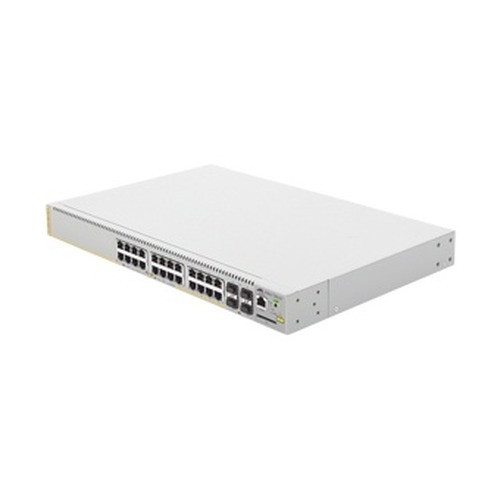
In This Guide
- Which switch delivers more PoE headroom and higher per-port power for demanding devices?
- How do switching fabric capacity, forwarding rate, and port speed differ between the two switches?
- What are the trade-offs in chassis depth, power draw, and acoustic output between these two switches?
- Which should you choose: the AT-x530L-28GPX-901 or the GS970M/28PS-10?
- Side-by-Side Specs
- FAQ
Which switch delivers more PoE headroom and higher per-port power for demanding devices?
The AT-x530L-28GPX-901 carries a 740 W PoE power budget across all 24 ports, supporting IEEE 802.3af (7.5 W), 802.3at (15.4 W), and 802.3bt Type 3 (30 W) per port simultaneously on all 24 ports. This means a fully loaded deployment of 24 × 30 W PoE+ devices draws 720 W, comfortably within budget.
The AT-GS970M/28PS-10 provides a 370 W total PoE budget. At 15 W per port it can power all 24 devices; at 30 W (PoE+) it is rated for a maximum of 12 simultaneous ports. Installers planning more than 12 high-draw cameras or access controllers must stage power allocation carefully on the GS970M/28PS-10.
Neither unit's spec sheet lists 802.3bt Type 4 (60 W or 90 W) support. The x530L's 2× stacking ports also enable budget aggregation across a stack, though per-unit PoE figures apply individually. The GS970M/28PS-10 spec sheet does not list stacking.
How do switching fabric capacity, forwarding rate, and port speed differ between the two switches?
The AT-x530L-28GPX-901 uses a 128 Gbps switching fabric with a 95.2 Mpps forwarding rate. Its four uplink ports are 1/10 Gigabit SFP+, enabling 10 GbE connections to core or aggregation switches. Measured latency is 3.98 µs at 1 Gbps and 1.63 µs at 10 Gbps.
The AT-GS970M/28PS-10 operates on a 56 Gbps switching fabric at 41.7 Mpps. Its four uplink ports are 100/1000X SFP, capped at 1 Gbps each. No latency figures appear in the provided spec sheet for the GS970M/28PS-10.
For high-density IP video deployments where NVR uplinks or inter-switch trunks require 10 GbE throughput, the x530L's SFP+ uplinks are a meaningful architectural advantage. The GS970M/28PS-10's 1 GbE SFP uplinks are adequate for lower-bandwidth or smaller-site deployments where aggregated camera bitrates remain within a 1 GbE ceiling.
What are the trade-offs in chassis depth, power draw, and acoustic output between these two switches?
Both switches are 1U rack-mount chassis with nearly identical widths (~440–441 mm) and identical heights (44 mm). The critical physical difference is depth: the AT-x530L-28GPX-901 measures 421 mm deep, while the AT-GS970M/28PS-10 is only 290 mm deep—131 mm shallower. In shallow-depth wall-mount enclosures or short-depth racks, the GS970M/28PS-10 has a clear fit advantage.
Maximum system power consumption reflects the larger PoE budget: the x530L draws up to 890 W versus 520 W for the GS970M/28PS-10. Maximum heat dissipation follows the same ratio—3,037 BTU/hr for the x530L versus 127 BTU/hr for the GS970M/28PS-10—a substantial difference that affects rack thermal planning and HVAC sizing.
Acoustically, the GS970M/28PS-10 is rated at 33 dBA, while the x530L is rated at 42 dBA (marked with an asterisk in the source data). A 9 dB difference is perceptible in noise-sensitive environments such as office wiring closets or courtroom AV racks. The x530L also supports stacking via its two dedicated stacking ports; the GS970M/28PS-10 spec sheet lists no stacking capability.
Which should you choose: the AT-x530L-28GPX-901 or the GS970M/28PS-10?
Our take: The AT-x530L-28GPX-901 is the stronger choice when a deployment demands maximum PoE headroom, 10 GbE uplinks, or multi-switch stacking. Its 740 W PoE budget is exactly double the GS970M/28PS-10's 370 W, enabling all 24 ports to run at full 30 W PoE+ simultaneously where the GS970M/28PS-10 caps out at 12 ports at that rate. Its 128 Gbps fabric and 10 GbE SFP+ uplinks dwarf the GS970M/28PS-10's 56 Gbps fabric and 1 GbE SFP uplinks, future-proofing aggregation bandwidth. However, the AT-GS970M/28PS-10 is the pragmatic fit for shallow-depth rack enclosures (290 mm vs. 421 mm), acoustically sensitive spaces (33 dBA vs. 42 dBA), or smaller sites where 370 W PoE and 1 GbE uplinks are sufficient—and where its 370 W lower maximum power draw simplifies electrical circuit planning. Platform qualifier: specify the x530L for enterprise or mid-large surveillance deployments; specify the GS970M/28PS-10 for SMB or space-constrained installations.
Side-by-Side Comparison
Spec-for-spec, from manufacturer data.
| Specification | Allied Telesis AT-x530L-28GPX-901 | Allied Telesis GS970M/28PS-10 |
|---|---|---|
| 10/100/1000T Copper Ports | 24 | 24 |
| SFP Uplink Ports | 4 × 1/10G SFP+ | 4 × 100/1000X SFP |
| Stacking Ports | 2 (dedicated) | — |
| PoE-Enabled Ports | 24 | 24 |
| Max PoE Power Budget | 740 W | 370 W |
| Max PoE+ (30W) Simultaneous Ports | 24 | 12 |
| Switching Fabric | 128 Gbps | 56 Gbps |
| Forwarding Rate | 95.2 Mpps | 41.7 Mpps |
| Latency at 1 Gbps | 3.98 µs | Not specified |
| Latency at 10 Gbps | 1.63 µs | Not specified |
| Chassis Dimensions (W×D×H mm) | 441 × 421 × 44 | 440 × 290 × 44 |
| Unpackaged Weight | 6.2 kg (13.67 lb) | 6.35 kg (14.0 lb) |
| Max Power Consumption | 890 W | 520 W |
| Max Heat Dissipation | 3,037 BTU/hr | 127 BTU/hr |
| Noise Level | 42 dBA | 33 dBA |
Frequently Asked Questions
Which should you choose: the AT-x530L-28GPX-901 or the GS970M/28PS-10?
The AT-x530L-28GPX-901 is the stronger choice when a deployment demands maximum PoE headroom, 10 GbE uplinks, or multi-switch stacking. Its 740 W PoE budget is exactly double the GS970M/28PS-10's 370 W, enabling all 24 ports to run at full 30 W PoE+ simultaneously where the GS970M/28PS-10 caps out at 12 ports at that rate. Its 128 Gbps fabric and 10 GbE SFP+ uplinks dwarf the GS970M/28PS-10's 56 Gbps fabric and 1 GbE SFP uplinks, future-proofing aggregation bandwidth. However, the AT-GS970M/28PS-10 is the pragmatic fit for shallow-depth rack enclosures (290 mm vs. 421 mm), acoustically sensitive spaces (33 dBA vs. 42 dBA), or smaller sites where 370 W PoE and 1 GbE uplinks are sufficient—and where its 370 W lower maximum power draw simplifies electrical circuit planning. Platform qualifier: specify the x530L for enterprise or mid-large surveillance deployments; specify the GS970M/28PS-10 for SMB or space-constrained installations.
Is the AT-x530L-28GPX-901 or the GS970M/28PS-10 better for larger surveillance deployments with high-power cameras?
The AT-x530L-28GPX-901 is better suited for larger deployments. Its 740 W PoE budget supports all 24 ports at 30 W simultaneously, whereas the GS970M/28PS-10's 370 W budget limits full 30 W PoE+ operation to a maximum of 12 ports at once. Additionally, the x530L's 10 GbE SFP+ uplinks can sustain the higher aggregated bitrates that come with dense, high-resolution camera arrays.
Can either switch fit in a shallow-depth or wall-mount rack enclosure?
The AT-GS970M/28PS-10 is the better fit for shallow enclosures at 290 mm depth. The AT-x530L-28GPX-901 requires 421 mm of usable rack depth—131 mm more. Both are standard 1U height (44 mm) and similar widths (~440 mm), so only depth is the differentiator for enclosure selection.
Do both switches support stacking, and how does that affect scalability?
Only the AT-x530L-28GPX-901 lists stacking support, via two dedicated stacking ports (noted with an asterisk in the specification data). The AT-GS970M/28PS-10 specification sheet does not list any stacking capability. Stacking on the x530L allows multiple units to be managed as a single logical switch, which simplifies administration and expands port count in growing deployments.
More Network Switch Comparisons
- Vivotek GEV-288A-370 vs Axis T8524
- Vivotek GEV-288A-370 vs Cradlepoint SW2400P-GN
- Vivotek GEV-288A-370 vs Allied Telesis AT-x530L-28GPX-901
- Vivotek GEV-288A-370 vs Ubiquiti USW-ENTERPRISE-24-POE
- Axis T8524 vs Cradlepoint SW2400P-GN
- Axis T8524 vs Allied Telesis AT-x530L-28GPX-901
Network Switch Buying Guides
Get a Second Opinion on Your Camera Choice
Share your site layout, coverage goals, and budget. Our team will validate the camera selection, flag anything we would change, and recommend products that match the use case.