
Aiphone IX-MV7-W vs Aiphone IX-MV7-HB: Specification Comparison
Both the Aiphone IX-MV7-W and IX-MV7-HB are IP video master stations from the IX Series, designed for use as the primary control point in IP-based intercom and access systems. They share the same 7-inch touchscreen form factor, PoE power sourcing, and H.264/MJPEG video codec support, making them genuine cross-shop candidates. The comparison centers on communication mode, physical form factor, I/O capability, protocol depth, and SIP compatibility — the dimensions that most directly affect system design and deployment context.

In This Guide
- How do the IX-MV7-W and IX-MV7-HB differ in communication modes and audio handling?
- Which station offers more I/O flexibility and network integration depth?
- How do the two stations compare on physical dimensions, power draw, and operating environment?
- Which should you choose: the IX-MV7-W or the IX-MV7-HB?
- Side-by-Side Specs
- FAQ
How do the IX-MV7-W and IX-MV7-HB differ in communication modes and audio handling?
The IX-MV7-W supports full-duplex hands-free communication only, with audio input rated at an unspecified impedance in the provided specs. Audio codecs are G.711 and G.722, and video codecs are H.264/AVC and Motion JPEG — identical to the -HB on codecs.
The IX-MV7-HB adds two additional communication modes beyond hands-free: push-to-talk and a privacy handset (reflected in the 'HB' suffix and the product name). Its audio input impedance is specified at 600Ω, and its speaker output is rated 8Ω at 0.5W. For environments where conversation privacy is operationally required — executive suites, healthcare, reception desks — the physical handset on the -HB is a functional differentiator the -W cannot replicate.
SIP protocol support is explicitly listed for the IX-MV7-HB (alongside IPv4, IPv6, TCP, UDP, HTTP, HTTPS, RTSP, RTP, RTCP, IGMP, MLD, SMTP, SFTP, DHCP, NTP, and DNS). SIP compatibility is not stated in the provided specs for the IX-MV7-W. Buyers integrating with a SIP PBX or unified communications platform should treat this as a material difference.
Which station offers more I/O flexibility and network integration depth?
The IX-MV7-HB provides 2 contact outputs and 4 trigger inputs, enabling direct connection to door strikes, relays, and external sensor inputs without a separate I/O module. These specs are not present in the IX-MV7-W's provided data, so no equivalent claim can be made for the -W.
The -HB also specifies an address book capacity of 500 stations, 8 speed-dial buttons, 50 bell schedule events per day, and IEEE 802.1x port security — none of which appear in the IX-MV7-W spec set provided. Network cable type is specified as Cat-5e/6 for the -HB; the -W lists Ethernet connectivity without cable category detail.
ONVIF compliance is confirmed for both units, but at different specificity: the -HB is listed as ONVIF Profile S, while the -W states ONVIF compliance without specifying a profile. Profile S governs video streaming interoperability, which matters when integrating with third-party VMS platforms.
Compliance certifications differ as well: the IX-MV7-HB carries UL 62368-1 and cUL 62368-1 listings. No equivalent safety certification data is provided for the IX-MV7-W.
How do the two stations compare on physical dimensions, power draw, and operating environment?
Both stations are powered by PoE at IEEE 802.3af Class 0. Power draw is explicitly stated at 4.32W for the IX-MV7-HB; the IX-MV7-W lists the same PoE standard and a 4.32W figure appears in its spec set, making power sourcing effectively equivalent between the two — a single Cat-5e/6 run handles both.
Operating temperature is specified for both: 32°F to 104°F (0°C to 40°C). Neither unit is rated for outdoor or extended-temperature use based on the provided specs.
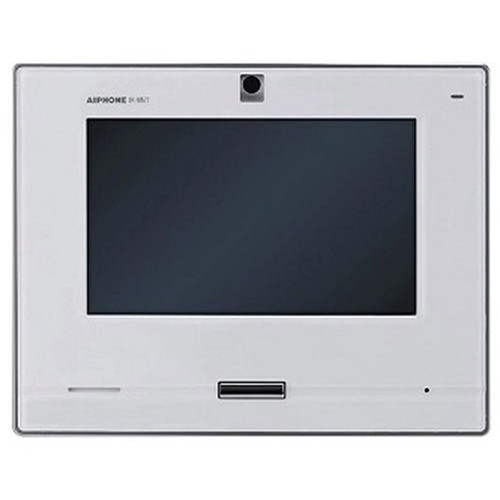
The physical footprints differ meaningfully. The IX-MV7-W measures 6-3/4" H × 8-11/16" W × 1-1/4" D — a shallower, more compact profile. The IX-MV7-HB is larger: 8-1/16" H × 11" W × 2-3/16" D, which accommodates the handset cradle and additional I/O terminals. The -W is specified for wall mount; the -HB's provided specs do not restrict mount type, though its greater depth is consistent with a desk or surface-mount installation. Both feature a 7-inch TFT LCD display; the -W's resolution is stated at 800×400. Resolution is not specified in the -HB's provided data.
Which should you choose: the IX-MV7-W or the IX-MV7-HB?
Our take: The IX-MV7-HB is the stronger choice when the deployment requires SIP trunk or PBX integration, physical handset privacy, or direct I/O connectivity to door hardware. Concretely: the -HB lists SIP as a supported protocol while the -W's specs do not; the -HB adds push-to-talk and handset modes versus the -W's hands-free-only operation; and the -HB provides 2 contact outputs and 4 trigger inputs not documented for the -W. The IX-MV7-W is the appropriate selection when a slimmer wall-mount profile is required — at 1-1/4" depth versus the -HB's 2-3/16" — or where rack space or aesthetic flush-mount constraints apply. Both units draw 4.32W over 802.3af PoE and operate identically from 32°F to 104°F. Platform qualifier: for IX Series systems connecting to a SIP-based UC environment or requiring onboard relay control, specify the IX-MV7-HB. For a compact, hands-free-only wall station on a pure IX IP network, the IX-MV7-W fits.
Side-by-Side Comparison
Spec-for-spec, from manufacturer data.
| Specification | Aiphone IX-MV7-W | Aiphone IX-MV7-HB |
|---|---|---|
| Display Size | 7-inch TFT LCD | 7-inch LCD |
| Display Resolution | 800×400 | — |
| Built-In Camera | 1/3" CMOS, 480p | 1/3" CMOS, 480p |
| Min. Illumination | — | 5 lux |
| Communication Modes | Hands-free (full-duplex) | Hands-free, push-to-talk, handset |
| SIP Support | — | Yes |
| Protocol Stack | — | IPv4, IPv6, TCP, UDP, SIP, HTTP, HTTPS, RTSP, RTP, RTCP, IGMP, MLD, SMTP, SFTP, DHCP, NTP, DNS |
| Audio Codecs | G.711, G.722 | G.711, G.722 |
| Video Codecs | H.264/AVC, Motion JPEG | H.264/AVC, Motion JPEG |
| ONVIF Compliance | Yes | Profile S |
| Power Source | PoE IEEE 802.3af Class 0 | PoE IEEE 802.3af Class 0 |
| Power Draw | 4.32W | 4.32W |
| Contact Outputs | — | 2 |
| Trigger Inputs | — | 4 |
| Station Address Book | — | 500 |
| Dimensions (H × W × D) | 6-3/4" × 8-11/16" × 1-1/4" | 8-1/16" × 11" × 2-3/16" |
| Operating Temperature | 32°F to 104°F (0°C to 40°C) | 32°F to 104°F (0°C to 40°C) |
| Safety Compliance | — | UL 62368-1, cUL 62368-1 |
| Port Security | — | IEEE 802.1x |
| Warranty | 2-Year | — |
Frequently Asked Questions
Which should you choose: the IX-MV7-W or the IX-MV7-HB?
The IX-MV7-HB is the stronger choice when the deployment requires SIP trunk or PBX integration, physical handset privacy, or direct I/O connectivity to door hardware. Concretely: the -HB lists SIP as a supported protocol while the -W's specs do not; the -HB adds push-to-talk and handset modes versus the -W's hands-free-only operation; and the -HB provides 2 contact outputs and 4 trigger inputs not documented for the -W. The IX-MV7-W is the appropriate selection when a slimmer wall-mount profile is required — at 1-1/4" depth versus the -HB's 2-3/16" — or where rack space or aesthetic flush-mount constraints apply. Both units draw 4.32W over 802.3af PoE and operate identically from 32°F to 104°F. Platform qualifier: for IX Series systems connecting to a SIP-based UC environment or requiring onboard relay control, specify the IX-MV7-HB. For a compact, hands-free-only wall station on a pure IX IP network, the IX-MV7-W fits.
Can either the IX-MV7-W or IX-MV7-HB connect to a SIP phone system or PBX?
Based on the provided specifications, SIP is listed as a supported protocol for the IX-MV7-HB. SIP support is not stated in the IX-MV7-W's provided spec data. Buyers integrating with a SIP PBX should specify the IX-MV7-HB and verify compatibility with their specific PBX platform directly with Aiphone.
Is the IX-MV7-W or IX-MV7-HB better for a reception desk where call privacy matters?
The IX-MV7-HB is the appropriate choice for privacy-sensitive environments. It supports handset, push-to-talk, and hands-free communication modes. The IX-MV7-W supports hands-free (full-duplex) only, with no handset option listed in its specifications.
Do I need an external relay module to control a door strike with either station?
The IX-MV7-HB specifies 2 contact outputs and 4 trigger inputs built in, enabling direct connection to door strikes and external sensors without an additional module. The IX-MV7-W's provided specifications do not include contact output or trigger input data, so external I/O capability for the -W cannot be confirmed from the available spec set.
More Intercom Comparisons
- Aiphone IX-MV7-HB vs Code Blue SLNP0029
- Aiphone IX-MV7-HB vs Axis I5304
- Aiphone IX-MV7-HB vs Aiphone IX-MV7-B
- Aiphone IX-MV7-HB vs Aiphone IXG-MK
- Code Blue SLNP0029 vs Aiphone IX-MV7-B
- Code Blue SLNP0029 vs Aiphone IXG-MK
Intercom Buying Guides
Get a Second Opinion on Your Camera Choice
Share your site layout, coverage goals, and budget. Our team will validate the camera selection, flag anything we would change, and recommend products that match the use case.