
Aiphone IX-MV7-HB vs Aiphone IX-MV7-B: Specification Comparison
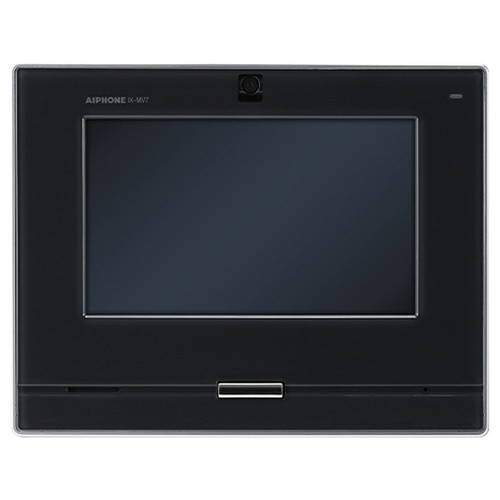
Both the IX-MV7-HB and IX-MV7-B are Aiphone IX-series SIP-compatible IP video master stations built around a 7-inch LCD touchscreen, designed to serve as the central command point in an IP intercom deployment. The critical differentiator is the handset: the IX-MV7-HB adds a dedicated privacy handset on top of hands-free and push-to-talk modes, while the IX-MV7-B supports only hands-free and push-to-talk. A secondary difference is physical size. All other core specs are identical across both units.

In This Guide
- Which station gives you more audio communication flexibility and privacy?
- How do the physical dimensions affect installation and mounting options?
- Are there any differences in network capability, power, or system integration specs?
- Which should you choose: the IX-MV7-HB or the IX-MV7-B?
- Side-by-Side Specs
- FAQ
Which station gives you more audio communication flexibility and privacy?
The IX-MV7-HB lists three communication modes per spec: hands-free, push-to-talk, and handset. The handset is a physical privacy receiver that allows a station operator to conduct a conversation without the audio being audible to bystanders — a meaningful difference in lobbies, reception desks, security posts, or any open-plan environment where call privacy matters.
The IX-MV7-B lists only hands-free and push-to-talk per spec. There is no handset mode documented. Both units share identical audio codec support (G.711, G.722), the same speaker output (8Ω 0.5W), and the same audio input impedance (600Ω), so audio quality and codec compatibility are equivalent; the gap is solely in the physical handset option.
How do the physical dimensions affect installation and mounting options?
The IX-MV7-HB is specified at 8-1/16" H × 11" W × 2-3/16" D. The IX-MV7-B is specified at 6-3/4" H × 8-11/16" W × 1-1/4" D. The HB is approximately 1-5/16" taller, 2-5/16" wider, and nearly 1" deeper than the B model. The added depth and width on the HB are consistent with housing the handset cradle mechanism.
The slimmer profile of the IX-MV7-B (1-1/4" depth vs 2-3/16") makes it better suited to shallow-wall or surface-mount situations with limited back-box depth. The larger footprint of the IX-MV7-HB requires a correspondingly larger rough-in. Installers should verify rough-in dimensions against the specific wall construction before specifying either unit.
Are there any differences in network capability, power, or system integration specs?
On every documented network, power, and integration spec, the two units are identical. Both operate on PoE IEEE 802.3af Class 0 at 4.32W. Both implement the same protocol stack: IPv4, IPv6, TCP, UDP, SIP, HTTP, HTTPS, RTSP, RTP, RTCP, IGMP, MLD, SMTP, SFTP, DHCP, NTP, and DNS. Both carry IEEE 802.1x port security and ONVIF Profile S compliance — though ONVIF Profile S is listed in the IX-MV7-HB spec and is not listed in the IX-MV7-B spec as provided.
Station capacity, I/O, and scheduling specs are also identical: 500-entry address book, 50 bell schedule events per day, 8 speed dial buttons, 2 contact outputs, 4 trigger inputs. Camera sensor spec language differs slightly — the HB lists '1/3" CMOS 480p' while the B lists only '480p' — but no performance difference is derivable from the provided data. Both require Cat-5e/6 cabling and carry identical UL 62368-1 and cUL 62368-1 compliance markings.
Which should you choose: the IX-MV7-HB or the IX-MV7-B?
Our take: The IX-MV7-HB is the stronger choice when call privacy is operationally required, such as at a staffed reception desk, security post, or lobby console where conversations must not be overheard. The defining spec delta is communication mode: the HB adds a physical handset to hands-free and push-to-talk, while the B omits it entirely per spec. The HB is also larger — 11" W × 8-1/16" H × 2-3/16" D versus 8-11/16" W × 6-3/4" H × 1-1/4" D — which has direct rough-in and back-box implications. Additionally, ONVIF Profile S compliance is documented for the HB but absent from the B's spec sheet as provided; installers integrating with ONVIF-dependent VMS platforms should confirm the B's compliance independently. All PoE power, I/O, network protocol, and scheduling specs are identical. Where wall depth is constrained or a dedicated handset is not needed, the IX-MV7-B's slimmer profile is the practical install.
Side-by-Side Comparison
Spec-for-spec, from manufacturer data.
| Specification | Aiphone IX-MV7-HB | Aiphone IX-MV7-B |
|---|---|---|
| Screen Size | 7" LCD | 7" LCD |
| Camera Sensor | 1/3" CMOS 480p | 480p (sensor size not specified) |
| Min Illumination | 5 lux | 5 lux |
| Audio Codecs | G.711, G.722 | G.711, G.722 |
| Video Codecs | H.264/AVC, Motion JPEG | H.264/AVC, Motion JPEG |
| Communication Modes | Hands-free, push-to-talk, handset | Hands-free, push-to-talk |
| Power Source | PoE IEEE 802.3af Class 0 | PoE IEEE 802.3af Class 0 |
| Power Draw | 4.32W | 4.32W |
| Contact Outputs | 2 | 2 |
| Trigger Inputs | 4 | 4 |
| Station Address Book | 500 | 500 |
| Bell Schedule Events | 50 per day | 50 per day |
| Speed Dial Buttons | 8 | 8 |
| ONVIF Compliance | Profile S | — |
| Operating Temperature | 32°–104°F (0°–40°C) | 32°–104°F (0°–40°C) |
| Dimensions (H × W × D) | 8-1/16" × 11" × 2-3/16" | 6-3/4" × 8-11/16" × 1-1/4" |
Frequently Asked Questions
Which should you choose: the IX-MV7-HB or the IX-MV7-B?
The IX-MV7-HB is the stronger choice when call privacy is operationally required, such as at a staffed reception desk, security post, or lobby console where conversations must not be overheard. The defining spec delta is communication mode: the HB adds a physical handset to hands-free and push-to-talk, while the B omits it entirely per spec. The HB is also larger — 11" W × 8-1/16" H × 2-3/16" D versus 8-11/16" W × 6-3/4" H × 1-1/4" D — which has direct rough-in and back-box implications. Additionally, ONVIF Profile S compliance is documented for the HB but absent from the B's spec sheet as provided; installers integrating with ONVIF-dependent VMS platforms should confirm the B's compliance independently. All PoE power, I/O, network protocol, and scheduling specs are identical. Where wall depth is constrained or a dedicated handset is not needed, the IX-MV7-B's slimmer profile is the practical install.
Is the IX-MV7-HB or IX-MV7-B better for a staffed security desk where conversations need to stay private?
Per spec, the IX-MV7-HB is the appropriate choice. It includes a dedicated handset communication mode in addition to hands-free and push-to-talk, allowing the operator to take calls without audio being broadcast into the room. The IX-MV7-B spec lists only hands-free and push-to-talk — no handset mode is documented.
Do the two stations differ in PoE power draw or network protocol support?
No. Both units draw 4.32W from a PoE IEEE 802.3af Class 0 source and share an identical protocol list: IPv4, IPv6, TCP, UDP, SIP, HTTP, HTTPS, RTSP, RTP, RTCP, IGMP, MLD, SMTP, SFTP, DHCP, NTP, and DNS. IEEE 802.1x port security is specified on both. There is no power or networking difference to factor into a switch or UPS budget.
Will either station fit in a shallow back-box installation?
The IX-MV7-B is the better candidate for shallow installations. Its specified depth is 1-1/4", compared to 2-3/16" for the IX-MV7-HB — a difference of nearly 1". The HB's added depth accommodates the handset cradle. Both units are also wider and taller than a standard single-gang rough-in, so a purpose-specific back-box is required regardless; verify exact cutout dimensions against the manufacturer's installation sheet before ordering.
More Intercom Comparisons
- Aiphone IX-MV7-HB vs Code Blue SLNP0029
- Aiphone IX-MV7-HB vs Axis I5304
- Aiphone IX-MV7-HB vs Aiphone IXG-MK
- Code Blue SLNP0029 vs Aiphone IX-MV7-B
- Code Blue SLNP0029 vs Aiphone IXG-MK
- Code Blue SLNP0029 vs Aiphone IX-MV7-HW-JP
Intercom Buying Guides
Get a Second Opinion on Your Camera Choice
Share your site layout, coverage goals, and budget. Our team will validate the camera selection, flag anything we would change, and recommend products that match the use case.