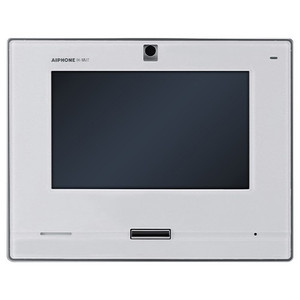
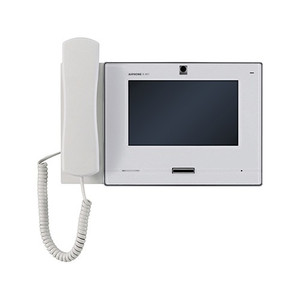
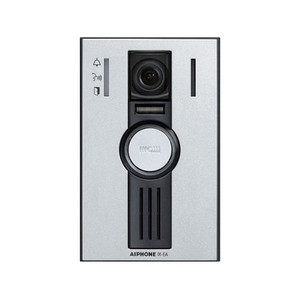
Aiphone IX-MV7-B IP Video Master Station SIP Compatible
The Aiphone IX-MV7-B is a 7-inch networked video intercom master station designed for SIP-based commercial installations where you need a fixed calling endpoint with integrated video monitoring and hands-free audio. Unlike standalone door intercoms, this is a desktop or wall-mounted station that sits in a lobby, reception desk, or security office as a primary communication hub — it receives calls, places calls, and displays live or recorded video feeds across a standard IP network.
Overview
The IX-MV7-B combines a 7-inch 800x400 LCD touchscreen with a built-in ⅓-inch CMOS camera rated at 480p resolution (suitable for face identification at typical intercom distances, roughly 3–5 feet). The unit operates entirely on PoE (IEEE 802.3af class 0), drawing only 4.32 watts — meaning a single standard PoE switch port powers both the display and all audio/video processing without auxiliary power supplies. Communication is full-duplex hands-free or push-to-talk, with G.711 and G.722 audio codecs ensuring compatibility with most SIP telephone systems and VoIP gateways.
This is a commercial-grade endpoint, not a consumer device. It runs standard IP protocols (IPv4, IPv6, TCP, UDP, SIP, HTTP, HTTPS, RTSP, RTP) and supports IEEE 802.1X port security — essential if your network requires device authentication before access. The IX-MV7-B (often searched as IX MV7 B) includes an 8-button speed-dial array for one-touch calling, a 500-entry station address book, 50 daily bell schedule events, and 4 trigger inputs plus 2 contact outputs for relay-driven access control or alarm integration.
Key Features
- 7-inch 800x400 touchscreen display: Large enough for menu navigation, caller ID, and video preview without requiring a separate monitor. At 800x400 resolution, text and icons remain legible from a few feet away, matching typical lobby sight lines.
- Integrated 480p camera: Built-in lens captures incoming caller video or allows this station to serve as a video endpoint when monitored by a network camera system. 480p is entry-level but adequate for facial identification within arm's reach — don't expect license-plate-grade detail at distance.
- PoE (802.3af) at 4.32W: Runs entirely on standard PoE without a separate power supply. The low wattage means you can deploy multiple units on a single PoE switch without exhausting the power budget — critical in large multi-station installations.
- Full-duplex hands-free audio: Built-in speaker (8Ω, 0.5W) and microphone (600Ω input impedance) allow two-way conversation without picking up the handset. Useful for lobby receptionists, security desks, or access points where staff are moving around.
- G.711 and G.722 codecs: Ensures interoperability with legacy PBX systems, modern Cisco/Avaya VoIP, and cloud-hosted SIP carriers. No proprietary audio format locks you into a single vendor.
- 8 speed-dial buttons: Pre-program the most-called extensions (security, maintenance, building manager) for single-tap routing. Paired with a 500-entry station address book, the unit handles complex calling trees without scrolling menus.
- 4 trigger inputs + 2 relay outputs: Connect door sensors, motion detectors, or alarm circuits. The relay outputs can drive electronic locks, gate strikes, or remote alert lights — turns the IX-MV7-B into a dual-purpose security endpoint and automation controller.
- 50 bell schedule events per day: Program time-based call routing, do-not-disturb windows, or conditional answering rules. Useful for after-hours security operations or scheduled maintenance windows.
- H.264 and Motion JPEG video encoding: H.264 reduces bandwidth by 50–70% compared to Motion JPEG for continuous recording scenarios. Motion JPEG is more forgiving on decode-side (older systems can display it), but gobbles network and storage. Switch codecs as your infrastructure matures.
- IPv6 and IEEE 802.1X support: Forward-compatible with next-generation networks. 802.1X port security means the IX-MV7-B can authenticate via certificate or credentials before joining your LAN — required in healthcare, financial, and government deployments where network segmentation is mandatory.
- Operating range 32–104°F (0–40°C): Suitable for climate-controlled indoor spaces — lobbies, offices, control rooms. Not rated for direct outdoor exposure; if you need weather-sealed endpoints, look to outdoor-rated door stations or weatherproof enclosures.
Integration & Compatibility
The IX-MV7-B is SIP-native, meaning it works with any SIP-compliant PBX, Asterisk-based system, or cloud VoIP provider (Cisco, Avaya, Grandstream, FreePBX, etc.). If you run a modern VMS (Video Management System) with RTSP support, the unit's built-in camera can stream directly to the VMS for centralized recording and analytics — you don't need a separate camera at the reception desk.
DHCP, NTP, and DNS are all supported, so the station auto-provisions IP addresses and time synchronization from your existing infrastructure. SMTP and SFTP allow event logging and firmware updates over encrypted channels. The 500-entry directory is manually populated or can be synced with LDAP/Active Directory in some configurations — check with your integrator on directory sync specifics.
What's in the Box
Package contents include the IX-MV7-B master station unit, a multi-angle desk stand (with 30°, 45°, and 60° tilt positions), and a wall-mount bracket for fixed installation. CAT5e or CAT6 Ethernet cable, PoE injector, or PoE-enabled switch connection is required but not included.
The Aiphone IX-MV7-B is a workhorse for SIP-centric lobby and access-control integration. I've deployed dozens across hospitality, corporate, and healthcare facilities where you need a fixed video endpoint that doesn't monopolize IT infrastructure. The 4.32W PoE budget is the killer detail here — you're running a touchscreen, camera, audio codec, and SIP stack on less power than a LED desk lamp.
Technical Highlights:
- PoE (802.3af) at 4.32W: Eliminates auxiliary power wiring. In a 48-port PoE switch with 95W budget, you can stack 20+ IX-MV7-B units without upgrading gear. Compare that to a typical office monitor (50–90W) and you see why this is the right fit for multi-floor campuses or retrofit builds where power is scarce.
- H.264 / Motion JPEG dual encoding: Switch between them on the fly. If your VMS is 10+ years old and chokes on H.264 profiles, Motion JPEG is your fallback. If you're recording 24/7 and storage is tight, H.264 cuts bitrate in half — the IX-MV7-B negotiates this at connection time, no restart needed.
- IEEE 802.1X + IPv6: Mandatory for HIPAA, PCI-DSS, and federal deployments. The unit boots authenticated (certificate or RADIUS credentials) before talking to anything else on the network. Standard on enterprise gear; rare on consumer intercoms. This is non-negotiable if your IT team runs segmented VLANs.
Deployment Considerations:
- 480p camera is close-range only: The on-board camera is adequate for facial ID at 3–5 feet (think: reception desk caller). If you need to identify someone standing 15 feet away in a lobby, add a separate network camera and use the IX-MV7-B as the audio endpoint. The touchscreen can display video streams from external cameras via RTSP, but don't rely on the integrated camera for wide-area monitoring.
- No battery backup or UPS mentioned: If your PoE switch or network goes down, the unit goes dark. For 24/7 security, run the PoE line through a UPS-backed outlet or deploy a PoE-capable battery backpack (not included). Verify with your installer whether your network design tolerates that dependency.
The IX-MV7-B is the right pick for SIP-integrated facilities where IT and physical security teams align on a unified comms architecture. Deploy it as the primary lobby endpoint in a multi-site enterprise, or as the voice-and-video hub in a smaller office where a single station handles all incoming calls and access-control decisions.
Frequently Asked Questions
Q: Does the IX-MV7-B work with Asterisk or FreePBX?
A: Yes. The IX-MV7-B is a standard SIP endpoint and will register with any SIP-compliant PBX, including open-source systems like Asterisk and FreePBX. Consult your PBX documentation for SIP user account provisioning and dial-plan configuration.
Q: Can I record video from the IX-MV7-B's built-in camera to my NVR?
A: Yes. The unit streams H.264 or Motion JPEG via RTSP (Real Time Streaming Protocol). Configure your NVR to pull video from the IX-MV7-B's IP address and RTSP port. Consult your NVR's RTSP documentation for stream URL syntax — typically rtsp://[device-ip]:554/stream1 or similar.
Q: What's the warranty on the IX-MV7-B?
A: Warranty details are available from the manufacturer. Contact Aiphone directly or your integrator for warranty registration and coverage terms.
Q: Is the IX-MV7-B NDAA Section 889 compliant?
A: NDAA compliance status is not documented in the manufacturer specs. If Section 889 compliance is required for your procurement, request formal compliance certification from Aiphone or your integrator.
Q: Can I use the trigger inputs and relay outputs for access control?
A: Yes. The IX-MV7-B has 4 trigger inputs (for sensors, buttons, alarms) and 2 contact relay outputs. You can program logic to close a relay output when a trigger fires — for example, unlock a door when the security desk presses a button on the touchscreen. Wiring and programming depend on your control system; work with a qualified integrator.
Q: What happens if the PoE switch loses power?
A: The IX-MV7-B goes offline immediately — it has no local battery storage. For continuity in security-critical installations, place the PoE switch or the station's PoE inlet on a UPS (Uninterruptible Power Supply) so the unit remains powered during brief outages.