
Aiphone IX-MV7-HB vs Aiphone IXG-MK: Specification Comparison
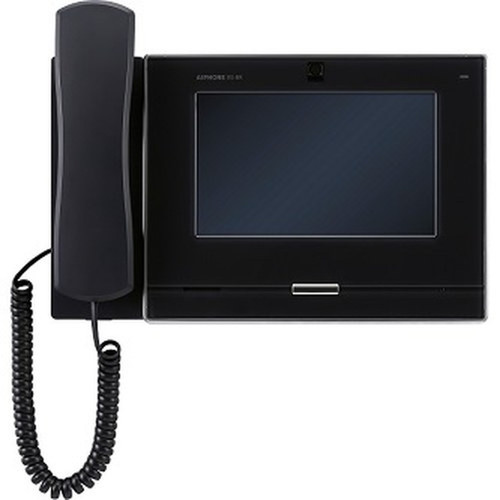
Both the Aiphone IX-MV7-HB and the Aiphone IXG-MK are SIP-based IP video intercom master/guard stations sharing the same 7-inch touchscreen form factor and PoE power delivery. The IX-MV7-HB is positioned as a master station with a privacy handset and deep protocol support, while the IXG-MK is marketed as a guard station optimized for lobby or security-office deployment with wall or rack mounting. Buyers evaluating either unit are choosing a central control point for an IP video intercom system, making direct comparison appropriate.

In This Guide
- How do video quality and audio communication capabilities compare between the IX-MV7-HB and IXG-MK?
- Which station offers broader network protocol support and integration flexibility?
- How do power consumption, I/O capacity, and physical deployment options differ?
- Which should you choose: the IX-MV7-HB or the IXG-MK?
- Side-by-Side Specs
- FAQ
How do video quality and audio communication capabilities compare between the IX-MV7-HB and IXG-MK?
The IX-MV7-HB specifies a 1/3" CMOS sensor at 480p resolution with a minimum illumination of 5 lux, supporting both H.264/AVC and Motion JPEG video codecs. The IXG-MK's tagline references 720p video for visitor verification, suggesting higher camera resolution, though no sensor size, lux rating, or explicit codec version is listed in its formal spec fields — only H.264 and MJPEG are confirmed. Buyers who need verified low-light camera performance should note that the IX-MV7-HB's 5-lux figure is a documented spec, while the IXG-MK provides no equivalent figure.
On audio, the IX-MV7-HB explicitly supports G.711 and G.722 audio codecs and offers three communication modes: hands-free, push-to-talk, and handset. The IXG-MK specifies hands-free (full-duplex) and push-to-talk but does not list audio codec standards by name. The IX-MV7-HB also documents a speaker output of 8Ω 0.5W and an audio input impedance of 600Ω, providing integrators with the electrical parameters needed for external speaker or amplifier wiring — data absent from the IXG-MK spec sheet.
Which station offers broader network protocol support and integration flexibility?
The IX-MV7-HB carries an extensive listed protocol stack: IPv4, IPv6, TCP, UDP, SIP, HTTP, HTTPS, RTSP, RTP, RTCP, IGMP, MLD, SMTP, SFTP, DHCP, NTP, and DNS. It also documents IEEE 802.1x port security and ONVIF Profile S compliance. This level of detail supports integration with third-party VMS platforms, email alert workflows (SMTP), secure file transfer (SFTP), and multicast video distribution (IGMP/MLD).
The IXG-MK confirms ONVIF compliance and H.264/MJPEG compression but lists no individual network protocols. The 802.1x port-security capability is not stated for the IXG-MK. For IT-managed networks requiring 802.1x authentication at the edge port, the IX-MV7-HB is the only model with a confirmed spec. The IXG-MK does note call-recording storage capability, which is not mentioned in the IX-MV7-HB spec sheet, giving the IXG-MK a potential advantage in guard-station audit and compliance workflows.
How do power consumption, I/O capacity, and physical deployment options differ?
Both stations are powered by PoE 802.3af. The IX-MV7-HB documents a precise power draw of 4.32W (within the 802.3af 15.4W budget). The IXG-MK states only '<13W' — a ceiling, not a measured draw — so switch port power budgeting is less precise for the IXG-MK. Both use Cat-5e or Cat-6 cabling and share identical published dimensions of 8-1/16" H × 11" W × 2-3/16" D.
The IX-MV7-HB provides 2 contact outputs and 4 trigger inputs, along with an 500-entry station address book, 50 bell-schedule events per day, and 8 speed-dial buttons — all explicitly specified. The IXG-MK does not publish contact output or trigger input counts, address-book capacity, bell-schedule limits, or speed-dial button counts in its available spec data. For deployment, the IXG-MK explicitly adds rack-mount capability alongside wall mount, while the IX-MV7-HB spec does not mention rack mounting. The IXG-MK also includes a stand for desk use per its spec notes.
Which should you choose: the IX-MV7-HB or the IXG-MK?
Our take: The IX-MV7-HB is the stronger choice when integrators require fully documented network protocol depth, precise I/O counts, and verified power consumption figures. It specifies 4.32W draw versus the IXG-MK's '<13W' ceiling, lists 2 contact outputs and 4 trigger inputs where the IXG-MK publishes none, and supports G.722 wideband audio with IEEE 802.1x port security — neither confirmed for the IXG-MK. The IXG-MK has meaningful advantages where its specs are documented: rack-mount support for 19" security-rack integration, an included desk stand, and a 720p video reference versus the IX-MV7-HB's specified 480p — though the IXG-MK's 720p claim appears only in marketing copy rather than formal spec fields. The IXG-MK's call-recording capability also suits guard-station audit requirements. Choose the IX-MV7-HB for IT-managed, protocol-rich deployments; consider the IXG-MK for security-room or rack-mounted guard posts where rack integration and call logging take priority.
Side-by-Side Comparison
Spec-for-spec, from manufacturer data.
| Specification | Aiphone IX-MV7-HB | Aiphone IXG-MK |
|---|---|---|
| Form Factor | Master Station | Guard Station |
| Screen Size | 7" LCD | 7" touchscreen |
| Camera Resolution | 480p (1/3" CMOS) | 720p (marketing copy only; not in formal specs) |
| Min Illumination | 5 lux | — |
| Video Codec | H.264/AVC, Motion JPEG | H.264, MJPEG |
| Audio Codec | G.711, G.722 | — |
| Communication Modes | Hands-free, push-to-talk, handset | Hands-free (full-duplex), push-to-talk |
| Power Source | PoE (IEEE 802.3af Class 0) | PoE (IEEE 802.3af) |
| Power Draw | 4.32W | <13W (ceiling only) |
| Port Security | IEEE 802.1x | — |
| ONVIF | Profile S | Yes (profile not specified) |
| Contact Outputs | 2 | — |
| Trigger Inputs | 4 | — |
| Station Address Book | 500 entries | — |
| Mount Type | Wall | Wall; Rack; Desk (stand included) |
| Dimensions | 8-1/16" H x 11" W x 2-3/16" D | 8-1/16" H x 11" W x 2-3/16" D |
Frequently Asked Questions
Which should you choose: the IX-MV7-HB or the IXG-MK?
The IX-MV7-HB is the stronger choice when integrators require fully documented network protocol depth, precise I/O counts, and verified power consumption figures. It specifies 4.32W draw versus the IXG-MK's '<13W' ceiling, lists 2 contact outputs and 4 trigger inputs where the IXG-MK publishes none, and supports G.722 wideband audio with IEEE 802.1x port security — neither confirmed for the IXG-MK. The IXG-MK has meaningful advantages where its specs are documented: rack-mount support for 19" security-rack integration, an included desk stand, and a 720p video reference versus the IX-MV7-HB's specified 480p — though the IXG-MK's 720p claim appears only in marketing copy rather than formal spec fields. The IXG-MK's call-recording capability also suits guard-station audit requirements. Choose the IX-MV7-HB for IT-managed, protocol-rich deployments; consider the IXG-MK for security-room or rack-mounted guard posts where rack integration and call logging take priority.
Is the IX-MV7-HB or IXG-MK better for larger deployments requiring network security compliance?
The IX-MV7-HB is better documented for this use case. It explicitly lists IEEE 802.1x port security, IPv6, and a full protocol stack including IGMP/MLD for multicast. The IXG-MK does not list 802.1x support or individual network protocols in its available specifications, making it harder to verify compliance with network-access-control policies.
Can the IXG-MK be rack-mounted in a security operations center?
Yes — the IXG-MK spec explicitly lists wall and rack as supported mount types, making it suitable for 19" rack integration in a security office or control room. The IX-MV7-HB specification does not mention rack-mount capability.
Which station has better video quality — the IX-MV7-HB or the IXG-MK?
The IXG-MK references 720p video in its tagline, compared to the IX-MV7-HB's specified 480p (1/3" CMOS). However, the IXG-MK's 720p figure appears only in marketing copy and is not confirmed in its formal spec fields, and no lux or sensor-size rating is published for the IXG-MK. The IX-MV7-HB's 480p at 5 lux is a verifiable spec. Buyers should request the IXG-MK datasheet to confirm the 720p claim before making a decision based on camera resolution.
More Intercom Comparisons
- Aiphone IX-MV7-HB vs Code Blue SLNP0029
- Aiphone IX-MV7-HB vs Axis I5304
- Aiphone IX-MV7-HB vs Aiphone IX-MV7-B
- Code Blue SLNP0029 vs Aiphone IX-MV7-B
- Code Blue SLNP0029 vs Aiphone IXG-MK
- Code Blue SLNP0029 vs Aiphone IX-MV7-HW-JP
Intercom Buying Guides
Get a Second Opinion on Your Camera Choice
Share your site layout, coverage goals, and budget. Our team will validate the camera selection, flag anything we would change, and recommend products that match the use case.