
Aiphone IX-MV7-HW-JP vs Aiphone IX-MV7-HB: Specification Comparison
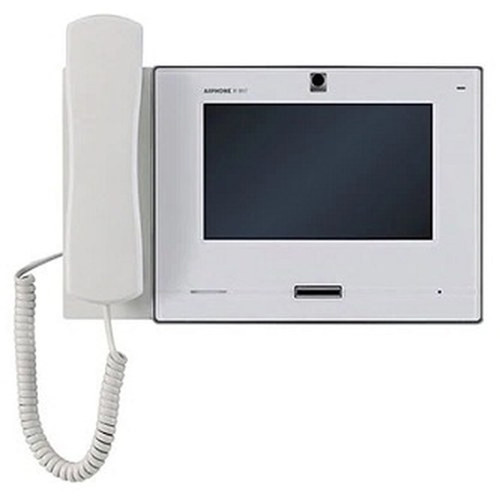
Both the Aiphone IX-MV7-HW-JP and IX-MV7-HB are 7-inch IP video master stations designed for the Aiphone IX Series intercom platform, intended for reception desks, security stations, or guard posts. Each unit offers a touchscreen LCD display, PoE power, H.264/MJPEG video codecs, full-duplex audio, and ONVIF Profile S compliance. A buyer choosing between these two is selecting between two functionally similar master stations that differ primarily in camera resolution, audio codec support, I/O capability, and protocol depth.

In This Guide
How do the display quality and camera resolution compare?
Both units feature a 7-inch LCD touchscreen and share the same physical dimensions (8-1/16" H × 11" W × 2-3/16" D). The IX-MV7-HW-JP specifies an 800×400 TFT LCD panel and a 1/3" CMOS camera at 720p (HD resolution). The IX-MV7-HB also uses a 1/3" CMOS sensor but is rated at 480p (SD resolution), with a minimum illumination of 5 lux — a figure not provided for the IX-MV7-HW-JP. For video encoding, both support H.264/AVC and Motion JPEG; the IX-MV7-HB additionally lists G.711 and G.722 audio codecs explicitly, whereas the IX-MV7-HW-JP does not specify audio codec standards beyond noting audio input support. The display resolution of the IX-MV7-HW-JP (800×400) is stated in the specs; the IX-MV7-HB does not specify panel resolution.
What are the power requirements and I/O integration capabilities?
Both stations draw power via PoE IEEE 802.3af Class 0 at a maximum of 4.32W — identical power profiles. Neither unit requires a separate power supply. On I/O, the IX-MV7-HB provides explicit figures: 2 contact outputs, 4 trigger inputs, an 8Ω 0.5W speaker output, and a 600Ω audio input. It also supports Cat-5e/6 network cabling and IEEE 802.1x port security. The IX-MV7-HW-JP does not publish equivalent I/O counts in the provided specifications. For operating environment, the IX-MV7-HB is rated 32°–104°F (0°–40°C); no operating temperature range is specified for the IX-MV7-HW-JP. Both units are wall-mount form factor.
Which unit offers broader network protocol support and compliance certifications?
The IX-MV7-HB publishes an extensive protocol stack: IPv4, IPv6, TCP, UDP, SIP, HTTP, HTTPS, RTSP, RTP, RTCP, IGMP, MLD, SMTP, SFTP, DHCP, NTP, and DNS, plus IEEE 802.1x port security. It also lists a 500-entry station address book, 50 bell schedule events per day, and 8 speed-dial buttons — functional capacity figures not provided for the IX-MV7-HW-JP. The IX-MV7-HW-JP lists TAA compliance and SIP support explicitly in its compliance field, alongside ONVIF Profile S, and is UL 62368-1 / cUL 62368-1 listed. The IX-MV7-HB shares UL 62368-1 / cUL 62368-1 but does not list TAA compliance in the provided specifications. Both carry ONVIF Profile S. SIP is confirmed for the IX-MV7-HW-JP; the IX-MV7-HB lists SIP in its protocol stack.
Which should you choose: the IX-MV7-HW-JP or the IX-MV7-HB?
Our take: The IX-MV7-HW-JP is the stronger choice when camera resolution and TAA compliance are primary requirements, while the IX-MV7-HB is the stronger choice when documented I/O integration depth and protocol transparency are the deciding factors. On resolution, the IX-MV7-HW-JP's 720p camera outperforms the IX-MV7-HB's 480p sensor — a meaningful delta for facial identification at the door. The IX-MV7-HW-JP also explicitly carries TAA compliance, which the IX-MV7-HB does not list. Conversely, the IX-MV7-HB documents 2 contact outputs, 4 trigger inputs, a 500-entry address book, 50 bell schedule events per day, and a full 17-protocol network stack — none of which are published for the IX-MV7-HW-JP. Buyers integrating door hardware relays or requiring verified I/O counts for system design should favor the IX-MV7-HB. Buyers in TAA-regulated environments or prioritizing higher-resolution video monitoring at the master station should favor the IX-MV7-HW-JP.
Side-by-Side Comparison
Spec-for-spec, from manufacturer data.
| Specification | Aiphone IX-MV7-HW-JP | Aiphone IX-MV7-HB |
|---|---|---|
| Device Class | IP Video Master Station | IP Video Master Station |
| Display Size | 7-inch TFT LCD | 7" LCD |
| Display Resolution | 800×400 | — |
| Camera Sensor | 1/3" CMOS | 1/3" CMOS |
| Camera Resolution | 720p | 480p |
| Min. Illumination | — | 5 lux |
| Video Codecs | H.264, MJPEG | H.264/AVC, Motion JPEG |
| Audio Codecs | — | G.711, G.722 |
| Communication Mode | Full-duplex handset or hands-free | Hands-free, push-to-talk, handset |
| Power Source | PoE IEEE 802.3af Class 0 | PoE IEEE 802.3af Class 0 |
| Power Draw | 4.32W max | 4.32W |
| Contact Outputs | — | 2 |
| Trigger Inputs | — | 4 |
| Station Address Book | — | 500 entries |
| Bell Schedule Events | — | 50 per day |
| Speed Dial Buttons | — | 8 |
| ONVIF Compliance | Profile S | Profile S |
| SIP Support | Yes | Yes (listed in protocol stack) |
| TAA Compliance | Yes | — |
| Port Security | — | IEEE 802.1x |
| Operating Temperature | — | 32°–104°F (0°–40°C) |
| Dimensions (H×W×D) | 8-1/16" × 11" × 2-3/16" | 8-1/16" × 11" × 2-3/16" |
| Safety Certifications | UL 62368-1, cUL 62368-1 | UL 62368-1, cUL 62368-1 |
| Warranty | 2-Year | — |
Frequently Asked Questions
Which should you choose: the IX-MV7-HW-JP or the IX-MV7-HB?
The IX-MV7-HW-JP is the stronger choice when camera resolution and TAA compliance are primary requirements, while the IX-MV7-HB is the stronger choice when documented I/O integration depth and protocol transparency are the deciding factors. On resolution, the IX-MV7-HW-JP's 720p camera outperforms the IX-MV7-HB's 480p sensor — a meaningful delta for facial identification at the door. The IX-MV7-HW-JP also explicitly carries TAA compliance, which the IX-MV7-HB does not list. Conversely, the IX-MV7-HB documents 2 contact outputs, 4 trigger inputs, a 500-entry address book, 50 bell schedule events per day, and a full 17-protocol network stack — none of which are published for the IX-MV7-HW-JP. Buyers integrating door hardware relays or requiring verified I/O counts for system design should favor the IX-MV7-HB. Buyers in TAA-regulated environments or prioritizing higher-resolution video monitoring at the master station should favor the IX-MV7-HW-JP.
Which station delivers better video quality for identifying visitors — the IX-MV7-HW-JP or IX-MV7-HB?
Based on published specifications, the IX-MV7-HW-JP is rated at 720p while the IX-MV7-HB is rated at 480p, both using a 1/3" CMOS sensor. The IX-MV7-HW-JP's higher camera resolution provides a clearer image for visitor identification. The IX-MV7-HB specifies a minimum illumination of 5 lux; that figure is not published for the IX-MV7-HW-JP.
Can either station control door locks or external devices through relay outputs?
The IX-MV7-HB explicitly lists 2 contact outputs and 4 trigger inputs in its specifications, making its relay and trigger I/O capability documented and specifiable for system design. The IX-MV7-HW-JP does not publish equivalent contact output or trigger input counts in the provided specifications, so that capability cannot be confirmed from available data alone.
Is either model suitable for U.S. federal government procurement requiring TAA compliance?
The IX-MV7-HW-JP lists TAA compliance in its published specifications. The IX-MV7-HB does not include TAA compliance in the specifications provided. Buyers with TAA requirements should specify the IX-MV7-HW-JP, or verify TAA status directly with Aiphone for the IX-MV7-HB before procurement.
More Intercom Comparisons
- Aiphone IX-MV7-HB vs Code Blue SLNP0029
- Aiphone IX-MV7-HB vs Axis I5304
- Aiphone IX-MV7-HB vs Aiphone IX-MV7-B
- Aiphone IX-MV7-HB vs Aiphone IXG-MK
- Code Blue SLNP0029 vs Aiphone IX-MV7-B
- Code Blue SLNP0029 vs Aiphone IXG-MK
Intercom Buying Guides
Get a Second Opinion on Your Camera Choice
Share your site layout, coverage goals, and budget. Our team will validate the camera selection, flag anything we would change, and recommend products that match the use case.