
Aiphone IX-MV7-B vs Axis I5304: Specification Comparison
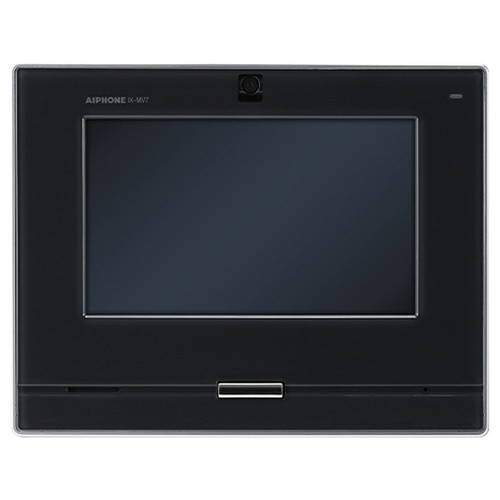
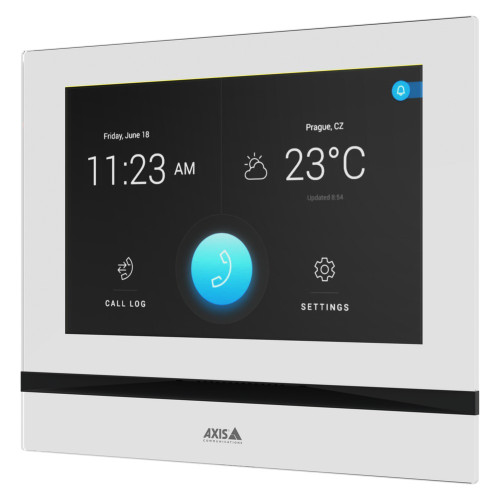
The Aiphone IX-MV7-B and Axis I5304 are both 7-inch touchscreen IP intercom master/answering stations designed for indoor reception and entry-management use. Both are SIP-compatible, PoE-powered, and intended as the operator-side endpoint in a networked intercom system — the unit a receptionist or security officer picks up to answer visitor calls. Buyers selecting an indoor IP answering station for a lobby, office, or multi-tenant building will legitimately cross-shop these two products.
In This Guide
- How do the display quality, audio performance, and communication modes compare?
- Which unit offers broader protocol support and system integration flexibility?
- How do the two units compare on power requirements, installation flexibility, and site-management capacity?
- Which should you choose: the IX-MV7-B or the I5304?
- Side-by-Side Specs
- FAQ
How do the display quality, audio performance, and communication modes compare?
Both units ship a 7-inch touchscreen: the IX-MV7-B specifies an LCD panel with 480p camera resolution and a minimum illumination of 5 lux, giving a concrete sense of image quality under low-light conditions. The I5304 specifies a capacitive touch screen at 7 inches but provides no camera resolution or minimum illumination figure in the supplied specifications.
On audio, the IX-MV7-B documents its codecs explicitly — G.711 and G.722 — and its speaker output (8Ω, 0.5W) and audio input impedance (600Ω). It supports both hands-free and push-to-talk communication modes. The I5304 specifies full-duplex two-way audio with echo cancellation, which is a meaningful differentiator for intelligibility in noisy lobbies, but no codec list, speaker wattage, or impedance figures are provided in the supplied specifications.
For buyers where audio clarity in reverberant spaces is critical, the I5304's echo cancellation claim is notable — though it cannot be quantitatively verified from the provided specs. Buyers who need to confirm codec compatibility with an existing SIP PBX (e.g., G.722 wideband) will find the IX-MV7-B's explicit codec declaration more useful at the specification stage.
Which unit offers broader protocol support and system integration flexibility?
The IX-MV7-B publishes an extensive protocol stack: IPv4, IPv6, TCP, UDP, SIP, HTTP, HTTPS, RTSP, RTP, RTCP, IGMP, MLD, SMTP, SFTP, DHCP, NTP, and DNS. It also includes IEEE 802.1x port security and documents two contact outputs and four trigger inputs — hardware I/O points that allow integration with door strikes, alarm panels, or access control relays directly from the station.
The I5304 lists SIP and native Axis IP intercom connectivity (AXIS TI5201, TI5601, TI5602), and runs the 2N OS platform. No independent protocol stack, hardware I/O count, or 802.1x support is specified in the provided data. Its compatibility is explicitly scoped to Axis IP intercoms and SIP-based VoIP systems.
For open, multi-vendor environments or projects requiring direct I/O integration without a separate controller, the IX-MV7-B's documented protocol breadth and hardware I/O give it a verifiable advantage. The I5304's native 2N OS may offer deeper integration within an all-Axis/2N ecosystem, but that capability is not quantifiable from the supplied specifications.
How do the two units compare on power requirements, installation flexibility, and site-management capacity?
Both stations are powered by PoE. The IX-MV7-B specifies IEEE 802.3af Class 0 at 4.32W — a precise figure that confirms compatibility with any 802.3af-capable switch port. The I5304 states 'IEEE PoE' without specifying the class or wattage draw; installers will need to verify switch compatibility independently.
For site management, the IX-MV7-B documents a 500-entry station address book, 8 speed-dial buttons, and 50 bell-schedule events per day — concrete capacity figures relevant to multi-tenant or large-building deployments. None of these capacity parameters are provided for the I5304 in the supplied specifications.
Installation flexibility: the I5304 specifies wall, recessed, and desk mount options. The IX-MV7-B provides physical dimensions (6-3/4" H × 8-11/16" W × 1-1/4" D) and UL 62368-1 / cUL 62368-1 compliance, but mounting options are not enumerated. The I5304 carries a 5-year warranty; no warranty term is stated in the IX-MV7-B's supplied specifications.
Which should you choose: the IX-MV7-B or the I5304?
Our take: The IX-MV7-B is the stronger choice when the project demands documented protocol flexibility, direct hardware I/O integration, and verifiable site-management capacity. It specifies a 500-entry address book, 8 speed-dial buttons, 50 bell-schedule events per day, 2 contact outputs, and 4 trigger inputs — none of which are specified for the I5304. Its IEEE 802.3af Class 0 / 4.32W PoE draw is precisely defined, and its protocol stack (including IPv6, RTSP, SMTP, SFTP, and IEEE 802.1x) is fully enumerated for PBX and network-security validation. The I5304's differentiating claim is full-duplex audio with echo cancellation, which is meaningful in noisy reception environments, plus a 5-year warranty and confirmed wall/recessed/desk mounting — but camera resolution, PoE class, and I/O counts are absent from supplied specs. Choose the IX-MV7-B for open SIP environments or deployments requiring direct relay integration; choose the I5304 where an all-Axis/2N ecosystem and echo-cancelled audio are the primary requirements.
Side-by-Side Comparison
Spec-for-spec, from manufacturer data.
| Specification | Aiphone IX-MV7-B | Axis I5304 |
|---|---|---|
| Device Class | IP Video Master Station | IP Network Answering Unit |
| Display Size | 7" LCD | 7" capacitive touch screen |
| Camera Resolution | 480p | — |
| Min. Illumination | 5 lux | — |
| Audio Codecs | G.711, G.722 | — |
| Audio Mode | Hands-free / Push-to-talk | Full-duplex with echo cancellation |
| Video Codec | H.264/AVC, Motion JPEG | — |
| Power Standard | IEEE 802.3af Class 0 | IEEE PoE (class not specified) |
| Power Draw | 4.32W | — |
| SIP Support | Yes | Yes |
| Hardware I/O | 2 contact outputs, 4 trigger inputs | — |
| Port Security | IEEE 802.1x | — |
| Address Book Capacity | 500 stations | — |
| Speed-Dial Buttons | 8 | — |
| Bell Schedule Events | 50 per day | — |
| Mounting Options | — | Wall, recessed, desk |
| Operating Temp. | 0°C ~ 40°C (32°F ~ 104°F) | — |
| OS / Platform | — | Axis 2N OS |
| Compliance / Certifications | UL 62368-1, cUL 62368-1 | — |
| Warranty | — | 5 years |
| Color / Finish | Black | White |
Frequently Asked Questions
Which should you choose: the IX-MV7-B or the I5304?
The IX-MV7-B is the stronger choice when the project demands documented protocol flexibility, direct hardware I/O integration, and verifiable site-management capacity. It specifies a 500-entry address book, 8 speed-dial buttons, 50 bell-schedule events per day, 2 contact outputs, and 4 trigger inputs — none of which are specified for the I5304. Its IEEE 802.3af Class 0 / 4.32W PoE draw is precisely defined, and its protocol stack (including IPv6, RTSP, SMTP, SFTP, and IEEE 802.1x) is fully enumerated for PBX and network-security validation. The I5304's differentiating claim is full-duplex audio with echo cancellation, which is meaningful in noisy reception environments, plus a 5-year warranty and confirmed wall/recessed/desk mounting — but camera resolution, PoE class, and I/O counts are absent from supplied specs. Choose the IX-MV7-B for open SIP environments or deployments requiring direct relay integration; choose the I5304 where an all-Axis/2N ecosystem and echo-cancelled audio are the primary requirements.
Is the IX-MV7-B or the I5304 better for a multi-tenant building with dozens of sub-stations?
Based on supplied specifications, the IX-MV7-B is the more documentable choice for large deployments: it explicitly supports a 500-entry station address book, 8 speed-dial buttons, and 50 bell-schedule events per day. The I5304 provides no equivalent capacity figures in its supplied specifications, so those parameters cannot be compared.
Can either unit connect to a third-party SIP PBX without proprietary hardware?
Both units list SIP as a supported protocol. The IX-MV7-B additionally documents G.711 and G.722 audio codecs and a full IP protocol stack, which facilitates PBX compatibility verification. The I5304 states SIP connectivity but does not list supported audio codecs in the supplied specifications, so codec-level PBX compatibility cannot be confirmed from the provided data alone.
Which unit requires less from the PoE switch infrastructure?
The IX-MV7-B specifies IEEE 802.3af Class 0 at 4.32W, meaning any standard 802.3af port will power it. The I5304 states 'IEEE PoE' without a class designation or wattage figure in the supplied specifications, so the minimum switch capability required cannot be confirmed without consulting the manufacturer's full datasheet.
More Intercom Comparisons
- Aiphone IX-MV7-HB vs Code Blue SLNP0029
- Aiphone IX-MV7-HB vs Axis I5304
- Aiphone IX-MV7-HB vs Aiphone IX-MV7-B
- Aiphone IX-MV7-HB vs Aiphone IXG-MK
- Code Blue SLNP0029 vs Aiphone IX-MV7-B
- Code Blue SLNP0029 vs Aiphone IXG-MK
Intercom Buying Guides
Get a Second Opinion on Your Camera Choice
Share your site layout, coverage goals, and budget. Our team will validate the camera selection, flag anything we would change, and recommend products that match the use case.