
ACTi Z79 vs Speco Technologies O4TDD2: Specification Comparison
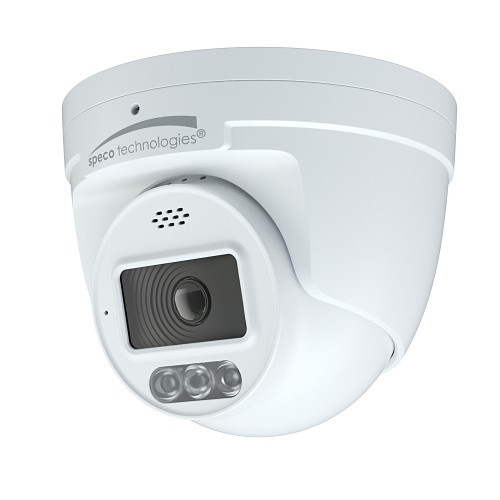
Both the ACTi Z79 and Speco Technologies O4TDD2 are 4MP outdoor turret cameras designed for fixed surveillance deployments. This comparison addresses the decision factors most relevant to integrators and IT buyers: imaging performance (sensor, lens, IR range, WDR), installation and environmental robustness (IP/IK ratings, power options, temperature tolerance), and platform integration (ONVIF compliance, edge analytics, audio, and local storage). Neither unit is PTZ; both target the same resolution class and form factor, making them direct cross-shop candidates.

In This Guide
How do the imaging specs compare?
Both cameras deliver 4MP resolution, but the specs diverge on sensor detail and IR reach. The Speco O4TDD2 specifies a 1/3" CMOS sensor, a maximum resolution of 2592×1520, and a rated IR range of 164 feet (50 m) at 30 fps. The ACTi Z79 does not disclose sensor size or a discrete IR distance figure in the provided specifications; its night-vision capability is listed as IR with Adaptive IR noted, but no range in feet or meters is stated.
On compression, the O4TDD2 supports H.265+, H.264+, and MJPEG — the "+" variants use scene-adaptive bitrate reduction beyond standard H.265/H.264. The Z79 supports H.265 and H.264 (no "+" designation per the provided specs). Both units include WDR; the O4TDD2 labels it "True WDR" while the Z79 lists "WDR" without a dB figure in either spec set. Lens focal length is identical: 2.8 mm fixed, F2.0 on the Z79; the O4TDD2 lists 2.8 mm fixed without an aperture figure.
What about installation and environment?
The ACTi Z79 carries an IP68 ingress rating — the higher of the two — meaning it is rated for continuous submersion beyond 1 meter, in addition to full dust exclusion. It also holds an IK10 impact rating, the maximum on the IEC 62262 scale, indicating resistance to 20-joule impacts. Its metal housing is explicitly noted. The Speco O4TDD2 is rated IP66, which covers powerful water jets and full dust exclusion but does not include submersion protection; no IK impact rating is provided in the supplied specifications.
On power, the Z79 is PoE-only (802.3af, 13 W max), requiring a standard PoE switch or injector. The O4TDD2 accepts either PoE (802.3af, stated as less than 13 W) or DC 12V, giving installers a secondary power path where PoE infrastructure is unavailable. Operating temperature for both cameras spans -40° on the cold end: the Z79 is rated -40°C to 60°C (-40°F to 140°F); the O4TDD2 is rated -40°F to 140°F (equivalent to -40°C to 60°C). Both support wall and ceiling mounting in a turret form factor; the O4TDD2 weight is specified at 1.48 lbs, while no weight figure is provided for the Z79.
Which fits your VMS and analytics better?
The ACTi Z79 declares ONVIF compliance and lists VMS compatibility as ONVIF, with no Profile tier specified in the provided data. The Speco O4TDD2 specifies ONVIF Profile G, which includes on-board recording and edge storage management in addition to live-stream interoperability — a meaningful distinction for VMSes that rely on Profile G for edge recording failover.
On edge analytics, the O4TDD2 provides AI-driven object detection: motion detection, line crossing, intrusion detection, face detection, and vehicle detection — all listed in the supplied specifications. No edge analytics capabilities are listed for the Z79 in the provided specifications. Both cameras include a built-in microphone; the O4TDD2 additionally lists a built-in speaker, enabling two-way audio. The Z79 specifies MicroSD on-board storage; no local storage spec is stated for the O4TDD2 in the provided data. The O4TDD2 carries a stated 3-year warranty; no warranty term is provided for the Z79 in the supplied specifications.
Which should you choose: the Z79 or the O4TDD2?
Our take: The O4TDD2 is the stronger choice when edge analytics, two-way audio, or dual-power flexibility are priorities. It adds AI object classification (line crossing, intrusion, face and vehicle detection) that the Z79 spec sheet does not list, supports both PoE and DC 12V versus the Z79's PoE-only input, and specifies ONVIF Profile G where the Z79 lists ONVIF without a profile tier — relevant for VMSes relying on edge-recording failover. The Z79 is the stronger choice when physical hardening is the primary concern: its IP68 rating exceeds the O4TDD2's IP66 by covering continuous submersion, and its IK10 impact rating (no equivalent listed for the O4TDD2) suits high-vandalism or washdown environments. The Z79 also specifies on-board MicroSD storage, which the O4TDD2 spec does not confirm. Platform selection should weigh analytics requirements and installation power infrastructure against the deployment environment's submersion and impact exposure.
Side-by-Side Comparison
Spec-for-spec, from manufacturer data.
| Specification | ACTi Z79 | Speco Technologies O4TDD2 |
|---|---|---|
| Resolution | 4MP | 4MP (2592×1520) |
| Image Sensor | — | 1/3" CMOS |
| Lens / Focal Length | 2.8mm fixed, F2.0 | 2.8mm fixed |
| IR Range | — | 164 ft (50 m) |
| WDR | WDR | True WDR |
| Max Frame Rate | — | 30 fps |
| Video Compression | H.265, H.264 | H.265+, H.264+, MJPEG |
| IP Rating | IP68 | IP66 |
| IK / Impact Rating | IK10 | — |
| Operating Temperature | -40°C to 60°C | -40°F to 140°F (-40°C to 60°C) |
| Power Input | PoE 802.3af (13W max) | PoE 802.3af (<13W) or DC 12V |
| ONVIF | Yes (no profile tier stated) | ONVIF Profile G |
| Edge Analytics | — | Motion, Line Crossing, Intrusion, Face, Vehicle Detection |
| Audio | Built-in microphone | Microphone + Speaker (two-way) |
| On-Board Storage | MicroSD | — |
| Warranty | — | 3 years |
| Weight | — | 1.48 lbs |
Frequently Asked Questions
Which should you choose: the Z79 or the O4TDD2?
The O4TDD2 is the stronger choice when edge analytics, two-way audio, or dual-power flexibility are priorities. It adds AI object classification (line crossing, intrusion, face and vehicle detection) that the Z79 spec sheet does not list, supports both PoE and DC 12V versus the Z79's PoE-only input, and specifies ONVIF Profile G where the Z79 lists ONVIF without a profile tier — relevant for VMSes relying on edge-recording failover. The Z79 is the stronger choice when physical hardening is the primary concern: its IP68 rating exceeds the O4TDD2's IP66 by covering continuous submersion, and its IK10 impact rating (no equivalent listed for the O4TDD2) suits high-vandalism or washdown environments. The Z79 also specifies on-board MicroSD storage, which the O4TDD2 spec does not confirm. Platform selection should weigh analytics requirements and installation power infrastructure against the deployment environment's submersion and impact exposure.
Is the Z79 or O4TDD2 better for low-light and night vision performance?
The O4TDD2 provides a specified IR range of 164 feet (50 m) and lists a 1/3" CMOS sensor. The Z79 lists IR and Adaptive IR night vision but does not state a rated IR distance or sensor size in the provided specifications, so a direct numerical comparison on those points cannot be made from the available data.
Which camera is more rugged for outdoor or washdown installations?
The Z79 holds an IP68 rating (continuous submersion) and an IK10 impact rating (20-joule strike resistance) in a stated metal housing. The O4TDD2 is rated IP66 (powerful water jets, no submersion) with no IK impact rating listed. For washdown, flooding-risk, or high-vandalism sites, the Z79's ratings are higher on both axes.
Can either camera trigger alerts based on people or vehicles without a separate analytics server?
Yes — the Speco O4TDD2 lists on-camera AI analytics including face detection and vehicle detection in its specifications, enabling edge-side alerting without an external analytics server. The ACTi Z79 specifications provided do not list any on-camera analytics beyond motion; verify with ACTi documentation before assuming equivalent capability.
More IP Camera Comparisons
Get a Second Opinion on Your Camera Choice
Share your site layout, coverage goals, and budget. Our team will validate the camera selection, flag anything we would change, and recommend products that match the use case.