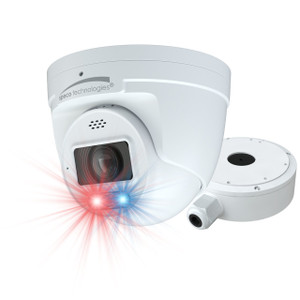
Speco Technologies O4TDD2 4MP AI IP Turret Camera with Digital Deterrent
Overview
The Speco Technologies O4TDD2 is a 4MP fixed turret network camera engineered for outdoor surveillance deployments requiring integrated AI analytics and extended infrared coverage. This wired IP camera combines edge-based object detection with H.265+ video compression and IP66 environmental protection, making it suitable for perimeter monitoring, facility access points, and general outdoor coverage where reliable day/night imaging is required. Built-in digital deterrent functionality adds an active security element beyond passive recording.
Key Features
- 4MP Resolution (2592×1520): Captures enough detail for facial and vehicle recognition at moderate distances—critical for access-point verification and forensic review without requiring high-resolution storage overhead.
- Fixed 2.8mm Lens: Delivers wide-angle field of view optimized for facility perimeter and entrance monitoring. This focal length prioritizes broad situational awareness over magnification, reducing the need for multiple cameras in straightforward coverage areas.
- 164-Foot IR Range with Day/Night: Infrared illumination maintains visibility in complete darkness, eliminating the need for external lighting infrastructure. True Wide Dynamic Range (WDR) processing handles mixed lighting conditions—backlit scenarios or high-contrast zones common in outdoor environments.
- H.265+ Compression: Reduces storage and bandwidth consumption roughly 50% compared to H.264 while maintaining image quality. Significant for multi-camera deployments recording 24/7 on limited network or storage budgets.
- IP66 Rating: Direct rain, snow, and dust won't compromise operation—appropriate for wall-mounted or pole-mounted exposed installations. Skip this model if you need submersion capability (IP67/IP68).
- PoE Power (802.3af): Draws under 13W via standard PoE, eliminating separate power supplies and reducing wiring complexity. Standard switch infrastructure supports deployment without additional electrical work.
- Edge-Based AI Analytics: Motion detection, line crossing (tripwire), intrusion (area violation), face detection, and vehicle detection execute on the camera itself. Reduces bandwidth by triggering recording only on relevant events and eliminates dependence on external analytics servers for basic detection tasks.
- ONVIF Profile G Compliance: Ensures interoperability with ONVIF-compliant VMS platforms and management software—no vendor lock-in or proprietary ecosystem required.
- 30 fps at Full Resolution: Supports smooth motion tracking for analytics and forensic review without frame-rate compromises.
- NDAA Section 889 Compliance: Meets U.S. federal procurement restrictions—mandatory for government agencies, critical infrastructure, and contractors supporting public-sector buyers.
- Multi-Codec Support (H.265+, H.264+, MJPEG): Flexibility to optimize for network conditions and VMS compatibility. H.265+ for efficiency, H.264+ for broad compatibility, MJPEG for simple streaming scenarios.
When This Model Is the Right Choice
Select the O4TDD2 when you need a fixed-lens turret with native AI analytics built into the edge device. Ideal for outdoor installations where PoE power is available and a wide 2.8mm field of view matches your coverage area. The integrated digital deterrent provides active deterrence beyond passive recording. Suitable for perimeter monitoring, access control checkpoints, parking areas, and facility entrances where 4MP resolution and 164-foot IR satisfy facial and vehicle recognition requirements.
When to Choose a Different Model
If your deployment requires variable focal length or zoom capability, evaluate a varifocal turret or PTZ alternative instead. If you need extreme low-light performance beyond infrared reach, consider cameras with larger sensors or specialized low-light optimization. For indoor-only applications in controlled lighting, a lower IP-rated dome may deliver cost savings. If NDAA compliance is not a requirement, non-restricted alternatives may be available at lower price points. If you need submersion protection, specify IP67 or IP68 rated models.
Integration and Compatibility
ONVIF Profile G support ensures the O4TDD2 integrates with Milestone XProtect, Genetec Omnicast, and other ONVIF-compliant VMS platforms without driver or custom integration development. Wired Ethernet (PoE) connectivity provides deterministic network performance without wireless pairing complexity or interference concerns. Stable, predictable performance supports both live monitoring and event-triggered recording workflows.
Frequently Asked Questions
Q: Is the Speco O4TDD2 NDAA Section 889 compliant?
A: Yes. The O4TDD2 meets U.S. federal procurement restrictions, making it suitable for government agencies and critical infrastructure projects.
Q: What is the maximum infrared range on the O4TDD2?
A: The O4TDD2 delivers 164 feet of infrared illumination, supporting visibility in complete darkness without external lighting.
Q: Does the O4TDD2 work with my ONVIF-compliant VMS?
A: Yes. The camera conforms to ONVIF Profile G, ensuring compatibility with standard VMS platforms such as Milestone XProtect, Genetec Omnicast, and others without custom integration.
Q: What compression standards does the O4TDD2 support?
A: The O4TDD2 supports H.265+, H.264+, and MJPEG, all streaming at 30 fps. H.265+ delivers 50% bandwidth savings versus H.264+.
Q: Can the O4TDD2 be used indoors?
A: Yes, though the IP66 rating and infrared range are optimized for outdoor deployment. Indoor use is viable but may not leverage the full environmental durability specification.
Q: What is the power consumption of the O4TDD2?
A: The O4TDD2 draws under 13W via standard 802.3af PoE, eliminating the need for separate power supplies.
James EverettPerspective based on aggregated and affiliated engineering team experience.
The O4TDD2 delivers solid value for fixed outdoor coverage where edge analytics matter and bandwidth conservation is real. The 164-foot IR range paired with WDR processing handles the typical mixed-lighting scenarios you'll encounter at facility perimeters—backlit entry doors, dawn/dusk conditions, vehicle headlight washout. H.265+ compression meaningfully reduces storage costs on multi-camera deployments, particularly valuable when recording 24/7 across a dozen or more cameras on standard storage hardware.
Technical Highlights:
- H.265+ Codec: 50% bandwidth reduction versus H.264+ translates to lower NVR storage overhead and reduced uplink bandwidth on bandwidth-constrained sites—real savings at scale.
- Edge-Based Analytics (Motion, Line Crossing, Intrusion, Face, Vehicle Detection): Executes on the camera itself, reducing reliance on external analytics servers and enabling the digital deterrent to activate on detection without server round-trip latency.
- 164-Foot IR + WDR: Maintains visibility in complete darkness and handles high-contrast outdoor lighting without external illumination infrastructure. True day/night capability simplifies deployment in uncontrolled outdoor environments.
- IP66 + PoE 802.3af: Direct mounting on exposed surfaces without weatherproof enclosures. Sub-13W draw means standard PoE switches handle multiple units without budget strain.
Deployment Considerations:
- Fixed 2.8mm lens—wide angle, no zoom. If you need variable focal length or magnification at distance, this is not the model. Evaluate a varifocal turret instead.
- IP66 protects against rain and dust, but not submersion. If the mounting location could flood or require washdown, specify IP67 or IP68 rated alternatives.
- NDAA compliance is built in—valuable for government and critical infrastructure buyers, but adds no cost if you don't need it. Don't pay for compliance you don't require.
The O4TDD2 is a straightforward fit for outdoor perimeter monitoring, access-point verification, and facility entrance coverage where a wide fixed lens and edge analytics reduce infrastructure complexity and storage overhead. Not a zoom or specialty camera, but reliable for what it is designed to do.