
ACTi Z79 vs Digital Watchdog DWC-VSTB04Bi: Specification Comparison
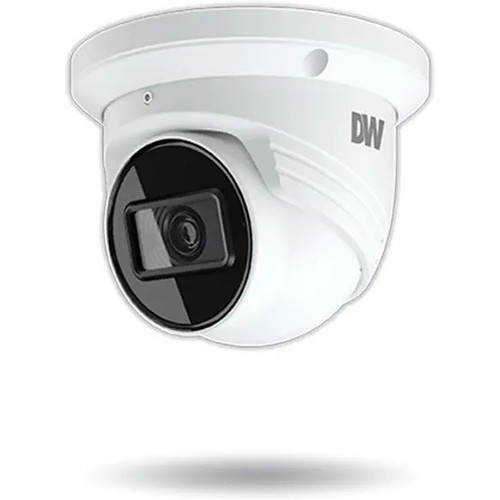
Both the ACTi Z79 and Digital Watchdog DWC-VSTB04Bi are 4MP outdoor turret cameras targeting the same fixed-camera installation market. They share a 2.8mm fixed lens, PoE power, H.265/H.264 compression, ONVIF conformance, and IK10 vandal resistance, making them genuine cross-shop candidates for integrators spec'ing outdoor perimeter or entry-point surveillance. The comparison below draws strictly from the provided specifications for each model.
In This Guide
How do the imaging specs compare?
Both cameras deliver 4MP resolution, but the DWC-VSTB04Bi specifies its pixel array explicitly at 2560×1440 using a 1/3" CMOS sensor, while the Z79 spec sheet does not state sensor size or pixel dimensions. The DWC-VSTB04Bi also calls out a minimum scene illumination of 0.005 lux in color and 0.0 lux in B/W, and its WDR is rated at 120dB True WDR. The Z79 lists WDR support but provides no dB rating. Both cameras use a 2.8mm fixed lens; the DWC-VSTB04Bi specifies a 94° horizontal field of view, while the Z79 lists F2.0 aperture — a figure absent from the DWC-VSTB04Bi spec.
For IR night vision, the DWC-VSTB04Bi specifies a 100-foot Smart IR range with auto day/night switching. The Z79 confirms IR and lists it as Adaptive IR, but no throw distance in feet or meters is provided in its specifications. The DWC-VSTB04Bi adds Smart DNR 3D digital noise reduction, de-fog, and supports multiple network resolutions from 4MP down to CIF at up to 30fps at all resolutions; the Z79 spec sheet does not enumerate supported sub-stream resolutions or a maximum frame rate.
What about installation and environment?
The Z79 carries an IP68 ingress protection rating, meaning it is rated for continuous submersion beyond 1 meter, and an IK10 impact rating in a metal housing. The DWC-VSTB04Bi is rated IP67 (protected against temporary submersion up to 1 meter) and IK10 in an aluminum die-cast housing. Both handle the same IK10 impact threshold, but the Z79's IP68 rating offers a higher water-ingress protection tier for installations exposed to standing water or wash-down environments.
On power, the Z79 draws up to 13W maximum over 802.3af PoE. The DWC-VSTB04Bi draws a maximum of 5W over PoE (802.3af) or DC12V, making it significantly more power-efficient on switch budgets with many ports. Operating temperature for the Z79 is specified as -40°C to 60°C; the DWC-VSTB04Bi is rated -30°C to 60°C, giving the Z79 a 10°C advantage at the cold end for arctic or unheated outdoor enclosures. Both support wall and ceiling mounting in a turret form factor; the DWC-VSTB04Bi provides physical dimensions (108×96mm, 0.46kg), which the Z79 spec sheet does not include.
Which fits your VMS and analytics better?
Both cameras are ONVIF conformant. The DWC-VSTB04Bi additionally supports DW Spectrum IPVMS natively and lists an extensive protocol suite: 802.1x, DDNS, DHCP, FTP, HTTP, HTTPS, ICMP, IGMP, NTP, PPPoE, QoS, RTCP, RTP, RTSP, SMTP, SNMP, UDP, and UPnP. It also ships with on-camera analytics including Line Crossing, Perimeter Intrusion, and Tampering Detection, along with 8 programmable privacy masks. The Z79's spec sheet confirms ONVIF but does not enumerate supported network protocols or on-camera analytics capabilities.
Both cameras include a built-in microphone. The DWC-VSTB04Bi adds one audio output and supports G.711A/U compression, enabling two-way audio configurations; the Z79 lists a built-in mic only with no audio output or compression codec specified. For edge storage, the DWC-VSTB04Bi supports Micro SD/SDHC/SDXC up to 1TB; the Z79 lists MicroSD support with no stated capacity ceiling. The DWC-VSTB04Bi includes a 5-year warranty; no warranty term is provided in the Z79 specifications.
Which should you choose: the Z79 or the DWC-VSTB04Bi?
Our take: The DWC-VSTB04Bi is the stronger choice when analytics, power efficiency, and a defined long-term warranty are priorities. Its on-camera Line Crossing, Perimeter Intrusion, and Tampering Detection analytics are specified; the Z79 lists none. Its maximum PoE draw is 5W versus the Z79's 13W, a meaningful difference on dense switch deployments. Its 120dB True WDR rating and 0.005 lux color sensitivity are explicit; the Z79 provides no dB figure or lux number. Conversely, the Z79 holds an advantage where extreme cold or water exposure is a factor: its IP68 rating exceeds the DWC-VSTB04Bi's IP67, and its -40°C cold-temperature floor is 10°C lower. Choose the Z79 for freeze-prone or submersion-risk sites; choose the DWC-VSTB04Bi for analytics-driven perimeter monitoring, power-constrained switch infrastructure, or installations requiring native DW Spectrum integration.
Side-by-Side Comparison
Spec-for-spec, from manufacturer data.
| Specification | ACTi Z79 | Digital Watchdog DWC-VSTB04Bi |
|---|---|---|
| Resolution | 4MP | 4MP (2560 × 1440) |
| Image Sensor | — | 1/3" CMOS |
| Lens / Focal Length | 2.8mm fixed, F2.0 | 2.8mm fixed |
| Horizontal FOV | — | 94° |
| Min. Illumination | — | 0.005 lux (color) / 0.0 lux (B/W) |
| IR Range | — | 100 ft (30 m) Smart IR |
| WDR | WDR (no dB rating specified) | True WDR 120dB |
| Max Frame Rate | — | 30fps at all resolutions |
| Video Compression | H.265, H.264 | H.265, H.264, MJPEG |
| IP Rating | IP68 | IP67 |
| IK / Impact Rating | IK10 | IK10 |
| Operating Temperature | -40°C to 60°C | -30°C to 60°C |
| Power Input / Max Draw | PoE 802.3af, 13W max | PoE 802.3af or DC12V, 5W max |
| Edge Storage | MicroSD (no max stated) | MicroSD/SDHC/SDXC up to 1TB |
| Audio | Built-in mic (no output specified) | Built-in mic + 1 audio in + 1 audio out, G.711A/U |
| On-Camera Analytics | — | Line Crossing, Perimeter Intrusion, Tampering Detection |
| ONVIF | Yes | Yes |
| Warranty | — | 5 years |
| Weight | — | 1.01 lbs (0.46 kg) |
| Housing Material | Metal | Aluminum die-casting |
Frequently Asked Questions
Which should you choose: the Z79 or the DWC-VSTB04Bi?
The DWC-VSTB04Bi is the stronger choice when analytics, power efficiency, and a defined long-term warranty are priorities. Its on-camera Line Crossing, Perimeter Intrusion, and Tampering Detection analytics are specified; the Z79 lists none. Its maximum PoE draw is 5W versus the Z79's 13W, a meaningful difference on dense switch deployments. Its 120dB True WDR rating and 0.005 lux color sensitivity are explicit; the Z79 provides no dB figure or lux number. Conversely, the Z79 holds an advantage where extreme cold or water exposure is a factor: its IP68 rating exceeds the DWC-VSTB04Bi's IP67, and its -40°C cold-temperature floor is 10°C lower. Choose the Z79 for freeze-prone or submersion-risk sites; choose the DWC-VSTB04Bi for analytics-driven perimeter monitoring, power-constrained switch infrastructure, or installations requiring native DW Spectrum integration.
Is the Z79 or DWC-VSTB04Bi better for low-light performance?
Based on provided specs, the DWC-VSTB04Bi specifies 0.005 lux in color and 0.0 lux in B/W with a 100-foot Smart IR range. The Z79 confirms IR and Adaptive IR support but provides no lux rating or IR throw distance in its specifications, so a direct low-light comparison cannot be made from the data available.
Which camera holds up better in harsh outdoor environments?
Both are IK10-rated. For water ingress, the Z79's IP68 rating (continuous submersion) exceeds the DWC-VSTB04Bi's IP67 (temporary submersion). For cold climates, the Z79 is rated to -40°C versus the DWC-VSTB04Bi's -30°C floor. The DWC-VSTB04Bi's aluminum die-cast housing is specified; the Z79's housing material is listed as metal.
Does either camera support on-board analytics without a separate VMS license?
Yes — the DWC-VSTB04Bi specifies on-camera Line Crossing, Perimeter Intrusion, and Tampering Detection analytics. The Z79 specification does not list any on-camera analytics capabilities, so edge-based detection without VMS processing is only confirmed for the DWC-VSTB04Bi.
More IP Camera Comparisons
Get a Second Opinion on Your Camera Choice
Share your site layout, coverage goals, and budget. Our team will validate the camera selection, flag anything we would change, and recommend products that match the use case.