
ACTi E44A vs ACTi Z316: Specification Comparison
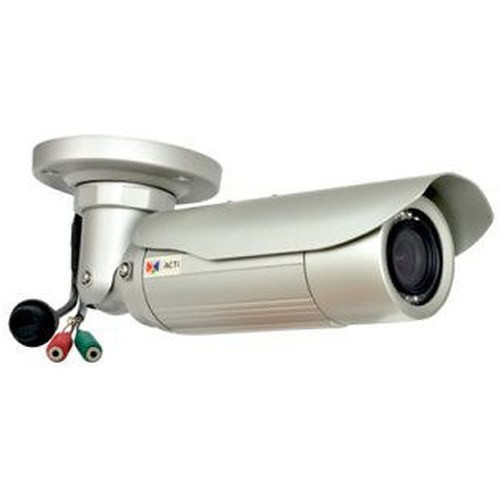
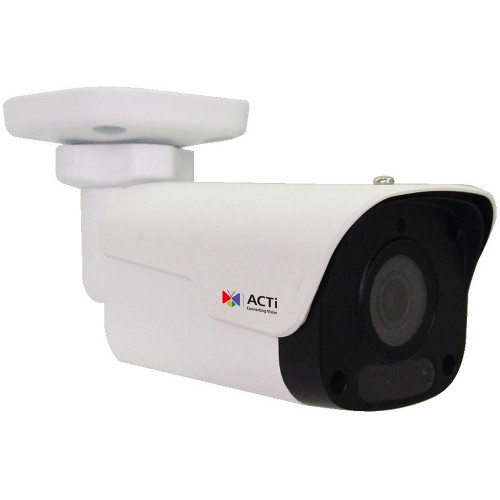
Both the ACTi E44A and ACTi Z316 are 2MP fixed bullet cameras targeting perimeter and general surveillance applications. The E44A is a full-size IR bullet with a vari-focal lens and Day/Night mechanical filter, while the Z316 is a compact mini bullet with a fixed 2.8mm lens, IP68-rated housing, and onboard audio and storage. This comparison helps installers and IT buyers decide which unit better fits their imaging, environmental, and integration requirements.
In This Guide
How do the imaging specs compare?
Both cameras deliver 2MP resolution. The E44A uses a vari-focal lens, allowing post-install focal-length adjustment, and its sensor supports facial identification at 8–15 ft and license-plate capture at up to 25 ft per the product card. Day/Night switching is achieved via a mechanical IR-cut filter. WDR is listed as 'Basic WDR' in the spec sheet, though the field tag also lists 'WDR' without a dB value provided for either model.
The Z316 uses a fixed 2.8mm f/2.0 lens with a horizontal field of view of 108.6°, delivering a wide-angle perspective suited to corridor or entry coverage. It is rated at 30 fps maximum frame rate; no frame-rate figure is specified for the E44A. The Z316's IR is listed as 'Adaptive IR,' implying automatic intensity adjustment to prevent overexposure at close range; the E44A's IR spec is listed without an adaptive qualifier. Neither product's minimum illumination value is provided in the supplied specifications.
What about installation and environment?
The Z316 carries an IP68 ingress-protection rating, meaning it is rated for continuous submersion beyond the depth and duration required for IP67, making it suitable for washdown or flood-prone exterior locations. The E44A has no IP rating listed in the provided specifications, so its suitability for wet or outdoor environments cannot be confirmed from the data supplied. Neither model includes an IK impact rating, operating temperature range, or dimensional data in the provided specs.
Power delivery differs: the Z316 is explicitly specified for PoE 802.3af at under 13W, compatible with standard switch ports without requiring high-power PoE. The E44A lists no PoE class, power input, or wattage in the provided specifications. The E44A supports Wall and Soffit mounting; the Z316's mounting options are not listed in the provided specifications. The E44A is listed as compatible with 'general' environments; the Z316 is listed as compatible with 'spaces.'
Which fits your VMS and analytics better?
The E44A explicitly lists ONVIF compliance, which simplifies integration with third-party VMS platforms that support the ONVIF profile standard. The Z316 does not list ONVIF compliance in the provided specifications; its VMS compatibility cannot be confirmed from the supplied data. Neither camera lists edge analytics capabilities in the provided specifications.
The Z316 includes a built-in microphone for on-camera audio capture and supports MicroSD on-board storage, providing local recording without NVR dependency. The E44A lists neither audio input/output nor edge storage in the provided specifications. The Z316 also supports H.265 and H.264 compression codecs, which are not listed for the E44A. These differences may meaningfully affect deployment architecture, bandwidth planning, and site-level redundancy.
Which should you choose: the E44A or the Z316?
Our take: The Z316 is the stronger choice when environmental resilience, bandwidth efficiency, and infrastructure simplicity are the primary concerns: its IP68 rating confirms suitability for submersion-risk or high-washdown locations where the E44A's unspecified ingress protection leaves risk unquantified, its 802.3af draw under 13W integrates without high-power PoE switches, and H.265 compression reduces storage and bandwidth overhead versus the E44A's unlisted codec. The E44A is the stronger choice when VMS interoperability is non-negotiable and a wide range of NVR platforms must be supported, given its explicit ONVIF compliance, and when scene framing must be set precisely after physical installation using its vari-focal lens. Buyers should note that neither camera's minimum illumination, operating temperature, nor IR range is specified in the supplied data, so low-light performance comparisons cannot be made from specification alone.
Side-by-Side Comparison
Spec-for-spec, from manufacturer data.
| Specification | ACTi E44A | ACTi Z316 |
|---|---|---|
| Resolution | 2 MP | 2 MP |
| Form Factor | Bullet | Bullet (Mini) |
| Lens Type | Vari-focal | Fixed 2.8mm f/2.0 |
| Horizontal FOV | — | 108.6° |
| Max Frame Rate | — | 30 fps |
| Video Compression | — | H.265; H.264 |
| WDR | Basic WDR | WDR |
| IR / Low-Light | IR; Day/Night (mechanical ICR) | Adaptive IR |
| IP Rating | — | IP68 |
| Power Input | — | PoE 802.3af |
| PoE Wattage | — | Under 13W |
| VMS Compatibility | ONVIF | — |
| Audio | — | Built-in microphone |
| Edge Storage | — | MicroSD |
| Mounting | Wall; Soffit | — |
Frequently Asked Questions
Which should you choose: the E44A or the Z316?
The Z316 is the stronger choice when environmental resilience, bandwidth efficiency, and infrastructure simplicity are the primary concerns: its IP68 rating confirms suitability for submersion-risk or high-washdown locations where the E44A's unspecified ingress protection leaves risk unquantified, its 802.3af draw under 13W integrates without high-power PoE switches, and H.265 compression reduces storage and bandwidth overhead versus the E44A's unlisted codec. The E44A is the stronger choice when VMS interoperability is non-negotiable and a wide range of NVR platforms must be supported, given its explicit ONVIF compliance, and when scene framing must be set precisely after physical installation using its vari-focal lens. Buyers should note that neither camera's minimum illumination, operating temperature, nor IR range is specified in the supplied data, so low-light performance comparisons cannot be made from specification alone.
Is the E44A or Z316 better for outdoor or wet environments?
Based on the provided specifications, the Z316 is the documented choice for wet or harsh outdoor environments due to its IP68 rating. The E44A has no IP rating listed in the supplied specs, so its weatherproofing cannot be confirmed from the available data.
Which camera works with more VMS platforms?
The E44A lists explicit ONVIF compliance, which is a widely adopted interoperability standard across VMS vendors. The Z316 does not list ONVIF compliance in the provided specifications, so compatibility with third-party VMS platforms cannot be confirmed without consulting the manufacturer's documentation directly.
Can the Z316 record locally without an NVR?
Yes, per the provided specifications the Z316 supports MicroSD on-board storage, enabling local recording independent of a network recorder. The E44A does not list any edge storage capability in the supplied specifications.
Get a Second Opinion on Your Camera Choice
Share your site layout, coverage goals, and budget. Our team will validate the camera selection, flag anything we would change, and recommend products that match the use case.