
ACTi B415 vs ACTi Z316: Specification Comparison
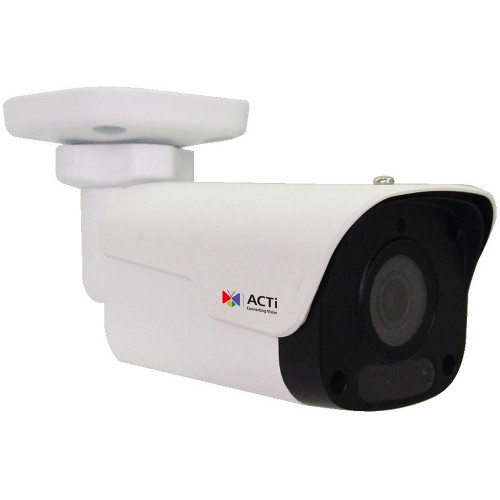
Both the ACTi B415 and ACTi Z316 are 2MP bullet cameras from the same manufacturer, but they serve markedly different deployment profiles. The B415 is a full-size zoom bullet with a 20x optical zoom lens, designed for wide-area perimeter surveillance. The Z316 is a compact mini bullet with a fixed wide-angle lens, suited to close-range or space-constrained installs. This comparison examines imaging capability, installation requirements, and integration features to help integrators and IT buyers determine which unit fits their project.

In This Guide
How do the imaging specs compare?
The B415 delivers 2MP resolution at up to 1944×1224 and offers a varifocal 4.7–94mm (20× optical zoom) f/1.6–f/3.5 DC iris lens, enabling the camera to cover long distances or wide scenes from a single fixed mount. Its minimum illumination is rated at 0.05 lux in color mode and 0 lux with IR active, supported by a 27-LED 850nm IR array with a stated range of 40m. The WDR performance is specified as Extreme WDR at 145dB. Maximum frame rate reaches 60 fps at 1080p and 720p, with 30 fps at lower resolutions. Sensor size is 1/2.8".
The Z316 also resolves at 2MP but is equipped with a fixed 2.8mm f/2.0 lens, delivering a wide horizontal field of view (stated as 108.6°) appropriate for close- to medium-range scenes. Maximum frame rate is 30 fps. The Z316's IR is described only as 'Adaptive IR' with no rated range, no lux figure, and no LED count provided in the available specifications. WDR is listed generically as 'WDR' with no dB rating given. The imaging gap between the two units is substantial: the B415 provides a quantified 145dB WDR, a known 40m IR range, and 60 fps capability at full HD; the Z316 lacks equivalent published figures for those parameters.
What about installation and environment?
The B415 carries IP67 and IK10 ratings along with NEMA 4X certification, protecting against dust ingress, temporary immersion, and sustained high-impact mechanical abuse—a meaningful combination for exposed perimeter or industrial sites. It is certified by CE, FCC, and UL (for optional PoE injector and power adapter). Operating temperature spans -40°C to 50°C (-40°F to 122°F), covering arctic-cold through hot climates. Power is supplied via PoE+ (802.3at Class 3) or DC 12V over a single RJ-45 pigtail connector; no IK rating note applies to the connector. Weight is approximately 2,169g (4.78 lb), reflecting the ruggedized metal housing and integrated zoom mechanism. Mounting is via pole or rack accessories.
The Z316 holds an IP68 rating—specifying protection against continuous submersion beyond the IP67 standard—making it the stronger choice for installations where standing water or washdown conditions are a factor. No IK impact rating is provided for the Z316. Power draw is PoE 802.3af at under 13W, compatible with standard PoE switch budgets without requiring PoE+ ports. Operating temperature range is not specified in the available data for the Z316. The mini bullet form factor implies a smaller, lighter footprint than the B415, though exact dimensions and weight are not published in the provided specifications. No NEMA rating is listed for the Z316.
Which fits your VMS and analytics better?
The B415 explicitly supports ONVIF Profile S, Profile G, and Profile Q, and additionally lists compatibility with Visca, Pelco-D, and Pelco-P PTZ command protocols—enabling pan/tilt/zoom control via those legacy protocol stacks. On-board analytics include VMD (video motion detection) and People Counting. Two-way audio is supported with line-in and line-out connections. Video compression covers H.264 (Baseline, Main, High profiles) and MJPEG; H.265 is not listed in the provided specifications for the B415. No on-board edge storage (SD card slot) is mentioned in the B415's specifications.
The Z316 supports H.265 and H.264 compression, offering the bandwidth and storage efficiency advantage of H.265 that the B415 does not list. The Z316 includes a built-in microphone for one-way audio capture; no line-out or two-way audio is specified. On-board MicroSD storage is explicitly noted for the Z316, providing local recording redundancy. However, ONVIF profile compliance, specific VMS compatibility, edge analytics capabilities, and PTZ protocol support are not stated in the available Z316 specifications, leaving those integration parameters unconfirmed.
Which should you choose: the B415 or the Z316?
Our take: The B415 is the stronger choice when the deployment requires long-range identification, verified ruggedness, or granular VMS integration. Its 20× optical zoom (4.7–94mm) versus the Z316's fixed 2.8mm lens is a fundamental optical difference: the B415 can cover distances the Z316 cannot. The B415 also provides a quantified 145dB Extreme WDR and a 40m IR range, whereas the Z316 lists no WDR dB figure and no IR distance. The B415's ONVIF Profile S/G/Q plus Visca/Pelco-D/Pelco-P support offers broader confirmed VMS and PTZ controller compatibility. Conversely, the Z316's IP68 rating exceeds the B415's IP67 for submersion-prone environments, its PoE 802.3af draw under 13W avoids requiring PoE+ infrastructure, and its H.265 compression and on-board MicroSD storage are capabilities the B415 does not list. Specify the B415 for perimeter and long-range fixed-mount surveillance; consider the Z316 for space-constrained, submersion-risk, or bandwidth-sensitive deployments where zoom is not required.
Side-by-Side Comparison
Spec-for-spec, from manufacturer data.
| Specification | ACTi B415 | ACTi Z316 |
|---|---|---|
| Resolution | 2MP (1944×1224) | 2MP |
| Image Sensor Size | 1/2.8" | Not specified |
| Lens / Focal Length | 4.7–94mm (20× optical zoom); f/1.6–f/3.5 DC iris | 2.8mm fixed; f/2.0 |
| Horizontal FOV | Not specified | 108.6° |
| Min Illumination | 0.05 lux (color); 0 lux (IR on) | Not specified |
| IR Range | 40m | Not specified |
| WDR | Extreme WDR (145dB) | WDR (dB not specified) |
| Max Frame Rate | 60 fps @ 1080p / 720p; 30 fps @ 480p / 240p | 30 fps |
| Video Compression | H.264 (Baseline/Main/High); MJPEG | H.265; H.264 |
| IP Rating | IP67 | IP68 |
| IK / Impact Rating | IK10 | Not specified |
| NEMA Rating | NEMA 4X | Not specified |
| Operating Temperature | -40°C to 50°C (-40°F to 122°F) | Not specified |
| Power Input / PoE Class | PoE+ (802.3at Class 3); DC 12V | PoE (802.3af); under 13W |
| Edge Storage | — | MicroSD |
| Audio | Two-way; line-in, line-out | Built-in microphone (one-way) |
| ONVIF Profiles | Profile S, G, Q | Not specified |
| PTZ Protocol Support | Visca; Pelco-D; Pelco-P | Not specified |
| Edge Analytics | VMD; People Counting | Not specified |
| Weight | 2169g (4.78 lb) | Not specified |
| Certifications | CE; FCC; IP67; IK10; NEMA 4X; UL (optional accessories) | Not specified |
Frequently Asked Questions
Which should you choose: the B415 or the Z316?
The B415 is the stronger choice when the deployment requires long-range identification, verified ruggedness, or granular VMS integration. Its 20× optical zoom (4.7–94mm) versus the Z316's fixed 2.8mm lens is a fundamental optical difference: the B415 can cover distances the Z316 cannot. The B415 also provides a quantified 145dB Extreme WDR and a 40m IR range, whereas the Z316 lists no WDR dB figure and no IR distance. The B415's ONVIF Profile S/G/Q plus Visca/Pelco-D/Pelco-P support offers broader confirmed VMS and PTZ controller compatibility. Conversely, the Z316's IP68 rating exceeds the B415's IP67 for submersion-prone environments, its PoE 802.3af draw under 13W avoids requiring PoE+ infrastructure, and its H.265 compression and on-board MicroSD storage are capabilities the B415 does not list. Specify the B415 for perimeter and long-range fixed-mount surveillance; consider the Z316 for space-constrained, submersion-risk, or bandwidth-sensitive deployments where zoom is not required.
Is the B415 or Z316 better for low-light performance?
Based on available specifications, the B415 has a published minimum illumination of 0.05 lux in color mode and 0 lux with IR active, backed by a 27-LED 850nm array with a stated 40m range. The Z316 lists only 'Adaptive IR' with no lux rating or IR range provided in its specifications. The B415's low-light performance is therefore documentable; the Z316's cannot be confirmed from published data.
Can the Z316 be used in areas that may flood or get hosed down?
The Z316 carries an IP68 rating, which covers continuous submersion and is more stringent than the B415's IP67 (temporary immersion). For washdown or flood-risk environments, the Z316's IP68 rating is the better-documented choice. Note that no IK impact resistance rating is published for the Z316, whereas the B415 is IK10-rated.
Which camera works with more VMS platforms?
The B415 explicitly lists ONVIF Profile S, G, and Q compliance plus Visca, Pelco-D, and Pelco-P protocol support—giving confirmed compatibility across a wide range of VMS and PTZ controller platforms. The Z316's ONVIF profile compliance and VMS compatibility are not stated in the available specifications, so integrators should verify Z316 VMS support directly with ACTi or the VMS vendor before specifying it.
Get a Second Opinion on Your Camera Choice
Share your site layout, coverage goals, and budget. Our team will validate the camera selection, flag anything we would change, and recommend products that match the use case.