
ACTi A83 vs ACTi E58: Specification Comparison
Both the ACTi A83 and ACTi E58 are 2MP dome cameras sharing the same resolution class, but they target fundamentally different deployment scenarios. The A83 is a motorized-zoom outdoor dome rated for harsh environments, while the E58 is a fixed indoor dome designed for standard interior installations. This comparison covers imaging capability, environmental and installation requirements, and integration features to help installers and IT buyers determine which unit fits a given site.
In This Guide
How do the imaging specs compare?
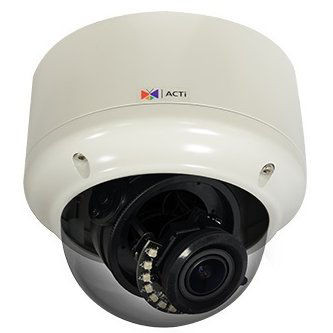
The A83 uses a 1/2.8" sensor with a 2.8–12mm motorized varifocal lens (approximately 4.3× optical zoom), achieving a minimum illumination of 0.002 lux in color and 0.001 lux in B/W at F1.4, dropping to 0 lux with its 12-element 850nm IR array active at up to 30m working distance. It delivers 142dB Extreme WDR and a maximum frame rate of 30 fps at 1920×1080. The E58 is spec'd at 2MP (1920×1080) with IR and Day/Night switching, but its sensor size, lens focal length, minimum illumination figure, IR range, and WDR dB value are not provided in the available specifications.
In practice, the A83's published low-light floor (0.002 lux color) and 30m IR range give installers concrete numbers for scene-sizing and lighting design. The E58's IR capability is confirmed only as present; no quantified illumination threshold or IR distance is available, so direct low-light comparison cannot be made from the provided specs. The A83's 142dB Extreme WDR is a specified figure; the E58's WDR is listed simply as 'WDR' with no dB value stated.
What about installation and environment?
The A83 carries IP66, IK10, and NEMA 4X ratings and is rated for –40°C to 50°C (–40°F to 122°F), making it suitable for outdoor perimeter use in extreme cold, precipitation, and vandal-risk locations. It draws up to 13W and is powered by PoE+ (802.3at, Class 3) or DC 12V. Mount options include wall, pole, pendant, corner, and rack. It ships with a 2m tail cable terminating in RJ-45.
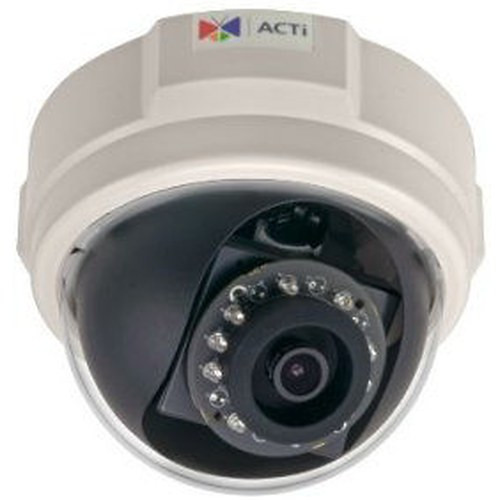
The E58 is an indoor dome with ceiling and surface mount options. No IP rating, IK rating, or operating temperature range is listed in the provided specifications, consistent with an indoor-only classification. It is powered by standard PoE (802.3af), which draws less than the 15.4W ceiling of 802.3af — compatible with a wider range of existing PoE switches without requiring 802.3at budget. No weight or physical dimension data is provided for the E58 in the available specs.
Which fits your VMS and analytics better?
The A83 supports ONVIF Profile S, G, T, and Q, as well as Pelco-D and Pelco-P serial protocols, broadening compatibility with legacy analog-hybrid VMS platforms. It includes on-board edge analytics (VMD and People Counting) and two-way audio (mic-in, line-in, line-out). Pan/tilt/rotation adjustment ranges are specified (Pan ±135°, Tilt 0–90°, Rotation ±90°) for physical repositioning. The A83's warranty is documented at 3 years.
The E58 is confirmed for ONVIF Profile S only; Profiles G, T, and Q are not listed. No edge analytics, audio capability, or on-board storage specification is present in the provided E58 data. No warranty term is stated for the E58 in the available specs. Buyers requiring People Counting, two-way audio, or broader ONVIF profile coverage will find those features absent or unconfirmed on the E58 based on the data provided.
Which should you choose: the A83 or the E58?
Our take: The A83 is the stronger choice when outdoor coverage, extreme environmental resilience, or advanced integration features are required. Three concrete spec deltas support this: first, the A83 is rated IP66/IK10/NEMA 4X with a –40°C to 50°C operating range, while the E58 carries no published IP, IK, or temperature rating; second, the A83 specifies a 2.8–12mm motorized lens with 30m IR range and 0.002 lux minimum illumination, versus no lens, IR distance, or illumination figure available for the E58; third, the A83 supports ONVIF Profiles S, G, T, and Q plus Pelco-D/P, People Counting, and two-way audio, while the E58 confirms only ONVIF Profile S with no analytics or audio listed. The E58 may suit straightforward indoor deployments where 802.3af switch compatibility is a priority and environmental hardening is unnecessary, but its spec sheet is materially incomplete for side-by-side evaluation.
Side-by-Side Comparison
Spec-for-spec, from manufacturer data.
| Specification | ACTi A83 | ACTi E58 |
|---|---|---|
| Resolution | 2MP (1920×1080) | 2MP (1920×1080) |
| Image Sensor | 1/2.8" | — |
| Lens / Focal Length | 2.8–12mm motorized (approx. 4.3× optical zoom) | — |
| Min Illumination | Color: 0.002 lux @ F1.4; B/W: 0.001 lux @ F1.4; 0 lux (IR on) | — |
| IR Range | 30m | — |
| IR Wavelength | 850nm | — |
| WDR | Extreme WDR (142 dB) | WDR (dB value not specified) |
| Max Frame Rate | 30 fps @ 1920×1080 | — |
| Video Compression | H.265; H.264; MJPEG | H.265; H.264; MJPEG |
| IP Rating | IP66 | — |
| IK / Impact Rating | IK10 | — |
| NEMA Rating | NEMA 4X | — |
| Operating Temperature | –40°C to 50°C (–40°F to 122°F) | — |
| Power Input / PoE Class | PoE+ 802.3at Class 3; DC 12V; 13W max | PoE 802.3af |
| Mount Options | Wall; Pole; Pendant; Corner; Rack | Ceiling; Surface |
| Application Environment | Outdoor | Indoor |
| ONVIF Profiles | Profile S, G, T, Q | Profile S |
| Additional Protocols | Pelco-D; Pelco-P | — |
| Edge Analytics | VMD; People Counting | — |
| Audio | Two-way (Mic-in, Line-in, Line-out) | — |
| Weight | 877.5g (1.935 lb) | — |
| Warranty | 3 Years | — |
Frequently Asked Questions
Which should you choose: the A83 or the E58?
The A83 is the stronger choice when outdoor coverage, extreme environmental resilience, or advanced integration features are required. Three concrete spec deltas support this: first, the A83 is rated IP66/IK10/NEMA 4X with a –40°C to 50°C operating range, while the E58 carries no published IP, IK, or temperature rating; second, the A83 specifies a 2.8–12mm motorized lens with 30m IR range and 0.002 lux minimum illumination, versus no lens, IR distance, or illumination figure available for the E58; third, the A83 supports ONVIF Profiles S, G, T, and Q plus Pelco-D/P, People Counting, and two-way audio, while the E58 confirms only ONVIF Profile S with no analytics or audio listed. The E58 may suit straightforward indoor deployments where 802.3af switch compatibility is a priority and environmental hardening is unnecessary, but its spec sheet is materially incomplete for side-by-side evaluation.
Is the A83 or E58 better for low-light and night surveillance?
Based on available specs, the A83 is the only model with quantified low-light performance: 0.002 lux (color) and 0.001 lux (B/W) at F1.4, with 12 IR LEDs at 850nm and a 30m working distance. The E58 lists IR and Day/Night capability but provides no minimum illumination figure or IR range in the available specifications, so a direct comparison cannot be made from the data provided.
Can the E58 be used outdoors?
No IP rating, IK rating, or operating temperature range is listed for the E58 in the available specifications. It is classified as an indoor dome. The A83, by contrast, is rated IP66, IK10, and NEMA 4X with a –40°C to 50°C range, making it the appropriate choice for any outdoor or harsh-environment installation.
Does the A83 or E58 work with more VMS platforms?
The A83 supports ONVIF Profiles S, G, T, and Q, plus Pelco-D and Pelco-P serial protocols, covering a broad range of modern and legacy VMS platforms. The E58 is confirmed for ONVIF Profile S only. If your VMS relies on Profile G (edge recording), Profile T (H.265/metadata), or Pelco serial control, the A83 is the compatible choice based on the specs provided.
Get a Second Opinion on Your Camera Choice
Share your site layout, coverage goals, and budget. Our team will validate the camera selection, flag anything we would change, and recommend products that match the use case.