
ACTi A818 vs Hanwha XND-8083RV: Specification Comparison
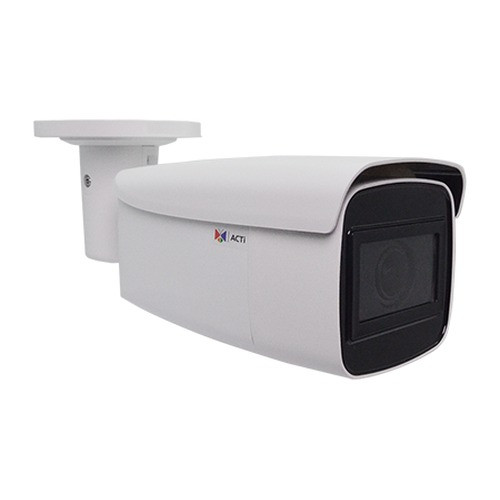
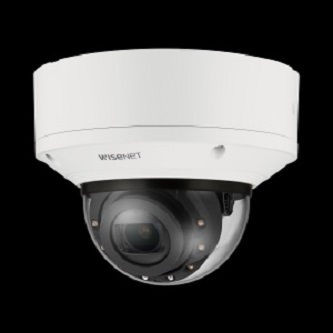
Both the ACTi A818 and Hanwha XND-8083RV are 6MP fixed dome network cameras aimed at installers seeking varifocal optics, IR night vision, and H.265 compression in a vandal-resistant housing. The A818 targets outdoor harsh-environment deployments with a 5x optical zoom range, while the XND-8083RV is rated for indoor use with a 2.1x motorized varifocal lens and an AI-driven analytics engine. This comparison evaluates imaging performance, installation requirements, and system integration against the published specifications for each model.
In This Guide
How do the imaging specs compare?
Both cameras deliver 6MP resolution at 30fps with H.265/H.264/MJPEG compression. The ACTi A818 uses a 1/2.7-inch sensor and a 2.7–13.5mm lens providing 5x optical zoom, with a minimum illumination of 0.01 lux (color) and 0 lux with its 850nm IR LEDs active at a specified throw range of 85m. The Hanwha XND-8083RV uses a larger 1/1.8-inch progressive CMOS sensor and a 4.4–9.3mm motorized varifocal lens offering 2.1x zoom, with minimum illumination of 0.04 lux (color) and 0 lux with IR on, and an IR viewable length of 50m. The larger sensor on the XND-8083RV typically yields better low-light signal quality per pixel, while the A818's longer zoom range and greater IR throw distance give it a reach advantage.
WDR figures differ materially: the A818 is spec'd at 150dB Extreme WDR, while the XND-8083RV is spec'd at 120dB extremeWDR. The A818 also lists BLC, while the XND-8083RV adds HLC and SSDR alongside BLC and WDR. The XND-8083RV includes a built-in gyro sensor for digital image stabilization and AI-based WiseNR II noise reduction, neither of which is listed in the A818 spec sheet. For DORI metrics, the XND-8083RV provides explicit detection/observe/recognize/identify distances (e.g., tele detect 151.3m, tele identify 15.1m); the A818 spec sheet does not publish DORI figures. Max aperture on the XND-8083RV is F1.3 wide, not specified for the A818.
What about installation and environment?
The ACTi A818 is rated IP68 and NEMA 4X for full submersion protection, IK10 for impact resistance, and carries CE, FCC, EAC, BIS, and Taiwan IoT Cybersecurity Level 1 certifications. Its operating temperature range is −30°C to +60°C, making it suitable for extreme outdoor environments. Mounting options listed include wall, pole, corner, and rack. It weighs 1,046g and connects via a 2m cable with RJ-45 pigtail. Power draw is 13W max via PoE+ (802.3at) Class 3 or DC 12V.
The Hanwha XND-8083RV is rated IP52 (splash-resistant, not submersion-rated) and IK10. It is designated for indoor application. Its operating temperature range is −25°C to +50°C, narrower at both ends compared to the A818. Power input is PoE+ (802.3at) Class 4 with a maximum draw of 22.5W, or DC 12V. The unit weighs 1,600g and measures Ø160×125mm. It includes a Micro USB port and CVBS output for installation alignment. The XND-8083RV also specifies 4GB RAM and 512MB Flash on-board, unspecified on the A818.
Which fits your VMS and analytics better?
Both cameras support ONVIF compliance. The A818 is compliant with ONVIF Profile S, G, T, and M. The XND-8083RV supports ONVIF Profile S, G, and T, plus SUNAPI (HTTP API) and the Wisenet open platform. Network protocol depth is substantially greater on the XND-8083RV, which lists IPv4/IPv6, RTSP, RTCP, RTP, SNMP v1/v2c/v3, LLDP, SRTP, 802.1X (EAP-TLS, EAP-LEAP, EAP-PEAP), and TPM 2.0 (FIPS 140-2 level 2) hardware security. The A818 spec sheet does not enumerate protocol or cybersecurity detail beyond Taiwan IoT Cybersecurity Level 1 certification and ONVIF profiles. The XND-8083RV supports up to 10 streaming profiles and 3 virtual channels; unicast up to 20 users and multicast are listed. Comparable network streaming detail is not published for the A818.
On analytics, the A818 lists VMD, People Counting, Smoke Detection, Face Detection, and Tampering Detection. The XND-8083RV's AI engine covers object detection (person, face, vehicle classes including car/bus/truck/motorcycle/bicycle, and license plate), IVA (virtual line, area, enter/exit, loitering, direction, appear/disappear, intrusion), defocus detection, plus business intelligence functions: people counting, queue management, and heatmap. Audio on the A818 includes mic-in, line-in, and line-out (2-way). The XND-8083RV provides selectable mic-in/line-in/built-in mic plus line out. Edge storage on the XND-8083RV supports two Micro SD/SDHC/SDXC slots up to 1TB (512GB × 2); the A818 spec sheet does not list any on-board SD storage capability.
Which should you choose: the A818 or the XND-8083RV?
Our take: The A818 is the stronger choice when the deployment demands outdoor durability and maximum optical reach: its IP68/NEMA 4X rating withstands submersion versus the XND-8083RV's indoor-grade IP52, its operating range extends to −30°C versus −25°C, its 5x zoom (2.7–13.5mm) spans nearly twice the focal length of the XND-8083RV's 2.1x (4.4–9.3mm), and its 85m IR throw exceeds the XND-8083RV's 50m. Conversely, the XND-8083RV is the stronger choice for indoor environments where deep AI analytics, network security posture, and edge storage matter: its larger 1/1.8-inch sensor, AI-based object/vehicle/license-plate detection, IVA suite, dual SD card slots (up to 1TB), TPM 2.0/FIPS 140-2 level 2 hardware security, and richer protocol stack (SNMPv3, 802.1X, SRTP) offer capabilities not listed in the A818 spec sheet. Choose the A818 for outdoor harsh-environment zoom coverage; choose the XND-8083RV for indoor AI-driven analytics on Wisenet or ONVIF-S/G/T VMS platforms.
Side-by-Side Comparison
Spec-for-spec, from manufacturer data.
| Specification | ACTi A818 | Hanwha XND-8083RV |
|---|---|---|
| Resolution | 6MP (2592×1944 max) | 6MP (3328×1872) |
| Image Sensor | 1/2.7 inch | 1/1.8" progressive CMOS |
| Lens / Focal Length | 2.7–13.5mm (5x optical zoom) | 4.4–9.3mm motorized varifocal (2.1x) |
| Max Frame Rate | 30fps @ 1920×1080; 25fps @ 2688×1520; 20fps @ 2592×1944 | 30fps |
| Min Illumination | 0.01 lux (color); 0 lux (IR on) | 0.04 lux (color); 0 lux (IR on) |
| IR Range | 85m @ 1.0 lux (850nm) | 50m (WiseIR) |
| WDR | 150dB Extreme WDR | 120dB extremeWDR |
| Video Compression | H.265; H.264; MJPEG | H.265/H.264 Main/High; MJPEG |
| IP Rating | IP68 / NEMA 4X | IP52 |
| IK / Impact Rating | IK10 | IK10 |
| Operating Temperature | −30°C to +60°C | −25°C to +50°C |
| Power Input / PoE Class | PoE+ (802.3at) Class 3; DC 12V — 13W max | PoE+ (802.3at) Class 4; DC 12V — 22.5W max |
| Edge Storage | — | 2× Micro SD/SDHC/SDXC up to 1TB (512GB × 2) |
| Audio | 2-way; mic-in; line-in; line-out | Selectable mic-in/line-in/built-in mic; line-out |
| ONVIF Profiles | S, G, T, M | S, G, T |
| Weight | 1,046g (2.31 lb) | 1,600g (3.53 lb) |
| Application Environment | Outdoor | Indoor |
| Warranty | 3 years | 3 years |
Frequently Asked Questions
Which should you choose: the A818 or the XND-8083RV?
The A818 is the stronger choice when the deployment demands outdoor durability and maximum optical reach: its IP68/NEMA 4X rating withstands submersion versus the XND-8083RV's indoor-grade IP52, its operating range extends to −30°C versus −25°C, its 5x zoom (2.7–13.5mm) spans nearly twice the focal length of the XND-8083RV's 2.1x (4.4–9.3mm), and its 85m IR throw exceeds the XND-8083RV's 50m. Conversely, the XND-8083RV is the stronger choice for indoor environments where deep AI analytics, network security posture, and edge storage matter: its larger 1/1.8-inch sensor, AI-based object/vehicle/license-plate detection, IVA suite, dual SD card slots (up to 1TB), TPM 2.0/FIPS 140-2 level 2 hardware security, and richer protocol stack (SNMPv3, 802.1X, SRTP) offer capabilities not listed in the A818 spec sheet. Choose the A818 for outdoor harsh-environment zoom coverage; choose the XND-8083RV for indoor AI-driven analytics on Wisenet or ONVIF-S/G/T VMS platforms.
Is the ACTi A818 or Hanwha XND-8083RV better for low-light outdoor use?
The A818 is spec'd for outdoor use with an 85m IR throw at 850nm and a minimum color illumination of 0.01 lux, versus the XND-8083RV's 50m WiseIR and 0.04 lux color minimum. However, the XND-8083RV's larger 1/1.8-inch sensor (versus the A818's 1/2.7-inch) generally captures more light per pixel. The XND-8083RV is also rated for indoor use only (IP52), so for outdoor night-vision applications the A818's IP68 rating, wider temperature range, and longer IR range make it the appropriate choice based on published specs.
Which camera offers more advanced analytics — the A818 or the XND-8083RV?
The XND-8083RV's analytics are substantially more extensive per the published specifications. It includes AI-engine object detection (person, face, vehicle sub-types, license plate), IVA functions (virtual line, area, enter/exit, loitering, direction, appear/disappear, intrusion), defocus detection, and business intelligence features (people counting, queue management, heatmap). The A818 lists VMD, People Counting, Smoke Detection, Face Detection, and Tampering Detection. If deep AI-based classification and IVA are required, the XND-8083RV's spec sheet supports those use cases; the A818 does not list equivalent AI classification capabilities.
Can the Hanwha XND-8083RV be used outdoors instead of the ACTi A818?
Based on the published specifications, the XND-8083RV is rated IP52 (protected against water spray at an angle up to 15° from vertical) and is designated for indoor application, with an operating temperature range of −25°C to +50°C. The ACTi A818 carries an IP68 and NEMA 4X rating (full submersion and hose-down resistant) and operates from −30°C to +60°C, and is designated for outdoor environments. For outdoor deployment — particularly in wet, washdown, or extreme-temperature conditions — the A818 meets published ingress and thermal specs that the XND-8083RV does not.
Get a Second Opinion on Your Camera Choice
Share your site layout, coverage goals, and budget. Our team will validate the camera selection, flag anything we would change, and recommend products that match the use case.