
ACTi A422 vs ACTi Z36: Specification Comparison
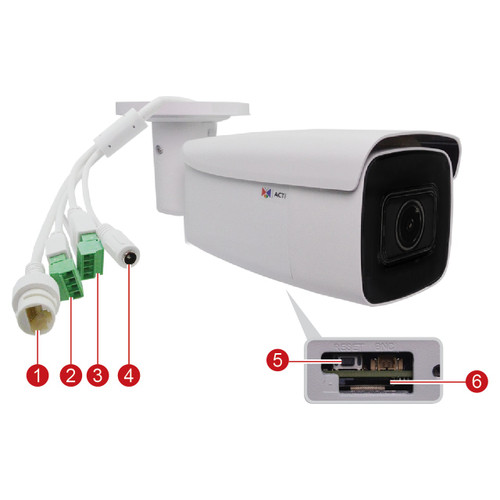
Both the ACTi A422 and ACTi Z36 are 4MP outdoor bullet IP cameras from the same manufacturer, making them a legitimate cross-shop for integrators selecting fixed surveillance hardware. The A422 is a full-size zoom bullet with a motorized varifocal lens and deep-learning analytics, while the Z36 is a compact mini bullet with a fixed wide-angle lens aimed at cost-sensitive or space-constrained deployments. This comparison examines how their imaging capabilities, installation requirements, and integration features differ across real spec data.
In This Guide
How do the imaging specs compare?
Both cameras share a 4MP (2688×1520) resolution and deliver 30 fps at full resolution, so raw pixel count and frame rate are equal. The A422 is equipped with a 1/2.7" sensor, a motorized 2.7–13.5mm varifocal lens delivering 5× optical zoom, and a minimum illumination of 0.003 lux in color mode (0 lux with IR active). Its IR illuminators operate at 850nm with a rated range of 85m. The A422 also carries Extreme WDR rated at 150dB. The Z36 uses a fixed 2.8mm lens at F2.0 with a 94.7° horizontal field of view. Its sensor size, minimum illumination figure, and IR range are not specified in the provided data. WDR is listed for the Z36 but no dB rating is given.
The A422's motorized zoom is the decisive imaging differentiator: it allows remote focal-length adjustment from 2.7mm to 13.5mm without a technician physically accessing the camera, and the 85m IR range substantially exceeds anything confirmable for the Z36. The Z36's fixed 2.8mm wide-angle lens suits broad-area coverage in tight spaces but cannot be re-aimed optically. Where the A422's 150dB Extreme WDR rating is a concrete, testable specification, the Z36's WDR capability is confirmed only as present—no dynamic range figure is available from the provided specs.
What about installation and environment?
The A422 carries an IP68 ingress-protection rating, indicating full dust exclusion and continuous submersion resistance beyond IP67's splash/immersion limit, alongside IK10 vandal resistance. Its operating temperature spans −40°C to +60°C (−40°F to +140°F). It weighs 1,410g (3.11 lb) and supports pole and corner mounting via accessory mounts. Power is supplied via PoE++ (802.3bt Class 3) or DC 12V; the motorized zoom mechanism is driven within that power envelope with no separate supply required. Ethernet connectivity is via an RJ-45 pigtail connector at 10/100 Base-T.
The Z36 is rated IP67 and IK10. Its operating temperature range, weight, and physical dimensions are not specified in the provided data. It is powered by standard PoE (802.3af), drawing under 13W, which broadens compatible switch and injector options compared to the A422's 802.3bt requirement. The Z36's lower PoE class is an installation advantage where 802.3bt infrastructure is not yet in place; the A422 requires a 802.3bt-capable switch or injector, which may add infrastructure cost on legacy networks.
Which fits your VMS and analytics better?
The A422 supports ONVIF Profile S, Profile G, Profile T, and Profile M, providing the broadest VMS compatibility of the two and enabling advanced features such as on-board recording (Profile G) and metadata streaming (Profile M). It integrates edge analytics via a dedicated Deep Learning Processing Unit (DLPU) supporting deep-learning-based events and Video Motion Detection (VMD). Audio is supported via a physical line-in and line-out interface enabling two-way audio. The A422 also provides manual GPS position setting for geolocation tagging in VMS maps. It holds UL Taiwan IoT Cybersecurity Certification.
The Z36 declares ONVIF compliance without specifying which profiles are supported beyond the base listing, which may limit advanced VMS feature availability compared to the A422's four-profile declaration. No edge analytics capability is specified for the Z36. Audio is provided via a built-in microphone only—no line-out or two-way capability is listed. The Z36 supports local on-board storage via MicroSDHC/MicroSDXC, which is not listed in the A422's provided specifications. No analytics certification, cybersecurity certification, or warranty term is provided in the Z36's spec data.
Which should you choose: the A422 or the Z36?
Our take: The A422 is the stronger choice when optical flexibility, extended IR range, deep-learning analytics, or multi-profile ONVIF integration are required. Its 5× motorized zoom (2.7–13.5mm vs the Z36's fixed 2.8mm) allows post-installation focal adjustment without physical access, its IR range is rated at 85m versus an unspecified figure for the Z36, and its Extreme WDR is quantified at 150dB versus an unrated WDR on the Z36. It also adds two-way audio, DLPU-based analytics, and four ONVIF profiles. The Z36 is the appropriate choice where budget, switch compatibility, or installation simplicity are the primary constraints: its 802.3af PoE (under 13W) works with any standard switch or injector without infrastructure upgrades, it offers on-board MicroSD storage not confirmed on the A422, and its wide 94.7° fixed lens covers broad scenes in confined spaces. Choose the A422 for perimeter and detail-capture applications; choose the Z36 for indoor corridors or commodity wide-area coverage on legacy PoE infrastructure.
Side-by-Side Comparison
Spec-for-spec, from manufacturer data.
| Specification | ACTi A422 | ACTi Z36 |
|---|---|---|
| Resolution | 4MP (2688×1520) | 4MP |
| Lens / Focal Length | 2.7–13.5mm motorized varifocal (5× optical zoom) | 2.8mm fixed, F2.0 (94.7° HOV) |
| Sensor Size | 1/2.7" | — |
| Min Illumination | 0.003 lux (color); 0 lux (IR on) | — |
| IR Range | 85m | — |
| IR Wavelength | 850nm | — |
| WDR | Extreme WDR (150dB) | WDR (no dB rating specified) |
| Max Frame Rate | 30 fps @ 2688×1520 | — |
| Video Compression | H.265; H.264; MJPEG | H.265; H.264 |
| IP Rating | IP68 | IP67 |
| IK / Impact Rating | IK10 | IK10 |
| Operating Temperature | −40°C to +60°C (−40°F to +140°F) | — |
| Power Input / PoE Class | PoE++ (802.3bt Class 3); DC 12V | PoE (802.3af) |
| ONVIF Profiles | Profile S; Profile G; Profile T; Profile M | ONVIF (profiles not specified) |
| Edge Analytics | Deep Learning (DLPU); VMD | — |
| Audio | Line-in; Line-out; Two-way | Built-in microphone only |
| On-Board Storage | — | MicroSDHC/MicroSDXC |
| Weight | 1,410g (3.11 lb) | — |
| Warranty | 3 years | — |
Frequently Asked Questions
Which should you choose: the A422 or the Z36?
The A422 is the stronger choice when optical flexibility, extended IR range, deep-learning analytics, or multi-profile ONVIF integration are required. Its 5× motorized zoom (2.7–13.5mm vs the Z36's fixed 2.8mm) allows post-installation focal adjustment without physical access, its IR range is rated at 85m versus an unspecified figure for the Z36, and its Extreme WDR is quantified at 150dB versus an unrated WDR on the Z36. It also adds two-way audio, DLPU-based analytics, and four ONVIF profiles. The Z36 is the appropriate choice where budget, switch compatibility, or installation simplicity are the primary constraints: its 802.3af PoE (under 13W) works with any standard switch or injector without infrastructure upgrades, it offers on-board MicroSD storage not confirmed on the A422, and its wide 94.7° fixed lens covers broad scenes in confined spaces. Choose the A422 for perimeter and detail-capture applications; choose the Z36 for indoor corridors or commodity wide-area coverage on legacy PoE infrastructure.
Is the A422 or Z36 better for low-light performance?
Based on available specs, the A422 has a confirmed minimum illumination of 0.003 lux in color mode and 0 lux with IR active, plus an 85m IR range at 850nm. The Z36's minimum illumination figure and IR range are not stated in its provided specifications, so a direct numerical comparison cannot be made. The A422 is the only model with confirmed low-light numbers.
Do both cameras work with my existing PoE switches?
Not necessarily. The Z36 uses standard 802.3af PoE (under 13W), which is compatible with virtually any PoE switch or injector. The A422 requires PoE++ (802.3bt Class 3), which delivers higher wattage for the motorized zoom mechanism. If your existing switches are 802.3af or 802.3at (PoE+) only, you will need 802.3bt-capable switches or midspan injectors for the A422.
Which camera supports on-board video storage?
The Z36 includes a MicroSDHC/MicroSDXC card slot for local on-board recording. On-board storage is not listed in the A422's provided specifications. If edge recording without a dedicated NVR is a requirement, the Z36 addresses that need based on available spec data; the A422's capability in this area cannot be confirmed from the provided information.
Get a Second Opinion on Your Camera Choice
Share your site layout, coverage goals, and budget. Our team will validate the camera selection, flag anything we would change, and recommend products that match the use case.