
ACTi A313 vs Hanwha QNO-7082R: Specification Comparison
Both the ACTi A313 and Hanwha QNO-7082R are 4MP outdoor bullet cameras targeting perimeter and general surveillance applications. They share a common resolution class (2688×1520 / 4MP), fixed-bullet form factor, PoE Class 3 power, H.265/H.264/MJPEG compression, IK10 vandal resistance, and IR night vision. This comparison evaluates how their imaging capabilities, environmental ratings, mounting flexibility, and VMS/analytics integration differentiate them for installers choosing between two similarly positioned outdoor cameras.
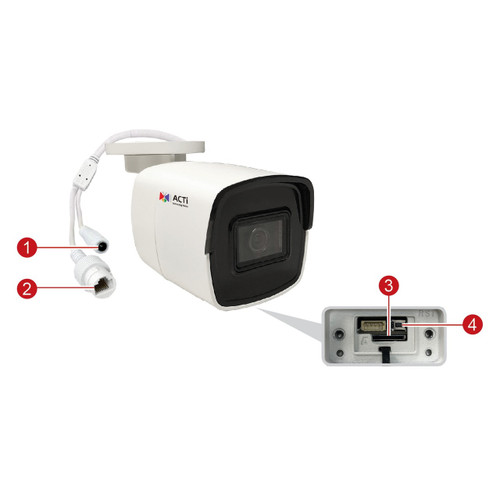
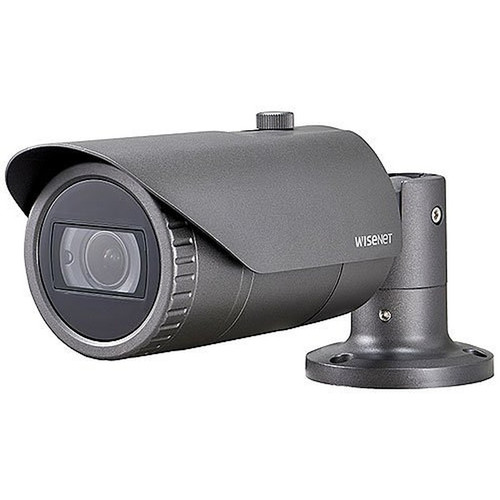
In This Guide
How do the imaging specs compare?
Both cameras deliver 4MP at 30fps, but their optical designs differ significantly. The A313 uses a fixed 2.8mm board-mount lens on a 1/2.7" sensor, making it a set-and-forget wide-angle unit — field of view is fixed at install time. The QNO-7082R uses a motorized varifocal DC auto-iris lens (3.2–10mm per the tagline spec), allowing remote zoom and focus adjustment post-installation without physical access to the camera head. No sensor size is specified for the QNO-7082R in the provided data.
On low-light performance, the A313 provides explicit figures: color minimum illumination of 0.003 lux and 0 lux in B/W with IR active, with three 850nm IR LEDs rated to 65m working distance. The QNO-7082R's provided specs list IR as a night-vision technology and note a Day/Night mode, but no specific minimum illumination value, IR wavelength, or IR range figure is present in the supplied specifications. The A313 also specifies 150dB Extreme WDR; the QNO-7082R lists WDR as a feature but no dB rating is provided.
What about installation and environment?
The A313 carries an IP68 ingress protection rating, meaning it is rated for continuous submersion beyond 1 meter — a step above the QNO-7082R's IP66 rating (protected against powerful water jets but not submersion). Both cameras share IK10 impact resistance. Operationally, the A313 is rated -40°C to 60°C; the QNO-7082R is rated -40°C to +55°C, a 5°C narrower upper bound. For storage, the QNO-7082R is rated to +60°C storage temperature.
Both cameras accept PoE Class 3 (IEEE 802.3af) and 12VDC. The A313 specifies a pigtail RJ-45 connector; the QNO-7082R uses a standard RJ-45 jack (10/100BASE-T). The A313 lists pole, wall, and board-mount options; the QNO-7082R's mounting options are not detailed in the provided specifications beyond 'outdoor.' The A313 weighs 490g (1.1 lb); the QNO-7082R weighs 1.98 lb (approximately 898g), nearly double — relevant when specifying junction boxes or mounting hardware load ratings.
Which fits your VMS and analytics better?
The A313 explicitly lists ONVIF Profile S, G, T, and M compliance, and names Milestone, Axis Camera Station, and Genetec as tested VMS platforms. Its edge analytics include a Deep Learning Processing Unit (DLPU) supporting face detection and people counting, plus Video Motion Detection. The QNO-7082R's ONVIF compliance covers Profile S/G/T via SUNAPI (HTTP API), but Profile M is not listed in the provided specs. Its analytics include defocus detection and directional detection; face detection and people counting are not listed in the provided specifications.
For on-board storage, the QNO-7082R lists microSD card support; the A313 does not list any local storage capability in the provided specifications. For audio, the QNO-7082R lists an audio input; the A313's provided specifications do not include any audio input or output. The QNO-7082R also specifies 512MB RAM and 256MB Flash onboard memory; no equivalent memory specification is provided for the A313. HTTPS encryption is listed for the QNO-7082R; the A313 lists UL Taiwan IoT Cybersecurity Certification as its stated cybersecurity credential.
Which should you choose: the A313 or the QNO-7082R?
Our take: The A313 is the stronger choice when submersion-resistant sealing (IP68 vs IP66), extended upper operating temperature (+60°C vs +55°C), deeper ONVIF profile coverage (S/G/T/M vs S/G/T), and DLPU-based analytics — specifically face detection and people counting — are primary requirements. The QNO-7082R is the stronger choice when remote lens adjustment after installation is essential: its motorized 3.2–10mm varifocal eliminates the need to physically re-aim the camera, a significant labor advantage in hard-to-access locations. The QNO-7082R also adds microSD edge storage and an audio input not present in the A313's specifications. Low-light spec comparison is constrained by the absence of a published minimum-illumination figure for the QNO-7082R. Buyers on Milestone, Axis Camera Station, or Genetec have documented A313 compatibility; QNO-7082R VMS compatibility beyond ONVIF is not specified in the provided data.
Side-by-Side Comparison
Spec-for-spec, from manufacturer data.
| Specification | ACTi A313 | Hanwha QNO-7082R |
|---|---|---|
| Resolution | 4MP (2688×1520) | 4MP |
| Max Frame Rate | 30fps @ 2688×1520 | 30fps |
| Image Sensor Size | 1/2.7" | — |
| Lens / Focal Length | 2.8mm fixed, board mount | Motorized varifocal 3.2–10mm (DC auto iris) |
| Min Illumination | Color 0.003 lux; B/W 0 lux (IR on) | — |
| IR Range | 65m | — |
| IR Wavelength | 850nm | — |
| WDR | 150dB Extreme WDR | WDR (dB rating not specified) |
| Video Compression | H.265; H.264; MJPEG | H.265; H.264; MJPEG |
| IP Rating | IP68 | IP66 |
| IK / Impact Rating | IK10 | IK10 |
| Operating Temperature | -40°C to +60°C | -40°C to +55°C |
| Power Input / PoE Class | PoE Class 3 (802.3af); DC 12V | PoE Class 3 (802.3af); DC 12V |
| ONVIF Profiles | Profile S, G, T, M | Profile S, G, T |
| Edge Analytics | Face detection, people counting (DLPU); VMD | Defocus detection; Directional detection |
| Edge Storage | — | microSD |
| Audio | — | Audio input |
| Weight | 490g (1.1 lb) | 1.98 lb (~898g) |
| Warranty | 3 years | 3 years |
Frequently Asked Questions
Which should you choose: the A313 or the QNO-7082R?
The A313 is the stronger choice when submersion-resistant sealing (IP68 vs IP66), extended upper operating temperature (+60°C vs +55°C), deeper ONVIF profile coverage (S/G/T/M vs S/G/T), and DLPU-based analytics — specifically face detection and people counting — are primary requirements. The QNO-7082R is the stronger choice when remote lens adjustment after installation is essential: its motorized 3.2–10mm varifocal eliminates the need to physically re-aim the camera, a significant labor advantage in hard-to-access locations. The QNO-7082R also adds microSD edge storage and an audio input not present in the A313's specifications. Low-light spec comparison is constrained by the absence of a published minimum-illumination figure for the QNO-7082R. Buyers on Milestone, Axis Camera Station, or Genetec have documented A313 compatibility; QNO-7082R VMS compatibility beyond ONVIF is not specified in the provided data.
Is the A313 or QNO-7082R better for low-light performance?
Based on available specifications, the A313 provides explicit low-light figures — 0.003 lux color and 0 lux B/W with IR active, and an IR range of 65m at 850nm. The QNO-7082R's provided specifications confirm IR night vision and Day/Night operation but do not include a minimum illumination value, IR wavelength, or IR range. A meaningful low-light comparison cannot be made from the supplied QNO-7082R data.
Which camera handles harsh weather better?
The A313 is rated IP68 (submersion-rated) versus the QNO-7082R's IP66 (water-jet resistant but not submersion-rated). Both are rated IK10 for impact. The A313 also has a slightly wider operating temperature ceiling of +60°C versus +55°C for the QNO-7082R. For installations subject to flooding, standing water, or extreme heat, the A313's ratings are more stringent per the provided specifications.
Which camera is easier to aim and commission on site?
The QNO-7082R's motorized varifocal lens (3.2–10mm per provided specifications) allows zoom and focus to be adjusted remotely or via the camera interface after physical mounting, reducing the need for ladder work or precise pre-positioning. The A313's 2.8mm fixed lens locks field of view at install time, so placement must achieve the desired coverage without post-install optical adjustment. For high-mounting or difficult-access installations, the QNO-7082R's motorized lens is the practical advantage.
Get a Second Opinion on Your Camera Choice
Share your site layout, coverage goals, and budget. Our team will validate the camera selection, flag anything we would change, and recommend products that match the use case.