
ACTi A313 vs ACTi Z36: Specification Comparison
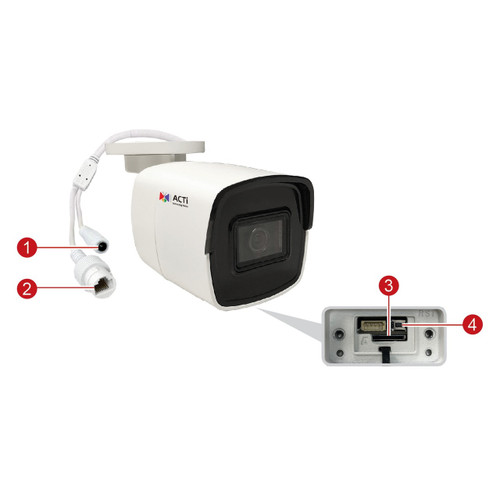
This comparison examines two 4-megapixel fixed mini bullet IP cameras from ACTi — the A313 and the Z36 — both targeting perimeter and general surveillance installations where a compact bullet form factor is required. The A313 is a feature-dense outdoor unit with deep-learning analytics, an IK10 vandal rating, and an IP68 ingress seal. The Z36 is a simpler 4MP bullet with built-in audio and onboard microSD storage but fewer documented specifications. Neither model includes pan/tilt/zoom capability; both use a 2.8mm fixed lens.
In This Guide
How do the imaging specs compare?
The A313 resolves at 2688x1520 (4MP) via a 1/2.7-inch sensor, delivering up to 30 fps at full resolution as well as 30 fps at 1080p and 720p. Its minimum illumination is rated at 0.003 lux in color and 0 lux in B/W mode with IR active. Three 850nm IR LEDs provide a working distance of 65 meters. Dynamic range is specified as Extreme WDR at 150 dB, a concrete figure that indicates the camera's ability to handle scenes with simultaneous bright and dark areas. The A313 also supports MJPEG in addition to H.265 and H.264.
The Z36 is listed at 4MP resolution but its pixel array dimensions, sensor size, maximum frame rate, and minimum illumination figures are not specified in the available data. IR capability is noted but wavelength and working distance are absent. WDR is listed without a decibel value. The lens is documented as 2.8mm F2.0 with a 94.7-degree horizontal field of view — the only optical spec where the Z36 provides more detail than the A313, which does not publish an aperture or horizontal FOV figure. For any application where low-light performance, IR range, or WDR depth must be verified against site requirements, the A313 provides the numbers needed to make that determination; the Z36 does not.
What about installation and environment?
The A313 carries an IP68 ingress protection rating, meaning it is rated for continuous submersion beyond one meter, and an IK10 impact rating. It is tested for operation from -40°C to 60°C (-40°F to 140°F), covering cold-climate outdoor deployments. The A313 weighs 490g and supports pole mount, wall mount, and board mount configurations. Power can be supplied via DC 12V or PoE; the product header lists PoE++ (802.3bt) Class 3 while the power supply section also references PoE Class 3 per IEEE 802.3af — buyers should confirm with ACTi which standard applies, as 802.3bt and 802.3af have different wattage envelopes. Connectivity is via a single RJ-45 pigtail at 10/100 Base-T.
The Z36 is rated IP67 — dust-tight and protected against temporary immersion up to one meter — and also carries IK10. Operating temperature range, weight, and mounting options are not specified in the available data. Power is supplied via standard PoE (802.3af), which is a lower wattage class than 802.3bt and is widely available from commodity switches. The Z36's simpler power requirement reduces infrastructure cost in environments where 802.3bt injectors or switches are not already deployed.
Which fits your VMS and analytics better?
The A313 is ONVIF-compliant across Profile S, Profile G, Profile T, and Profile M, and is explicitly listed as compatible with Milestone, Axis Camera Station, and Genetec in addition to generic ONVIF. It includes a deep learning processing unit (DLPU) supporting video motion detection, face detection, and people counting at the edge — functions that reduce server-side processing load. The Z36 lists ONVIF compliance without specifying which profiles are supported beyond generic ONVIF, and analytics capabilities are not specified.
On auxiliary features the Z36 offers a built-in microphone and MicroSDHC/MicroSDXC edge storage — neither of which is listed for the A313. For installations that require local audio capture or continuous on-camera recording as a failover when network connectivity is interrupted, the Z36 provides those capabilities. The A313 does not list audio or edge storage in its published specifications; buyers who need those features alongside the A313's analytics and environmental ratings should confirm availability with ACTi before specifying.
Which should you choose: the A313 or the Z36?
Our take: The A313 is the stronger choice when documented imaging performance, extreme-environment ratings, or edge analytics are decision criteria. Its IR working distance of 65 meters against the Z36's unspecified range, its 150 dB Extreme WDR rating versus the Z36's unquantified WDR, and its color minimum illumination of 0.003 lux versus the Z36's undisclosed figure give installers concrete numbers to match against site requirements. The A313 also supports four ONVIF profiles and is verified against Milestone, Axis Camera Station, and Genetec. The Z36 holds an advantage where built-in audio capture or onboard microSD edge storage is required, and its standard 802.3af PoE simplifies switch selection. When site conditions are benign and budget or infrastructure constraints favor simplicity, the Z36 merits consideration — but its specification gaps make pre-purchase verification with ACTi essential.
Side-by-Side Comparison
Spec-for-spec, from manufacturer data.
| Specification | ACTi A313 | ACTi Z36 |
|---|---|---|
| Resolution | 2688 x 1520 (4MP) | 4MP (dimensions not specified) |
| Sensor Size | 1/2.7" | — |
| Lens | 2.8mm fixed, board mount | 2.8mm fixed, F2.0, 94.7° HOV |
| Max Frame Rate | 30 fps @ 2688x1520 | — |
| Min Illumination (Color) | 0.003 lux | — |
| Min Illumination (B/W) | 0 lux (IR on) | — |
| IR Wavelength | 850nm | Not specified |
| IR Working Distance | 65m | — |
| WDR | Extreme WDR, 150 dB | WDR (dB not specified) |
| IP Rating | IP68 | IP67 |
| IK Rating | IK10 | IK10 |
| PoE Standard | PoE++ 802.3bt (Class 3 per header; 802.3af also referenced — verify with ACTi) | PoE 802.3af |
| Operating Temperature | -40°C to 60°C | — |
| Compression | H.265; H.264; MJPEG | H.265; H.264 |
| ONVIF Profiles | Profile S, G, T, M | Generic ONVIF (profiles not specified) |
| Edge Analytics | DLPU: face detection, people counting, VMD | — |
| Audio | — | Built-in microphone |
| Edge Storage | — | MicroSDHC / MicroSDXC |
| VMS Compatibility | Milestone, Axis Camera Station, Genetec, ONVIF | ONVIF |
| Weight | 490g (1.1 lb) | — |
| Warranty | 3 years | — |
Frequently Asked Questions
Which should you choose: the A313 or the Z36?
The A313 is the stronger choice when documented imaging performance, extreme-environment ratings, or edge analytics are decision criteria. Its IR working distance of 65 meters against the Z36's unspecified range, its 150 dB Extreme WDR rating versus the Z36's unquantified WDR, and its color minimum illumination of 0.003 lux versus the Z36's undisclosed figure give installers concrete numbers to match against site requirements. The A313 also supports four ONVIF profiles and is verified against Milestone, Axis Camera Station, and Genetec. The Z36 holds an advantage where built-in audio capture or onboard microSD edge storage is required, and its standard 802.3af PoE simplifies switch selection. When site conditions are benign and budget or infrastructure constraints favor simplicity, the Z36 merits consideration — but its specification gaps make pre-purchase verification with ACTi essential.
Can either camera record locally without a recorder or NVR?
The Z36 supports MicroSDHC and MicroSDXC edge storage, enabling local recording on the camera itself. The A313 does not list onboard storage in its published specifications; confirm with ACTi before specifying it for standalone recording applications.
Which camera is better suited to outdoor installations in extreme cold or wet environments?
The A313 is rated IP68 (continuous submersion) and tested to -40°C, making it suitable for harsh outdoor deployments including cold climates. The Z36 is rated IP67 (temporary immersion to one meter), which is adequate for most outdoor use, but its operating temperature range is not published — verify with ACTi before deploying in extreme cold.
Do both cameras work with Milestone or Genetec VMS?
The A313 explicitly lists compatibility with Milestone, Axis Camera Station, and Genetec via ONVIF Profile S, G, T, and M. The Z36 lists generic ONVIF compliance without specifying profiles or named VMS partners. In practice, generic ONVIF Profile S is broadly supported, but profile-specific features such as Profile G recording or Profile T metadata may not be available on the Z36 — confirm with your VMS vendor and ACTi before deployment.
Get a Second Opinion on Your Camera Choice
Share your site layout, coverage goals, and budget. Our team will validate the camera selection, flag anything we would change, and recommend products that match the use case.