
ACTi A313 vs ACTi A422: Specification Comparison
Both the ACTi A313 and ACTi A422 are outdoor-rated 4MP (2688×1520) fixed bullet IP cameras sharing the same sensor class, enclosure rating, and PoE power standard. A buyer choosing between them is trading a compact, fixed-focal-length mini bullet against a heavier zoom bullet with a 5× motorized lens. The decision hinges on deployment geometry: a known, fixed field of view versus a site where the required angle of coverage is uncertain or may need to change without a physical lens swap.
In This Guide
How do the imaging specs compare?
Both cameras resolve 4MP (2688×1520) at 30 fps and share a 1/2.7" sensor, 150 dB Extreme WDR, and identical minimum illumination figures of 0.003 lux in color and 0 lux with IR active. The A313 uses a fixed 2.8 mm board-mount lens, locking its horizontal field of view at a wide angle suited for close-range, broad-scene coverage. The A422 uses a 2.7–13.5 mm motorized varifocal lens delivering 5× optical zoom, giving integrators the ability to dial in tight or wide coverage without a physical lens change. Notably, the A422's 30 fps rating is specified only at full 2688×1520; the A313 additionally confirms 30 fps at 1920×1080 and 1280×720, while the A422 spec sheet does not detail sub-stream frame rates.
IR performance differs meaningfully: the A313 specifies three 850 nm IR LEDs with a stated working distance of 65 m, whereas the A422 specifies 850 nm IR at an 85 m working distance—a 31% increase in rated IR throw. Both cameras support H.265, H.264, and MJPEG compression. The A313 explicitly lists VMS compatibility with Milestone, Axis Camera Station, and Genetec in addition to ONVIF Profiles S, G, T, and M; the A422 spec sheet lists ONVIF Profiles S, G, T, and M but does not enumerate named third-party VMS integrations.
What about installation and environment?
Both cameras carry IP68 and IK10 ratings and are rated for an identical operating temperature range of -40°C to 60°C (-40°F to 140°F), making environmental protection a non-differentiator. Both accept DC 12V or PoE Class 3 (IEEE 802.3af) power; the spec listings for both units also reference PoE++ (802.3bt) Class 3, meaning either camera can be driven from a standard 802.3af switch at 15.4 W or a higher-budget 802.3bt port.
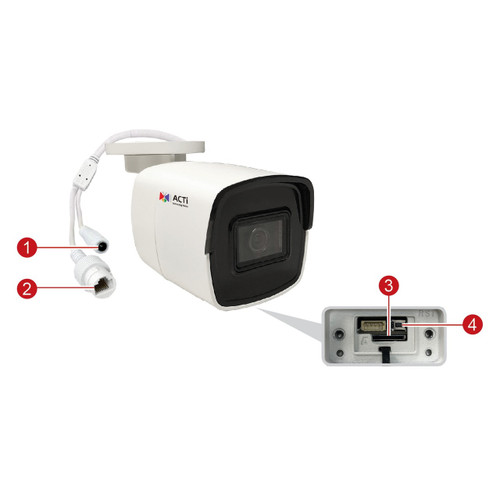
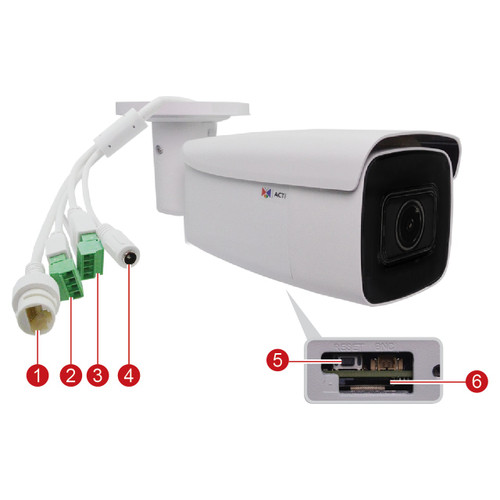
Form factor and weight diverge significantly. The A313 is a mini bullet weighing 490 g (1.08 lb) with a pole, wall, or board-mount footprint, suitable for low-profile or space-constrained installs. The A422 is a full-size zoom bullet at 1,410 g (3.11 lb)—nearly three times heavier—and is specified for pole and corner mounting. The A422's motorized zoom mechanism accounts for the mass difference and requires a mounting surface rated for the additional load. Both use an RJ-45 pigtail connector and 10/100 Base-T Ethernet.
Which fits your VMS and analytics better?
Both cameras run ACTi's Deep Learning Processing Unit (DLPU) and support Video Motion Detection (VMD). The A313 spec additionally calls out face detection and people counting as named analytics functions; the A422 spec lists DLPU and VMD but does not enumerate specific deep-learning sub-functions beyond that. For ONVIF, both devices are Profile S, G, T, and M compliant.
Audio is a differentiator: the A422 specifies an audio input (line-in, line-out) and two-way audio capability; the A313 spec does not list any audio interface. On-board or edge storage is not specified for either model in the provided data. Both cameras include manual GPS position setting. The A313 carries a UL Taiwan IoT Cybersecurity Certification, explicitly named in its spec; the A422 lists the same certification. Both carry a 3-year manufacturer warranty.
Which should you choose: the A313 or the A422?
Our take: The A313 is the stronger choice when the field of view is fixed, installation space or mounting payload is constrained, and named deep-learning analytics (face detection, people counting) or confirmed Milestone/Genetec/Axis Camera Station VMS integration are required. The A422 is the stronger choice when the scene geometry is variable or the standoff distance demands optical reach: its 2.7–13.5 mm motorized lens provides 5× optical zoom that the A313's fixed 2.8 mm lens cannot replicate, and its IR throw extends to 85 m versus the A313's 65 m—a 20 m advantage. The A422 also adds two-way audio, absent on the A313. Against those advantages, the A422 weighs 1,410 g versus the A313's 490 g and does not enumerate named VMS integrations or specific DLPU sub-functions in the available spec. Choose the A313 for fixed wide-angle, analytics-forward deployments on light mounts; choose the A422 for long-range, zoom-adjustable, or audio-capable installations.
Side-by-Side Comparison
Spec-for-spec, from manufacturer data.
| Specification | ACTi A313 | ACTi A422 |
|---|---|---|
| Resolution | 4MP (2688×1520) | 4MP (2688×1520) |
| Image Sensor | 1/2.7" | 1/2.7" |
| Lens / Focal Length | 2.8 mm fixed | 2.7–13.5 mm (5× optical zoom) |
| Min Illumination (Color) | 0.003 lux | 0.003 lux |
| Min Illumination (B/W / IR on) | 0 lux | 0 lux |
| IR Range | 65 m | 85 m |
| IR Wavelength | 850 nm (3 LEDs) | 850 nm |
| WDR | 150 dB Extreme WDR | 150 dB Extreme WDR |
| Max Frame Rate | 30 fps @ 2688×1520; 30 fps @ 1080p; 30 fps @ 720p | 30 fps @ 2688×1520 |
| Video Compression | H.265; H.264; MJPEG | H.265; H.264; MJPEG |
| IP Rating | IP68 | IP68 |
| IK / Impact Rating | IK10 | IK10 |
| Operating Temperature | -40°C to 60°C (-40°F to 140°F) | -40°C to 60°C (-40°F to 140°F) |
| Power Input / PoE Class | DC 12V; PoE++ (802.3bt) Class 3 / IEEE 802.3af | DC 12V; PoE++ (802.3bt) Class 3 / IEEE 802.3af |
| Audio | — | Line-in; Line-out; Two-way |
| Edge Analytics | DLPU: face detection, people counting, VMD | DLPU; VMD |
| ONVIF Profiles | S, G, T, M | S, G, T, M |
| VMS Compatibility (named) | Milestone; Axis Camera Station; Genetec | Not specified |
| Mount Type | Pole; Wall; Board mount | Pole; Corner |
| Weight | 490 g (1.08 lb) | 1,410 g (3.11 lb) |
| Cybersecurity Certification | UL Taiwan IoT Cybersecurity | UL Taiwan IoT Cybersecurity |
| Warranty | 3 Year(s) | 3 Year(s) |
Frequently Asked Questions
Which should you choose: the A313 or the A422?
The A313 is the stronger choice when the field of view is fixed, installation space or mounting payload is constrained, and named deep-learning analytics (face detection, people counting) or confirmed Milestone/Genetec/Axis Camera Station VMS integration are required. The A422 is the stronger choice when the scene geometry is variable or the standoff distance demands optical reach: its 2.7–13.5 mm motorized lens provides 5× optical zoom that the A313's fixed 2.8 mm lens cannot replicate, and its IR throw extends to 85 m versus the A313's 65 m—a 20 m advantage. The A422 also adds two-way audio, absent on the A313. Against those advantages, the A422 weighs 1,410 g versus the A313's 490 g and does not enumerate named VMS integrations or specific DLPU sub-functions in the available spec. Choose the A313 for fixed wide-angle, analytics-forward deployments on light mounts; choose the A422 for long-range, zoom-adjustable, or audio-capable installations.
Is the A313 or A422 better for low-light performance?
Both cameras share identical minimum illumination figures—0.003 lux in color and 0 lux with IR active—so low-light sensitivity is equivalent. Where they differ is IR range: the A422 is rated to 85 m versus the A313's 65 m, meaning the A422 can illuminate subjects at greater distances in complete darkness.
Can I adjust the zoom on the A313 in the field without swapping lenses?
No. The A313 uses a fixed 2.8 mm board-mount lens; the field of view is set at manufacture and cannot be changed without a physical lens replacement. The A422 uses a motorized 2.7–13.5 mm varifocal lens with 5× optical zoom that can be adjusted remotely or on-site without hardware changes.
Does either camera support two-way audio or on-board storage?
The A422 specifies audio input, line-in, line-out, and two-way audio capability. The A313 spec does not list any audio interface. Neither camera's provided specifications include on-board or edge storage details.
Get a Second Opinion on Your Camera Choice
Share your site layout, coverage goals, and budget. Our team will validate the camera selection, flag anything we would change, and recommend products that match the use case.