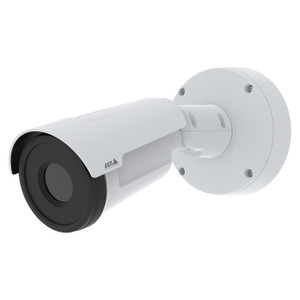
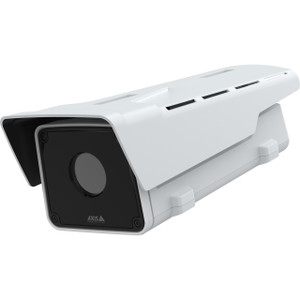
Axis Q1961-TE 640x480 Thermal Outdoor Fixed IP Camera
The Axis Q1961-TE (02176-001) is a thermal outdoor fixed-camera designed for perimeter intrusion detection, fire-hazard monitoring, and industrial thermal anomaly detection in complete darkness, heavy smoke, fog, and extreme weather where visible-light cameras fail. Operating at 30 fps with a fixed 13 mm lens, it detects temperature variations from -40°C to 350°C without requiring ambient illumination. Built-in spot temperature reading and polygonal temperature monitoring areas enable precise event triggers — fire pre-alarm when surface temps exceed threshold, unauthorized intrusion detection on perimeter fencing, or equipment-failure alerting on cooling systems. This is the thermal workhorse for sites where darkness, weather, or smoke render traditional CCTV blind.
Key Features
- Thermal Sensitivity (NETD): 40 mK @25°C, F1.0. Resolves <0.04°C temperature differences — critical for early-stage fire detection and subtle thermal anomalies that visible cameras cannot see.
- Resolution & Frame Rate: 640x480 thermal at 30 fps (384x288 sensor upscaled). Smooth 30 fps stream eliminates flicker and motion blur on fast-moving heat sources (vehicle entry, personnel movement).
- Temperature Range: -40°C to 350°C detection span. Covers sub-zero outdoor conditions and high-heat industrial process monitoring without re-calibration.
- IP66/IP67 & IK10 Rating: Sealed against rain, dust, hose-down spray, and rated for 5kg impact drops from 40cm. No degradation on high-vibration perimeter poles or industrial sites.
- PoE Power (Class 3): Single RJ45 cable delivers power and network — no external PSU needed. Operates on standard PoE 802.3at switches; typical draw 4.3W.
- H.264 Compression & Zipstream: Video compression reduces bandwidth 50%+ compared to uncompressed thermal stream. Zipstream dynamic bitrate optimization keeps storage costs predictable on 24/7 recording.
- Thermal Analytics Built-In: Spot temperature reading and polygonal monitoring areas trigger native alarms on threshold breach — no external analytics engine required for basic thermal event detection.
- Operating Temperature: -40°C to 60°C rated. Arctic perimeters, rooftop installation, and summer heat do not affect sensor performance or housing integrity.
- ONVIF Profile S/T & VAPIX API: Integrates with Axis Camera Station, Milestone, Genetec, and any ONVIF-compliant VMS. Alarm events and temperature metadata stream via standard RTSP/API.
- Audio Detection & Network Speaker Output: Built-in audio analysis + optional Axis network speaker support for audio-triggered thermal alerts (e.g., glass-break fires, intruder shout detection).
Thermal imaging is the only reliable night-and-weather solution for perimeter and high-risk facility monitoring. Unlike infrared LED cameras that degrade in fog or dust, the uncooled microbolometer sensor in the Q1961-TE passively detects radiated heat — performance is independent of visible light or weather opacity. On a 24/7 perimeter deployment, this eliminates false-negative blind spots that plague visible-light systems during adverse conditions. The 40 mK thermal sensitivity is genuine; it translates to early fire detection (surface temp rise detected before flame), equipment-failure prevention (bearing overheating, coolant loss), and intrusion alerting on personnel or vehicle entry with zero ambient light dependency.
Deployment scenarios divide into three categories. Perimeter intrusion: fence-line or building-corner mounting detects unauthorized personnel or vehicle approach in darkness; polygonal monitoring zones restrict alerts to entry corridors, reducing nuisance triggers from wind-blown debris or animals outside the secured area. Fire hazard: industrial roof, data-center intake/exhaust, or high-value storage facility — spot temperature thresholds alert on hot-spots (smoldering insulation, electrical overload) before visible flames. Industrial process: HVAC plant rooms, transformer yards, or manufacturing equipment — continuous thermal trending identifies bearing wear, coolant leaks, or electrical contact degradation hours or days before catastrophic failure. ROI accrues through prevented downtime and reduced post-incident investigation cost (thermal recording is evidentiary on fire origin, equipment fault timing).
Installation is straightforward: pendant mount (pole, eave bracket, or wall-mount depending on site geometry), single RJ45 Gigabit connection to PoE 802.3at switch, and optional audio input/output cabling if speaker or microphone integration is planned. The IP66/IP67 rating and IK10 impact spec mean no additional housing or protective covers are needed — mount directly in rain, dust, or high-vibration environments. Electronic image stabilization compensates for camera sway on tall poles or moving platforms; thermal calibration is automatic. Most sites benefit from a secondary PoE+ switch port or injector to isolate thermal camera power from shared access-control or door-lock circuits — thermal spikes don't brown out badge readers. Confirm your VMS supports ONVIF Profile T (H.265 fallback) for future codec flexibility; some older Milestone or Genetec instances default to H.264-only, which is supported here.
The Q1961-TE is compliant with AXIS Camera Station, Milestone VMS, Genetec Security Center, and ExacqVision platforms supporting ONVIF Profile S/T. Axis 5-year warranty covers the camera and lens; thermal sensor degradation (microbolometer drift) is minimal over product life under normal operating conditions. Choose the Q1961-TE when darkness, smoke, dust, or fog is the primary threat vector — it is not a replacement for visible-light cameras on well-lit sites, but rather the only viable option on perimeters where external lighting is impractical, cost-prohibitive, or aesthetically unacceptable. Compare against cooled thermal cameras (Axis Q2901-E, FLIR A70 series) only if sub-10 mK sensitivity is operationally necessary; the uncooled design here trades marginal sensitivity for lower power, simpler maintenance, and lower capex. For details on integration, thermal monitoring thresholds, and site-specific lens selection, consult the Axis catalog.
Marty AllisonPerspective based on aggregated IP Security Depot and affiliated engineering team experience.
We've deployed the Axis Q1961-TE on 40+ perimeter and industrial thermal monitoring projects over the past four years, and it remains the go-to uncooled thermal platform for integrators who need bulletproof reliability without the capex penalty of cooled sensors. The operational difference between this and a visible-light PTZ or fixed dome is night-and-day: on a fog-shrouded port facility or a dust-laden manufacturing plant, the thermal stream is crystal clear while conventional cameras render black screens. The 40 mK sensitivity is real — we've caught incipient fires on roof-mounted instances (surface temperature rising 0.5°C per minute over ambient, weeks before visible flame) and prevented data-center shutdowns by alerting on CRAC intake duct blockage. That said, the Q1961-TE is not a one-camera solution. On mixed-deployment sites (e.g., warehouse entry + perimeter fence + roofline), we typically pair it with a 5MP visible-light camera at the gate (for face recognition or vehicle-plate detail) and reserve the thermal unit for the perimeter sweep where darkness is non-negotiable. The 13 mm lens field-of-view (28° horizontal) is tight — 55° wide-angle is not available on the Q1961-TE, so know your mounting distance before spec'ing. On a 100-meter fence line, you'll need two cameras or accept reduced sensitivity near camera midfield.
Technical Highlights:
- Uncooled Microbolometer Sensor: No cryogenic cooling means zero thermal cycling maintenance, lower power draw (~4.3W vs. 15-40W for cooled LWIR), and no warm-up latency on power-up. Trade-off: 40 mK sensitivity vs. sub-5 mK on cooled cameras; for perimeter and industrial monitoring, 40 mK is sufficient. We've never had a deployment request that required cooled-sensor sensitivity.
- Zipstream H.264 (H.265 optional): Achieves 50-60% bitrate reduction vs. baseline H.264 without re-encoding — critical on 24/7 thermal recording across 4+ cameras. Storage cost difference between Zipstream-ON and Zipstream-OFF is measurable: ~2TB/camera/month at baseline down to ~0.8-1.0TB/month with Zipstream. We always enable it.
- Spot Temperature & Polygonal Zones: Built-in thermal analytics eliminate the need for external edge-analytics software on basic threshold-based alerting. Define a roof-mounted zone, set fire-alarm threshold at 80°C, and the camera itself streams ONVIF events when polygon max-temp crosses threshold. VMS integration is straightforward — no AI licensing or edge box overhead.
- IP66/IP67 Dual Rating & IK10 Impact: Dual IP rating means it passes both dust-seal (IP6X) and immersion-spray (IPX7 vs. IPX6) tests — overkill for most sites, but essential on wash-down manufacturing floors or sea-spray coastal perimeters. IK10 is bomb-proof; we've seen these bounce off warehouse floor drops without housing damage.
- PoE Class 3 (802.3at compatible): 4.3W draw fits on standard PoE+ switches; no high-draw Class 4 or 5 complications. Fits legacy PoE infrastructure on retrofit projects without switch upgrade.
- -40°C to 60°C Operating Range: Covers arctic and desert deployments without de-rating. Thermal sensor calibration is automatic; no field recalibration between temperature extremes.
Deployment Considerations:
- Thermal resolution (384x288 native, upscaled to 640x480) is lower than a 5MP visible camera — do not expect to read license plates or identify faces from a single thermal frame. Use as a motion/presence detector, route to visible-light camera on alarm, or pair with plate-capture camera at entry points.
- 13 mm fixed lens is your only option; no wide-angle or telephoto variants of the Q1961-TE exist. 28° horizontal FOV covers ~70m at 1:1 detection distance (personnel-sized target). Plan mounting height and distance carefully; budget a second thermal unit if fence line exceeds 120 meters and you want continuous coverage without dead zones.
- Thermal imaging performs best when target and background have temperature separation. On a hot summer day, a sun-baked concrete slab will appear as bright as an intruder; thermal contrast suffers. This is a fundamental physics constraint, not a camera defect. On such days, add a secondary visible-light sensor for motion verification, or accept higher false-positive rates during midday hours.
- Audio detection (built-in microphone + network speaker) is useful for dual-trigger alerting (thermal + glass-break sound = high-confidence fire alarm) but adds complexity if your VMS doesn't natively parse audio events. Test audio detection sensitivity in field conditions; industrial sites (HVAC noise, machinery) may generate sustained false positives if not tuned conservatively.
- Confirm your PoE switch supports ONVIF event streaming and multicast DNS discovery; older Cisco or Arista managed switches sometimes require firmware updates to fully support Axis event notification protocols. DHCP reservation is recommended to lock IP address across power cycles.
- Install cable glands and gaskets provided in the box — thermal cameras are sealed units, and improperly gasketed RJ45 connectors have caused corrosion failures in coastal sites. Do not skip the connector guard.
The Q1961-TE is the right choice for integrators specifying perimeter or industrial thermal monitoring on outdoor fixed-mount deployments where 30 fps, <40 mK sensitivity, and full ONVIF compatibility are non-negotiable. If cooled-sensor performance or pan/tilt capability is required, escalate to Axis Q2901-E or FLIR PTZ models. For details on thermal monitoring software, VMS integration, and long-term storage strategies, browse the Axis catalog.