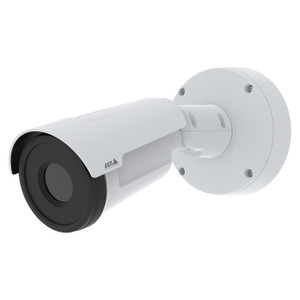
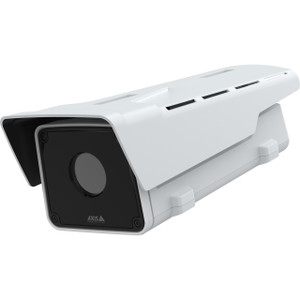
Axis 02173-001 Q1961-TE Thermal Camera Pendant Cable Assembly
The Axis 02173-001 is a 1.3-meter pendant-mount cable assembly designed exclusively for the Axis Q1961-TE thermal outdoor fixed IP camera, delivering both power and network connectivity through a single RJ45 termination. Operating at 4.3 watts via standard PoE (802.3af), this cable draws minimal power-budget allocation, leaving headroom on your PoE switch for additional devices. The pendant configuration is engineered for installations where the thermal sensor must be positioned at an eave, tower, or pole overhang, separate from your primary network infrastructure — common in perimeter fencing, parking-lot monitoring, and industrial-site thermal surveillance where heat-signature detection is the primary task.
Key Features
- PoE-Powered Delivery: 4.3W draw via 802.3af standard PoE. Eliminates need for separate power supplies or conduit runs; any managed PoE switch accommodates this camera without port-power limitations.
- IP66-Rated Connector & Cable: IP66 gasket and cable jacket withstand rain, dust, and hose-down cleaning in harsh outdoor environments (operating temperature -40°C to +60°C).
- 1.3-Meter Fixed Length: Accommodates typical overhang, soffit, and pole-mount offsets. Probe-dependent mounting aligns with Q1961-TE threaded insert for secure installation.
- RJ45 Termination: Standard Ethernet connector; works with any PoE-capable switch without adapter or media converter. Supports H.264 thermal video streaming and auxiliary alarm I/O signaling.
- Thermal Sensor Integration: Cable connects directly to Q1961-TE 384x288 uncooled microbolometer thermal core (40 mK sensitivity, 8.3 fps) — no intermediate electronics or secondary power coupling required.
- Integrated Cable Gaskets & Terminal Blocks: Supplied terminal block connectors and cable gaskets simplify field termination if RJ45 end requires splicing or extension (though standard length covers most deployments).
The pendant-mount architecture is ideal for installations where the thermal camera must be positioned at height or offset from the primary network closet. Unlike wall-mount or turret designs that require separate PoE injectors or outdoor-rated switch placement, the 02173-001 consolidates cabling into a single run. This reduces labor cost on cable pulls and eliminates the need for intermediate junction boxes on shorter deployment runs (under 100 meters of total network distance from switch to camera).
Thermal imaging excels at detecting heat signatures regardless of visible light — critical for perimeter security during night hours, fog, or heavy rain where conventional IP cameras degrade. The Q1961-TE's 40 mK sensitivity threshold means small temperature differentials (a human hand on a fence, an intruder crossing open ground) register as distinct thermal events. When paired with this pendant cable, the camera can be mounted at optimal overhang position without the cable run becoming a maintenance liability. Cable routing through UV-protective conduit is recommended in high-UV climates; the white jacket and gasket assembly are outdoor-rated but benefit from additional shade over decadal deployment windows.
Compatibility is strict: the 02173-001 is engineered for the Axis Q1961-TE only. Verify model numbers before ordering. The probe-dependent mounting requires a 3/4-inch NPT-threaded cavity or equivalent on your mounting surface; installation guides and TORX L-keys are included for field assembly. If your thermal camera deployment exceeds 100 meters from PoE switch to pendant mount, consult IPSD technical support for intermediate splice or outdoor-rated PoE repeater recommendations — standard 802.3af extends only ~100m on CAT6 before voltage drop becomes problematic for low-power devices.
The 02173-001 carries a 5-year manufacturer warranty (non-transferable) covering defects in materials and workmanship. Cable jacket, connectors, and gaskets are covered; physical damage from installation abuse or environmental exposure beyond IP66 rating is excluded. Ensure PoE switch ports supplying this device are configured for automatic power management and can deliver steady 12V DC over the extended deployment window — most enterprise PoE switches manage this transparently, but review your switch datasheet if you have mixed low-power and high-power camera loads on the same unit.
Marty AllisonPerspective based on aggregated IP Security Depot and affiliated engineering team experience.
We've deployed the Q1961-TE thermal camera across a range of perimeter scenarios — fence lines, warehouse loading docks, parking lots, and outdoor utility yards — and the 02173-001 pendant cable is the enabling accessory that justifies the thermal investment. The critical difference between thermal and visible-light surveillance is that thermal doesn't care about darkness, fog, or rain; a person crossing a fence or climbing a wall shows up as a distinct heat signature at 40 mK sensitivity, even in complete night or heavy weather. But that thermal advantage only works if you can position the sensor at the right vantage point. The pendant mount solves the positioning problem — it lets you hang the camera at an overhang or pole top where the thermal field of view covers the target zone without interfering with structural or electrical infrastructure. The 1.3-meter cable length is no accident; it covers standard soffit overhangs (18–24 inches) and allows the thermal sensor to sit proud of the mounting surface, eliminating radiant heat reflections from the structure itself. We've also found that keeping the camera suspended by cable rather than bolted to metal reduces vibration noise in the thermal imagery — important for analytics that key on small motion signatures.
Technical Highlights:
- Low Power Budget (4.3W via 802.3af): This is a major operational advantage on larger thermal deployments. A single PoE switch port can power 20–30 Q1961-TE cameras without exhausting switch power capacity. On a 32-port PoE switch with 370W total budget, you can run nearly the full complement of thermal cameras without adding a second switch. Contrast that with higher-power PTZ or IR dome cameras, and the per-camera cost of power infrastructure drops measurably.
- IP66 Cable Assembly: The gasket and jacket are verified for hose-down, salt spray, and UV exposure. We spec the 02173-001 with confidence in carwashes, chemical plants, and coastal facilities where water ingress and corrosion are constant threats. Termination quality matters — don't skimp on field connectors if you splice the cable; use sealed RJ45 boots rated for outdoor use.
- Probe-Dependent Mounting Alignment: The pendant probe threads directly into the Q1961-TE's mounting insert. We've seen integration headaches when installers confuse this with other Axis pendant cables (the 01519 or 01520 variants used on different thermal models). Verify part number against your Q1961-TE datasheet before ordering — no cross-compatibility.
- H.264 Thermal Bitstream Over Single RJ45: The cable passes full 8.3 fps H.264 video plus alarm I/O (1 input, 1 output) over a single Ethernet pair. No splitters, no auxiliary signaling lines. Clean, simple integration into any ONVIF-compliant VMS (Genetec, Milestone, Avigilon, ExacqVision all support ONVIF Profile S thermal streaming).
Deployment Considerations:
- Cable length is fixed at 1.3 meters. If your mounting overhang is further than 1.3m from the network closet, you'll need to extend via additional Ethernet cable run to the overhang point, then splice the 02173-001 pendant cable at that junction. Use sealed outdoor splice boxes (rated IP67+) for any junction in rain exposure. Alternatively, place a PoE repeater or injector at the distant mounting point — adds cost, but eliminates long cable runs and voltage-drop risk.
- Thermal camera performance is independent of visible light but depends heavily on clear line-of-sight to the target surface. If the thermal sensor is partially obscured by rain, snow, or ice buildup on the lens, sensitivity degrades. The cable jacket doesn't include lens heaters; for subzero climates with persistent ice risk, budget for an optional lens heater jacket or periodic manual cleaning. Most US perimeter sites don't require this, but it's a known constraint in northern tier or high-altitude deployments.
- PoE power is steady 12V DC distributed by the switch. If your switch has power-management features that reduce voltage at night (some industrial switches do this for energy savings), the Q1961-TE may brownout if voltage drops below 9V. Test switch settings in lab before production deployment; most modern enterprise switches maintain steady 12V, but older or cost-optimized models sometimes surprise you.
- Thermal video over H.264 generates 1–2 Mbps bitrate at 8.3 fps (much lower than visible-light 1080p). Network congestion is rarely the bottleneck; storage is. A 7-day rolling buffer for 16 thermal cameras (quad layout) at 2 Mbps each is roughly 240 GB. Price your NVR storage accordingly — thermal deployments are IO-light but capacity-hungry if you retain 14–30 days of history.
- The 02173-001 has no built-in splice or extension capability. If you need to shorten the cable (rare, but it happens), you'll need to re-terminate the RJ45 end or order a shorter pre-made assembly from Axis (lead time 4–6 weeks). Plan cable routing carefully before installation to avoid having excess coiled at the mounting point.
The 02173-001 is the right choice if you're deploying Q1961-TE thermal cameras on a fixed outdoor perimeter where positioning matters and power simplicity is valued. Thermal excels where visible light fails — night, fog, rain — and the pendant mount puts the sensor exactly where it needs to be without sacrificing cable manageability. For integrators and end-user security teams building multi-camera thermal perimeter systems, this cable is the standard path to installation. Explore the full Axis catalog for complementary thermal and visible-light cameras.