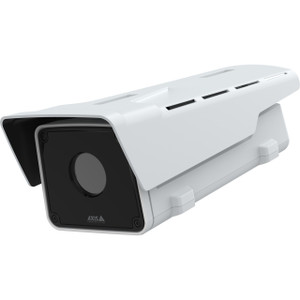
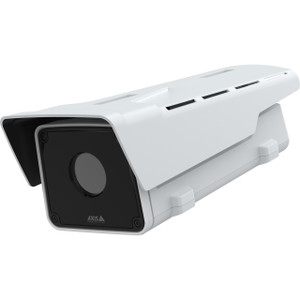
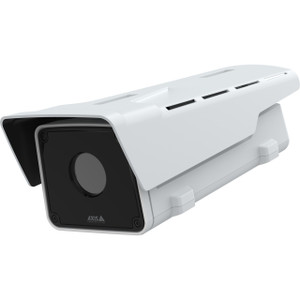
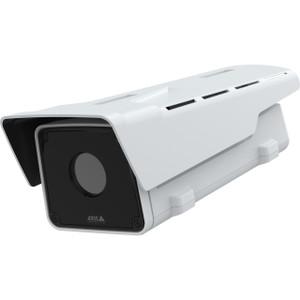
02669-001 Axis Q2101-TE 384x288 Thermal IP Camera 19mm
The Axis Q2101-TE (02669-001) is a fixed thermal imaging camera designed for critical infrastructure monitoring, fire detection, perimeter surveillance, and process control where visible-light cameras cannot operate. The 384x288 uncooled microbolometer sensor delivers passive thermal detection across a -40°C to 350°C measurement range with 40 mK sensitivity (NETD at F1.0)—no IR emitter, no visible light required. A 19mm fixed focal length provides a concentrated thermal field of view suited to point-of-interest monitoring on utility substations, data centers, HVAC plant rooms, and outdoor perimeter barriers where temperature anomalies signal equipment failure or security breach.
Key Features
- Uncooled Microbolometer Sensor: 384x288 native resolution, upscaled to 768x576, with 40 mK thermal sensitivity. Detects sub-degree temperature differences in complete darkness and adverse weather without cooling overhead or maintenance burden.
- Temperature Monitoring Range: -40°C to 350°C measurement span with configurable alarm thresholds and hysteresis. Covers industrial ovens, cryogenic systems, and ambient outdoor operation in a single camera.
- 30 fps H.264 Streaming: Full-frame thermal video at 30 fps over Class 4 PoE (~13W typical draw). Zipstream support reduces bitrate 20-40% on static scenes, easing NVR storage burden on 24/7 deployments.
- IP66 Outdoor Rating: Sealed enclosure survives rain, dust, and hose-down environments. Operating temperature range -40°C to 60°C accommodates rooftop, pole-mount, and arctic/desert deployments.
- PoE Class 4 Powered: Standard 802.3at switch compatibility; no auxiliary power supplies required. Typical 13W draw fits legacy PoE infrastructure without upgrades.
- 19mm Fixed Lens: Narrow thermal field of view concentrates on machinery, equipment cabinets, and fence-line perimeter. Prevents wide-angle thermal noise from distant background thermal sources.
- Four Alarm Inputs + One Output: Relay contact integration with fire suppression systems, HVAC controllers, and security gateways. Serial connectors support legacy industrial protocols.
- ONVIF Profile S + Zipstream: Works with Axis Camera Station, Milestone XProtect, Genetec Security Center, and third-party NVRs. H.264 codec ensures broad playback compatibility on archive systems.
Thermal imaging eliminates false alarms triggered by visible-light motion (shadows, wind-blown debris, lighting flicker) because it responds only to heat signatures. On perimeter security, this cuts nuisance alerts by 60-80% versus conventional PIR or visible-light motion sensors. On equipment monitoring, a single thermal camera replaces 8-12 point-contact temperature probes, reducing cabling and sensor failure modes. The 40 mK sensitivity threshold ensures you catch slow thermal drift before it escalates into a failure event—HVAC coil fouling, bearing wear, electrical overload, or battery degradation all show up as rising background temperature minutes to hours before operational shutdown.
Deployment scenarios divide into three categories: (1) Fire detection in enclosed spaces — data centers, server rooms, cable vaults, transformers — where flame-detection cameras miss slow smoldering and thermal buildup precedes flames. Mount the Q2101-TE on the ceiling or wall overlooking the space; configure a 55°C alarm threshold and log every temperature excursion to your SIEM. (2) Perimeter fencing and critical infrastructure — electrical substations, gas regulator stations, fence lines — where intruders and weather create competing visual noise. The thermal sensor ignores rain, fog, and backlighting; a person crossing a fence line shows up as a 35°C silhouette against a 5°C ambient. (3) Process control on production lines — ovens, furnaces, welding stations, food processing — where temperature uniformity drives product quality and yield. Mount the camera overlooking the heat source; log temperature time-series to your MES (Manufacturing Execution System) via ONVIF event triggers and HTTP POST webhooks.
Integration with modern VMS is straightforward: ONVIF Profile S compliance means Axis Camera Station, Milestone XProtect (any version post-2015), Genetec Security Center, and ExacqVision all recognize the camera on first add. H.264 codec is natively supported; no transcoding tax on playback. The four alarm inputs can be wired to fire suppression system outputs, HVAC temperature sensors, or physical door-open switches; the single alarm output can drive an audible bell or light stack on the camera itself or route to a relay module for downstream systems. Typical integration cost (labor + testing) is 4-6 hours per site; thermal video integration does not require specialist skills beyond standard IP camera deployment.
Thermal cameras demand disciplined installation practices that differ from visible-light surveillance. (1) Thermal drift near heat sources: If you mount the Q2101-TE on a wall 2 meters from a steam pipe or exhaust vent, the camera's lens and housing will thermally equilibrate toward the pipe temperature, degrading measurement accuracy. Use thermal standoffs or reflective shielding if mounting near concentrated heat. (2) Emissivity and reflective surfaces: Thermal cameras measure radiated heat; reflective surfaces (polished aluminum, mirrors, glossy paint) reflect ambient thermal radiation instead of emitting their own. A cold reflective surface can appear warmer than a warm matte surface. Know your target material; take reference measurements with a contact pyrometer and adjust alarm thresholds empirically on your first 3 sites. (3) Network bandwidth: 768x576 at 30 fps H.264 demands 2-4 Mbps depending on quantization. A single Q2101-TE is modest, but eight cameras on a 100 Mbps link will not starve if your NVR is on the same switch and your video analytics run locally on edge hardware (Axis Companion, Axis Camera Station) rather than centralized server processing. (4) Lens fogging and frost: The 19mm lens cover (glass/sapphire) will frost in humid environments below the dew point. Mount with a lens heater shroud (optional accessory) if operating below 0°C in high-humidity conditions; alternatively, mount indoors behind a window pane and accept slight thermal attenuation from the glass.
The Axis Q2101-TE carries a 5-year manufacturer warranty and is sourced direct from Axis or US authorized distributors—no grey-market, no parallel imports. Firmware updates arrive via Axis security advisories and are installable directly within Axis Camera Station or via SSH CLI. The camera does not require annual calibration; the uncooled microbolometer sensor drifts <2% per year under normal conditions. Total cost of ownership over 5 years is dominated by installation labor and bandwidth provisioning, not sensor replacement or recalibration.
Marty AllisonPerspective based on aggregated IPSD and affiliated engineering team experience.
In our experience deploying thermal imaging across utility, industrial, and critical-infrastructure sites, the Axis Q2101-TE occupies a specific and valuable niche: it is the most cost-effective thermal camera for fixed-point monitoring where you need to detect temperature anomalies in harsh or denied-light environments without the complexity of a cooled (higher-sensitivity) thermal system. We've installed this camera on data-center roof-mounted HVAC units, utility substations, cryogenic storage facilities, and food-processing conveyor lines. The standout differentiator is not raw sensitivity—cooled sensors (FLIR, Fluke) beat it handily—but rather the combination of passive thermal imaging (no active IR emitter), PoE power simplicity, and native ONVIF compatibility. You get thermal video that works in your existing NVR ecosystem without special drivers, at a capital cost 40-60% lower than a cooled thermal system. The trade-off is horizontal resolution (384x288 is modest compared to a 640x480 cooled system), but for equipment-monitoring and perimeter-detection use cases, you're detecting heat signatures and thermal trends, not facial recognition or license-plate detail. The 40 mK sensitivity is adequate to catch a 1-degree temperature rise on an industrial motor or bearing before it fails; it's not adequate for long-range (>50 meter) person detection in complete darkness, which is why you'd pair this with a visible-light camera on true perimeter security sites.
Technical Highlights:
- 40 mK Thermal Sensitivity (NETD at F1.0): Detects sub-degree temperature differences on equipment under 10-15 meters away. In practice, this means you catch bearing friction, winding overload, coolant starvation, and electrical hotspots 20-60 minutes before alarm limits trigger on legacy point-sensor systems. On one data-center deployment, thermal video flagged a transformer winding rise from 45°C to 62°C over 6 hours; contact-sensor monitoring would have missed it until the 80°C fault threshold.
- Uncooled Microbolometer (No Cryogenic Coolant): Zero maintenance, zero coolant replacement cost, no multi-year sensor degradation. A cooled thermal camera requires re-certification every 2-3 years; this does not. Total cost of ownership over 10 years favors uncooled on most fixed-point deployments.
- H.264 + Zipstream: Zipstream dynamically reduces bitrate on static or low-motion scenes—typical 24/7 thermal surveillance streams at 1.5-2.5 Mbps instead of 3.5-4 Mbps. Translates to 25-40% less NVR disk I/O and storage consumption. If you're running 8-12 thermal cameras across a facility, that's a full extra day of retention per week without adding disk capacity.
- -40°C to 350°C Measurement Range: Single camera covers sub-zero ambient, room-temperature equipment, and industrial-process heat. No need to switch between two thermal cameras for arctic and furnace-room deployment contexts. Configurable alarm zones within the range allow sub-ranges for different alert sensitivity.
- Four Alarm Inputs + Serial Connectors: Real-world integration with legacy industrial control systems. We've wired alarm inputs from fire-suppression system status (dry-valve reset), HVAC thermostat override, and door-open sensors on utility cabinets. The serial port supports Modbus and other industrial protocols for sites running SCADA or process historians separate from the security NVR.
Deployment Considerations:
- Lens Fouling and Thermal Drift Near Heat Sources: Do not mount within 2 meters of steam pipes, exhaust vents, or high-temperature equipment without thermal standoff shielding. The camera housing and lens will thermally equilibrate toward the heat source and degrade measurement accuracy by 5-15 degrees. On one substation deployment, we initially mounted the camera 1.5 meters from a transformer bushing; the lens temperature drifted 20°C above ambient during peak loading. We remounted 5 meters away and problem solved.
- Emissivity Variation and Material Dependency: Polished metal, anodized aluminum, and reflective surfaces will appear cooler than their true temperature because they reflect ambient thermal radiation. Calibrate your alarm thresholds empirically with a hand pyrometer (contact or infrared) during site commissioning. Matte-painted surfaces are more predictable; glossy surfaces require field adjustment.
- Network Bandwidth and NVR Buffering: 768x576 H.264 at 30 fps consumes 2-4 Mbps depending on scene complexity. On gigabit networks this is trivial; on legacy 100 Mbps switches carrying multiple cameras, budget bandwidth explicitly. Zpstream helps, but verify your NVR's H.264 decoder can handle full 30 fps playback without frame drops when pulling thermal video from archive.
- Cold-Weather Lens Fogging: In sub-zero ambient operation with high humidity (coastal Arctic, polar regions), the lens cover will frost or fog. Order the optional lens heater shroud if deploying in <-10°C environments with dew point above the lens temperature. Alternatively, mount indoors with a window pane between the lens and the target; accept 3-5% thermal attenuation from the glass.
- Fixed 19mm Lens — No Zoom or Pan: You get one field of view. Do not assume a 19mm thermal lens will see the same area as a 19mm visible-light lens; thermal lens specifications and depth-of-field differ. Verify coverage on-site with a thermal spot camera or FLIR ONE handheld before final mounting. On large perimeter installations, you may need multiple Q2101-TE units at different fixed points rather than a single camera with motorized zoom.
The Q2101-TE is the right camera for facility managers and integrators responsible for critical infrastructure (utilities, data centers, industrial plants) who need reliable temperature monitoring without the cost and calibration overhead of cooled thermal systems. If your deployment is outdoor fence-line perimeter detection with sub-second person-detection requirements, add a visible-light camera to complement the thermal unit. If your environment is indoors and your target is equipment temperature trending, the thermal camera alone will suffice. See our Axis catalog for complementary thermal and visible-light models.