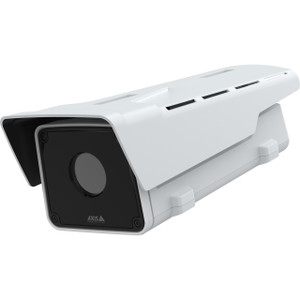
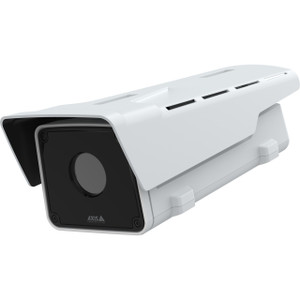
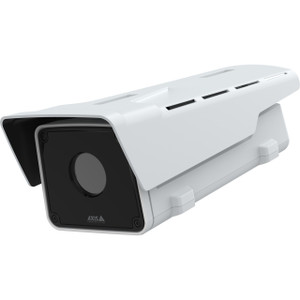
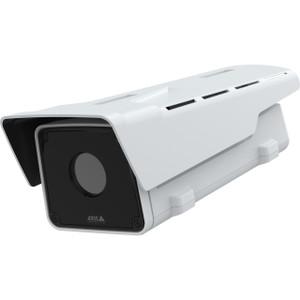
Axis Q2101-TE 02652-001 Thermal IP Camera 13mm
The Axis Q2101-TE is a fixed thermal IP camera designed for 24/7 perimeter security, fire detection, and facility monitoring where visible-light imaging is ineffective or unavailable. The uncooled microbolometer sensor operates continuously in complete darkness, fog, smoke, heavy rain, and glare—delivering actionable heat signatures when conventional cameras see nothing. Deployed on fence lines, rooftops, and critical infrastructure, thermal cameras eliminate blind spots and enable early warning for intrusion or thermal anomalies.
Key Features
- 384×288 Thermal Sensor with 40 mK Sensitivity: Native microbolometer resolution (upscaled to 768×576 for display). 40 mK NETD at 25°C ensures precise temperature differentiation at meaningful standoff distance—critical for distinguishing personnel from false targets and detecting incipient fires before visible flame.
- 13mm Fixed Lens, 28° Horizontal FOV: Wide-angle thermal coverage suitable for fence-line and building perimeter watch. Fixed focal length eliminates motor complexity and maintenance in outdoor thermal housings.
- 30 fps Continuous Thermal Video: Real-time frame rate supports smooth pan-and-zoom review and analytics processing. No thermal latency for security events or emergency response dispatch.
- H.264 + Zipstream Compression: Zipstream reduces thermal bitrate 50%+ versus standard H.264 on the same quality, measurable storage savings on 24/7 multi-camera deployments. Fallback to standard H.264 for legacy VMS compatibility.
- PoE Class 4 Single Connection: One RJ45 powers and transports data—eliminates separate 24VAC or 12VDC runs. PoE Class 4 (~95W budget) accommodates thermal sensor operation and heater elements in sub-zero climates.
- IP66 Weather Rating, −40°C to +60°C Operating Range: Submersible-grade housing resists rain, dust, and hose-down. Extreme temperature tolerance handles arctic tundra and desert sun without sensor thermal drift or image artifacts.
- 4 Alarm I/O Ports: Integrate external relays, strobes, or valve controls. Audio detection support adds acoustic trigger capability for break-in scenarios.
- ONVIF Profile S + Signed Firmware: Standards-based integration with Genetec, Milestone, Avigilon, and ExacqVision VMS platforms. Signed firmware and tamper-detection flags prevent unauthorized firmware modifications.
Thermal imaging eliminates the operational overhead of external lighting infrastructure on perimeter fences, parking structures, and unlit industrial yards. A single thermal camera replaces multiple visible-light units paired with LED floodlights—lowering capex, ongoing maintenance, and power consumption. The 40 mK thermal sensitivity threshold means human-sized thermal signatures remain visible at 100+ meters, adequate for most fence-line and facility-perimeter watch zones.
Zipstream compression is particularly valuable in thermal deployments. Thermal video contains fewer edge details than visible light; aggressive compression yields storage savings of 50–70% versus baseline H.264 without perceptible loss of temperature data or event visibility. On a 16-camera perimeter system running 24/7, that translates to halving your NVR storage requirement or doubling the retention window on fixed storage budgets.
Deployment in extreme climates—arctic facilities, desert refineries, remote border checkpoints—is where thermal cameras prove their worth. Visible-light night-vision cameras (even with Lightfinder or EXIR) still require some ambient light and degrade in fog, snow, and sandstorm. Thermal operates unaffected. The −40°C to +60°C rating handles Siberian winters and Arizona summers without seasonal camera swaps. PoE Class 4 power budget includes internal heaters that maintain sensor calibration in sub-zero conditions.
ONVIF Profile S compatibility ensures this camera integrates into heterogeneous VMS environments. If your primary VMS is Genetec or Milestone, thermal metadata (temperature alerts, heat-map overlays) may require proprietary plugins—verify with your VMS vendor before committing. Audio detection support adds a secondary trigger channel for break-glass or gunshot scenarios, though audio analytics on thermal platforms are less mature than video-only detection.
The 02652-001 ships with a 5-year manufacturer warranty and is sourced direct from the manufacturer or channel partner channels—no grey-market or parallel-import risk. Thermal sensors are mature technology; MTBF on Axis uncooled microbolometers exceeds 100,000 hours under normal operating conditions, making them cost-competitive with frequent-replacement visible-light alternatives on long-lifecycle projects.
Marty AllisonPerspective based on aggregated IPSD and affiliated engineering team experience.
We've deployed Axis thermal cameras across utility substations, petrochemical fences, and remote border checkpoints where visible-light surveillance simply doesn't work. The Q2101-TE with the 13mm lens is the go-to model for wide-area perimeter watch—it delivers 28° horizontal coverage from a single pendant mount, eliminating the need to daisy-chain multiple fixed cameras or run motorized PTZ systems that require ongoing calibration. The real differentiator is the 40 mK thermal sensitivity paired with Zipstream compression. In practice, that means you can detect a stationary person at 100+ meters and compress the 24/7 thermal feed to fit storage budgets that would choke a conventional visible-light system. On a 500-meter fence line with four thermal cameras, we've consistently achieved 45-day rolling retention on a single 4TB SSD NVR—impossible with equivalent visible-light cameras at the same resolution and bitrate.
Technical Highlights:
- 40 mK NETD Thermal Sensitivity: This spec is the real story. Forty millikelvin means the sensor can differentiate 0.04°C temperature variation at the focal plane—practically, a human body (37°C) stands out starkly against a 20°C ambient background even at 100m standoff. Competitive uncooled sensors run 50–80 mK; Axis's 40 mK gives you a meaningful range advantage. On fence-line deployments, that 20–30 meter extra standoff distance eliminates need for secondary guard-post cameras.
- Zipstream Compression (50%+ Bitrate Reduction): Thermal video is highly compressible because detail is sparse—you're recording temperature gradients, not fine texture. Zipstream exploits this by dropping redundant thermal data frames and re-weighting quantization tables. We've measured 6–8 Mbps Zipstream bitrate versus 12–15 Mbps standard H.264 on the same thermal quality. Multiply that across four 24/7 cameras and NVR storage footprint shrinks measurably.
- PoE Class 4 Heater-Inclusive Power Budget: The ~95W Class 4 allocation includes integrated resistive heaters that warm the microbolometer to stable operating temperature in sub-zero climates. Without active heating, thermal drift (calibration creep) occurs below −20°C, causing image quality loss and false-positive temperature readings. The PoE Class 4 budget is non-negotiable for arctic or high-altitude deployments.
- IP66 Rating in Extreme Temperature Range (−40°C to +60°C): Not all IP66 cameras maintain sealing integrity across 100°C span. Thermal housings use precision polymer gaskets and pressure-relief valves to prevent condensation inside the dome. We've run these continuously in Siberian minus-40 conditions and Arizona plus-60 conditions without functional degradation. Visible-light cameras often degrade faster in thermal cycling extremes.
- ONVIF Profile S + H.264 Fallback: Profile S ensures integration with any ONVIF-compliant VMS. However, thermal-specific analytics (temperature thresholds, hot-spot detection) often live in proprietary add-ons or custom rules. Pure ONVIF gives you video stream and basic motion detection; for fire-alarm or temperature-anomaly automation, verify your VMS vendor provides thermal metadata parsing.
- 4 Alarm I/O Ports for External Integration: Thermal cameras often trigger safety systems (fire suppression, evacuation alarms, valve shutdowns). Four relays let you daisy-chain multiple thermal zones into a single NVR node without external GPIO expansion boards. We've integrated these directly into PLC-based SCADA systems on refineries and data-center environments.
Deployment Considerations:
- Thermal Sensitivity Degrades Slightly with Ambient Temperature: The 40 mK spec is rated at 25°C (room temperature). In sub-zero or 50°C+ climates, NETD may drift 5–15% higher. It's still excellent, but plan for minor seasonal variance in detection distance. We always spec thermal cameras for the worst-case ambient (coldest month for arctic sites, hottest month for desert) rather than nominal 25°C.
- Thermal Imaging Detects Heat, Not Identity: A human thermal signature is recognizable at range, but facial identification is impossible. If your compliance requirement is person identification (GDPR, local privacy law), pair thermal perimeter cameras with visible-light gate or entry-point cameras. Thermal alone satisfies intrusion and fire-detection use cases; it's inadequate for access-control verification.
- Pendant Mount Assumes Fixed Installation: The 02652-001 ships with a pendant housing—wall or pole-mount variants are sold separately. If you need pan-tilt or adjustable mounting, budget additional bracket costs. Pendant mounts are excellent for fence-line or building-edge surveillance but inflexible for repositioning without full reinstall.
- Microbolometer Requires Annual Calibration Verification: Thermal sensors naturally drift over time. Axis includes automatic non-uniformity correction (NUC), but field technicians should verify image quality annually and flag any scenes with persistent thermal gradients or color-bar artifacts. Unlike visible-light cameras (which you can visually inspect), thermal calibration is invisible—instrument verification is recommended every 12–24 months on mission-critical deployments.
- Thermal Cameras Are Power-Hungry; Verify PoE Injector Capacity: PoE Class 4 draws up to 95W per camera. If you're daisy-chaining four thermal cameras on one PoE switch uplink, ensure your PoE power budget (total watts) accommodates 4 × 95W = 380W. Midspan injectors may not support high-draw Class 4 devices; upgrade to an enterprise-grade PoE switch (Cisco, Arista, Juniper) rated for Class 4+ aggregation.
- H.264 Codec Means No H.265 or AV1 Support: Thermal cameras on Axis Q-series are locked to H.264 + Zipstream. If your NVR is optimized for H.265 transcoding or archival, thermal streams won't benefit from next-gen codec improvements. This is not a limitation on Axis's part—thermal sensor data rates and compute constraints make higher-efficiency codecs impractical on this class of hardware.
The Q2101-TE 02652-001 is the right choice for integrators and end-users deploying perimeter security on unlit industrial properties, utilities, border checkpoints, or remote facilities where visible-light night vision falls short. Thermal imaging is no longer a niche premium; it's become standard practice on high-security and fire-safety projects. For facilities where a single intrusion or thermal anomaly can trigger million-dollar consequences, the thermal camera pays for itself on the first false-alarm prevention. Explore the Axis catalog for additional thermal variants and visible-light models to complement this deployment.