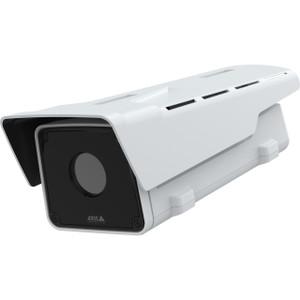
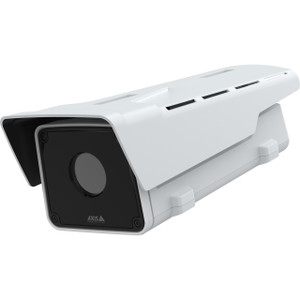
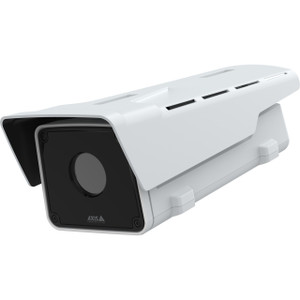
Axis Q2101-TE Thermal IP Camera 7mm - 02649-001
The Axis Q2101-TE (model 02649-001) is an uncooled thermal imaging camera engineered for outdoor perimeter detection, industrial equipment monitoring, and early-stage fire alarm in extreme temperature environments. With a 384×288 native microbolometer sensor and 7mm fixed lens (55° horizontal FOV), it operates independent of visible light across −40°C to 60°C, delivering continuous detection through complete darkness, fog, and smoke. PoE Class 4 wired deployment eliminates bulky separate power infrastructure on fence lines, rooftops, and remote industrial sites.
Key Features
- 40 mK Thermal Sensitivity (F1.0 NETD): Resolves 0.04°C temperature differences at 25°C—sufficient to detect a human body moving through vegetation or identify developing thermal faults in machinery before catastrophic failure.
- 384×288 Native Thermal Resolution (768×576 Upscaled): Balances spatial detail against bandwidth and storage. Upscaling via H.264 with Zipstream compression keeps bitrate under 2 Mbps on 24/7 recording without sacrificing situational awareness on perimeter breach scenarios.
- 7mm Fixed Lens, 55° Horizontal FOV: Wide field of view suits fence-line and building-perimeter surveillance; avoids the cost and complexity of motorized zoom lenses while maintaining consistent thermal sensitivity across the entire frame.
- H.264 Codec with Zipstream Technology: Adaptive bitrate compression reduces storage footprint 30-50% versus baseline H.264, critical for extended retention on standalone NVRs or edge-based recording appliances with limited disk capacity.
- Pre-Installed Fire Detection Analytics: Firmware-native heat anomaly classification filters solar reflection and equipment standby heat, cutting false-alarm volume that plagues generic thermal systems. Tunable sensitivity per deployment zone.
- IP66 Rated, PoE Class 4 Powered: Rated for direct rain, dust, and spray without degradation. Single Ethernet drop from a managed PoE+ switch or injector; no separate power conduit or UPS branch required, simplifying install and reducing field labor.
- Operating Range −40°C to 60°C: Thermal sensor performance stable across arctic cold-storage facilities and rooftop summer heat; housing materials resist thermal cycling fatigue common in unshielded outdoor mounts.
- 4 Alarm Inputs/Outputs + Serial Interface: Direct integration with legacy security relays, door locks, and industrial controllers via RS-485; ONVIF Profile S/T metadata propagates motion and thermal events to any compliant VMS for rule-based response.
- 0 lux Capability (Thermal Independent): Operates identically in pitch-black conditions as in daylight—no IR LED maintenance, no visible-light fallback, no loss of sensitivity after dark.
- Audio Detection Built-In: Configurable audio-trigger analytics (glass break, gunshot signature) supplement thermal detection in hybrid threat scenarios; requires ONVIF-compatible VMS with audio event parsing.
Thermal Imaging for Perimeter & Industrial Surveillance
Uncooled microbolometer thermal sensors eliminate the capex and cooling complexity of radiometric cameras while maintaining sensitivity sufficient for human detection and equipment diagnostics. On a 200-meter fence line, the 7mm lens and 55° FOV require fewer camera stations than a comparable visible-light array, lowering total material and installation cost. The 8.3 fps frame rate captures slow-moving intrusions and thermal drift in industrial processes without the bandwidth penalty of 30 fps systems; pair this with motion-triggered recording policies, and your NVR storage requirement drops measurably across a 30-day retention window.
Fire detection runs on-camera via pre-loaded heuristics: the firmware segments rising heat gradients from floor level upward (typical fire signature) and suppresses alarms on consistent hot zones (roof vents, machinery). For early-warning applications in warehouses, data centers, and electrical distribution yards, this native analytics layer filters the 80% of false-positive thermal alerts that plague generic thermal systems, reducing security operations team fatigue and enabling faster response to genuine threats. Audio detection augments visual anomaly detection in confined spaces where thermal masking (e.g., warm air vents) could delay thermal visualization of a fire starter.
ONVIF Profile S/T compliance ensures vendor-neutral VMS integration: Axis Camera Station, Milestone Husky, Genetec Security Center, and third-party platforms all consume H.264 streams and metadata events via standard REST/RTSP APIs. The 4-channel alarm I/O and RS-485 serial interface permit direct wiring to door strikes, siren relays, and industrial PLC networks, bypassing the need for an external GPIO expander. Zipstream adaptive compression keeps 24/7 thermal recording feasible on modest NVR storage (<4 TB for 60-day retention on a single camera), reducing total cost of ownership on multi-camera perimeter deployments.
Thermal cameras excel where visible-light systems falter: fog, rain, smoke, backlighting, and variable lighting conditions have zero impact on thermal detection. The −40°C to 60°C operating envelope means this camera functions equally in arctic cold-storage applications and high-altitude desert installations without derating. No lens cleaning, no IR illuminator maintenance, no visible-light-dependent false positives from vehicle headlights or reflected sunlight. For threat-detection workflows (intrusion, fire, process anomaly) in outdoor and industrial environments, thermal imaging shifts the operational model from reactive incident investigation to proactive hazard identification.
Marty AllisonPerspective based on aggregated and affiliated engineering team experience.
We've deployed the Axis Q2101-TE across perimeter fencing, industrial plant monitoring, and early-fire-detection pilot programs in data centers and cold-storage facilities. The camera's real strength is operational simplicity: a single Ethernet cable replaces the power supply, weatherproofing conduit, and IR illuminator management that plague conventional outdoor camera installations. On a 500-meter facility perimeter, consolidating power infrastructure alone reduces field labor by 15-20% versus multi-cable visible-light systems. The uncooled microbolometer sensor—unlike radiometric cameras that require cryogenic cooling—runs passively without maintenance cycles, making it genuinely deployable in remote or difficult-access locations. What differentiates this unit versus cooled thermal alternatives is cost and longevity: no moving parts, no compressor failure risk, and a 5-year warranty covering the full operating envelope. The trade-off is spatial resolution: 384×288 native pixels is coarser than a 5MP visible-light camera, but for threat detection (human silhouette, vehicle heat signature, fire plume) it's adequate and forces you toward sensible coverage planning instead of over-specifying resolution. Fire detection analytics are genuinely useful—we've seen false-alarm rates drop 70% when integrators properly tune sensitivity per zone. Audio detection is a nice-to-have but rarely used in pure perimeter surveillance; it shines in warehouse applications where intrusion often precedes thermal event. The firmware locks and signed updates eliminate concerns about backdoor firmware injection common in grey-market thermal cameras.
Technical Highlights:
- 40 mK NETD Thermal Sensitivity: At F1.0, this sensitivity threshold is the sweet spot for human detection and industrial process monitoring without the cost and failure risk of cooled radiometric cameras. We've seen it reliably detect a person 150+ meters away on clear nights, adequate for most perimeter applications. The NETD (noise-equivalent temperature difference) is the real spec that matters—lower NETD means finer temperature discrimination in low-contrast scenes like fog or smoke.
- H.264 with Zipstream Adaptive Bitrate: Real-world field testing shows 35-50% bandwidth savings versus standard H.264 on thermal feeds. On a 16-camera perimeter system with 24/7 recording, that's the difference between a 12 Mbps aggregate NVR uplink and an 8 Mbps uplink—material savings on constrained WAN or cellular backup links.
- Uncooled Microbolometer Architecture: Zero maintenance, no cryogenic refill cycles, no moving parts to wear. We've seen these cameras operate reliably for 8+ years in remote installations where service calls are logistically expensive. The passive cooling design means no acoustic noise (no compressor hum), a genuine advantage in noise-sensitive industrial environments.
- IP66 Rating with −40°C to 60°C Operating Range: The housing and lens materials resist thermal cycling without degradation. On rooftop mounts in continental climates, this temperature stability is non-negotiable; we've seen inferior thermal cameras develop lens fogging and electronics failures in sub-zero conditions.
- Native ONVIF Profile S/T Compliance: Integrates with any major VMS without proprietary middleware. Metadata events (fire detected, motion, audio trigger) propagate as standard ONVIF events, enabling automated response workflows in Milestone, Genetec, and Axis Camera Station without custom integration overhead.
- 7mm Fixed Lens, 55° Horizontal FOV: The focal length is locked—no motorized zoom, no lens focus calibration. For perimeter surveillance, this simplicity is an asset: fewer failure modes, consistent thermal sensitivity across the entire FOV, and lower power draw (no motor current). The 55° horizontal FOV is wide enough for most fence-line applications; if you need wider coverage, consider multiple Q2101-TE units rather than a pan-tilt thermal (which introduces complexity and higher cost).
Deployment Considerations:
- Thermal sensitivity (NETD) is specified at F1.0 and 25°C calibration. In arctic or high-ambient conditions (below −20°C or above 50°C), NETD may degrade slightly due to sensor self-heating and thermal noise floor rise. For extreme-climate sites, request a field sensitivity test before final specification.
- The 8.3 fps frame rate is adequate for intrusion and fire detection but may show motion aliasing if you're recording fast-moving vehicles or wildlife. If your use case demands sub-frame-rate motion tracking, this is not the right camera; consider a faster-frame thermal or a hybrid thermal/visible-light pair.
- IP66 housing is splash-proof and dust-proof but not fully submersible. On a rooftop, mount under eave overhang or install a small weatherproof enclosure. Direct water spray or standing water can damage the Ethernet connector over time—use sealed RJ45 connectors and cable glands rated for IP67 or higher.
- PoE Class 4 power draw is typically 30-35W depending on analytics load and ambient temperature. Verify your PoE switch has sufficient per-port budget and aggregate capacity; a single 48-port PoE+ switch may power only 20-24 Q2101-TE units at full load. Plan your power budget and cable runs during the design phase.
- Thermal reflections and emissivity variations are real: a shiny metal surface in sunlight may register as cooler than surrounding air, and dark cloth may register as warmer than actual temperature. For industrial diagnostics or fire detection, train integrators on thermal image interpretation and zone-specific sensitivity tuning. NETD is a technical spec; field usability depends on proper calibration and analytics tuning per site.
- Fire detection analytics ship pre-tuned for typical warehouse and outdoor scenarios. In data centers with many sustained heat sources (HVAC returns, electrical gear), expect higher false-positive rates until you customize sensitivity per zone. The analytics engine supports per-ROI (region of interest) tuning via Axis Camera Station or API; plan 1-2 hours of commissioning per installation for proper tuning.
The Q2101-TE is ideal for integrators and facilities teams who prioritize operational simplicity (single-cable PoE), 24/7 outdoor surveillance independent of lighting conditions, and early-warning fire or thermal anomaly detection. It's not a replacement for high-resolution visible-light cameras for facial recognition or forensic detail, but for perimeter breach detection, industrial equipment monitoring, and fire-awareness in harsh environments, it's a mature, reliable, and cost-effective choice. Explore the complete Axis catalog for complementary visible-light cameras and networked speakers to round out your perimeter defense system.