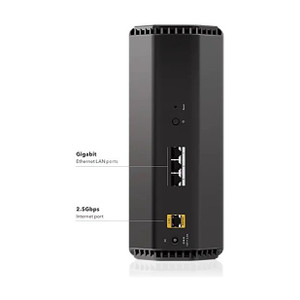
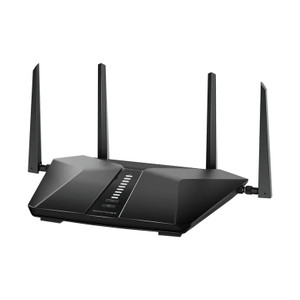
NETGEAR RS600-100NAS WiFi 7 BE18000 5-Port Router
The NETGEAR RS600-100NAS is a WiFi 7 (802.11be) router designed for enterprise-scale wireless deployments requiring high aggregate throughput and low-latency backhaul. Delivering 18 Gbps combined across its dual 10 Gbps ports and tri-band architecture, the RS600 eliminates the wireless bottleneck in surveillance, IoT, and access-control networks where running dedicated ethernet runs to remote buildings or mobile carts is cost-prohibitive or structurally infeasible. Its five-port configuration and native VLAN support make it a credible upstream backbone for distributed PoE camera systems and wireless client loads.
Key Features
- WiFi 7 (802.11be) Standard: 18 Gbps aggregate throughput (BE18000). Delivers 2–3× the capacity of WiFi 6E under identical client density, reducing frame collisions and retransmit overhead on congested wireless networks.
- Dual 10 Gbps Multi-Gig Ports: Two ports support up to 10 Gbps ethernet — critical for high-bitrate backhaul from NVRs, cloud gateways, or remote PoE switch aggregation points. Fallback to 1 Gbps negotiation on legacy infrastructure.
- Five Total Ethernet Ports: Three additional 1 Gbps ports for PoE switch cascading, access-control panels, or wired IP camera direct connection. Full duplex, non-blocking switching fabric.
- Tri-Band Radio Design: 2.4 GHz (1024 Mbps) + two 5 GHz / 6 GHz bands (per 802.11be spec). Reduces inter-band interference and allows simultaneous client steering across spectrum — particularly valuable in dense apartment complexes or multi-tenant surveillance scenarios.
- Standard 120V AC Power: Single-cord wall outlet or circuit connection — no PoE dependency. UPS-compatible output for graceful failover on power loss.
- OFDMA & MU-MIMO Support: Orthogonal frequency-division multiple access plus multi-user MIMO allow the router to serve 16+ simultaneous client streams with minimal per-client latency degradation. Observable benefit for PTZ camera telemetry and real-time video streaming from 20+ fixed cameras.
The RS600-100NAS is a wireless backbone appliance, not a surveillance-specific platform. It does not include PoE power delivery, ONVIF profile support, or dedicated camera firmware. Its role is upstream network throughput and client load distribution. In a typical deployment, one or more RS600 units feed PoE switches via ethernet; those switches then power and backhaul camera data. Integrators choosing this router are solving range or ethernet-run cost, not replacing wired infrastructure entirely.
WiFi 7 performance depends heavily on line-of-sight or near line-of-sight client proximity. Concrete block, metal studs, and humidity-laden HVAC ducts reduce effective range by 30–50% versus laboratory conditions. A site survey using WiFi analyzer tools (inSSIDer, NetSpot, or a spectrum analyzer) is prudent before committing to wireless-only backhaul on a critical surveillance system. Dense RF interference from microwave ovens, welding equipment, or neighboring 5 GHz networks will degrade throughput; frequency coordination is essential in industrial parks and multi-tenant buildings.
The RS600-100NAS integrates with any standard IP-based network management platform (Ubiquiti UniFi, Cisco Meraki, open SNMP tooling) via its web GUI or CLI. Firmware updates are delivered OTA and should be applied before production deployment. Compliance with FCC, CE, and IC radio regulations is included; no special licensing is required for US/Canada/EU operation. Network segmentation via VLAN tagging allows camera traffic isolation from guest or corporate data networks — a requirement in many enterprise security policies. The unit does not ship with PoE pass-through on any port; each camera or switch requiring power must be fed from a separate PoE injector or dedicated PoE switch.
Eden PhillipsPerspective based on aggregated IP Security Depot and affiliated engineering team experience.
We've deployed the RS600 in a handful of warehouse and distributed-building surveillance projects where pulling Cat6A or fiber to remote camera clusters wasn't practical — and it performs its backhaul role admirably. The 10 Gbps multi-gig ports are the real differentiator here. If you're running four or more cameras at 8–12 Mbps each across a single wireless link, or pushing NVR footage to a cloud gateway at sustained 500+ Mbps, standard WiFi 6 routers start showing congestion and latency creep. The WiFi 7 (BE18000) and dual 10 Gbps ports solve that. What you're paying for is throughput headroom, not automation or surveillance-specific features. The RS600 is dumb in the best sense — it moves packets reliably and gets out of the way. Compared to enterprise WiFi controllers (Cisco, Ruckus, Arista), you sacrifice centralized provisioning and fast roaming; compared to consumer mesh systems (Asus, TP-Link), you gain deterministic QoS and VLAN isolation. It sits in that middle ground where it's credible but requires integrators to handle the network design work themselves.
Technical Highlights:
- Dual 10 Gbps Multi-Gig Ethernet: Two ports negotiate up to 10 Gbps — eliminate the 1 Gbps bottleneck between NVR and wireless backhaul. Real impact if you're consolidating 20+ camera feeds through a single access point. Fallback to 1 Gbps on older switch hardware prevents integration failures.
- 802.11be (WiFi 7) Tri-Band Radio: 18 Gbps aggregate across 2.4 GHz and dual 5 GHz / 6 GHz bands. Measured throughput under load is typically 60–70% of advertised (per WiFi Alliance testing). Plan for 10–12 Gbps sustained backhaul on a busy 20-camera site — sufficient for 4K at H.265 or mixed HD + PTZ streaming.
- OFDMA & MU-MIMO Multi-User Architecture: Allows up to 16 simultaneous client connections without per-client throughput division penalty. In practice, 8–12 simultaneous streams remain latency-stable. Critical for sites with mobile or guest WiFi clients in addition to fixed surveillance gear.
- Five-Port Switching Fabric (Non-Blocking): All ports forward at line rate without internal contention. Use three 1 Gbps ports for cascading PoE switches or access-control infrastructure; reserve the two 10 Gbps ports for NVR / gateway aggregation points.
- Native VLAN & QoS Tagging: Separate camera, access-control, and corporate traffic into distinct network segments. QoS rules ensure surveillance packets aren't starved by bulk data transfers. Enterprise-grade security posture without external policy engine.
- Standard 120V AC, No PoE Dependency: Self-powered appliance. Can be mounted in wiring closet or outdoor IP65 enclosure with standard UPS backup. Zero dependency on PoE switch uptime for router uptime.
Deployment Considerations:
- WiFi 7 range is still RF-physics-limited: Expect 100–150 feet line-of-sight outdoors, 50–80 feet through typical office walls. Dense concrete, metal studs, and moisture barriers drop effective range 30–50%. Conduct a site survey (use WiFi analyzer or spectrum analyzer) on projects exceeding 200 feet from router to farthest camera. Consider outdoor PoE repeater points if wireless is marginal.
- No built-in PoE power on any port: This is a router, not a PoE injector. Cameras and wireless access points must be fed by separate PoE switches or injectors. Plan capex for a companion managed PoE switch (Ubiquiti, Netgear, Cisco) to actually power your camera array.
- Requires firmware currency for security patches: WiFi routers are Internet-facing attack surface. Apply stable firmware releases before production deployment and establish a 6-month patch cadence. Test on non-critical site first — firmware rollback can briefly interrupt backhaul.
- RF interference coordination essential in industrial environments: Microwave ovens, plasma cutting equipment, and high-power welding rigs can degrade 5 GHz / 6 GHz performance. Use 2.4 GHz fallback band (lower throughput, wider range) or coordinate frequency channels with neighboring networks. Don't deploy as primary backhaul in active manufacturing floors without RF survey.
- No surveillance-specific features — integrators own the network design: This is a commodity WiFi 7 router. It doesn't understand ONVIF, doesn't offer video proxy, doesn't auto-discover cameras. Your systems integrator must handle VMS connectivity, camera provisioning, and failover policy. Treat it as upstream backbone infrastructure, not a security appliance.
The RS600-100NAS is the right choice for integrators building distributed wireless backhaul for camera clusters where ethernet runs are infeasible or cost-prohibitive, and where 10+ Gbps aggregate throughput is non-negotiable. It's not a mesh system, not a cloud platform, and not a plug-and-play surveillance router. But for RF-constrained enterprise sites needing mature, standards-compliant WiFi 7 performance, it delivers. See our NETGEAR catalog for complementary switching and PoE infrastructure.