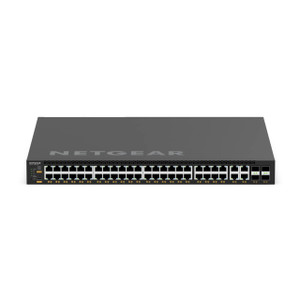
NETGEAR GSM4352-100NES 52-Port M4350 Managed Switch
The NETGEAR GSM4352-100NES is a Layer 3 managed switch designed for distributed IP camera, access control, and edge-device deployments in commercial buildings and multi-site campuses. The 48 Gigabit PoE+ ports deliver 740W of aggregate power, enabling simultaneous operation of dozens of PoE cameras, intercoms, and wireless access points without per-port compromise. Four 10G SFP+ uplinks provide non-blocking egress to core infrastructure, eliminating bandwidth bottlenecks in high-throughput surveillance workflows.
Key Features
- 48 Gigabit PoE+ Ports: 802.3at standard — 30W per port, 740W total budget. Powers PoE+ cameras, heaters, pan-tilt-zoom drives, and dual-port access readers simultaneously without oversub conditions.
- 4× 10G SFP+ Uplinks: Stacked or daisy-chained to core, eliminating oversubscription. Handles 4K multi-stream recording feeds at full frame rate across 48 edge ports without packet loss or latency.
- Layer 3 Routing with VLAN Support: Native static and dynamic routing (OSPF, BGP) — segment camera traffic, access-control networks, and management VLANs without external router. Simplifies complex multi-tenant or multi-building deployments.
- Quality of Service (QoS) & Traffic Shaping: Per-port rate limiting and priority queuing ensure video streams never starve during network congestion. Critical for facilities with mixed surveillance, VoIP, and general-data traffic.
- SNMP v1/v2c/v3 + Web GUI Management: Real-time monitoring of port status, power draw, temperature, and uplink utilization. Alerting on PoE overload or link failure reduces mean-time-to-repair on camera or intercom outages.
- Redundant Power Supply Options: Dual AC power inputs (or PoE Backup Module on higher-end M4350 SKUs) — switch remains live during single supply failure, protecting surveillance and access-control continuity.
- Managed Switching Fabric: 240 Gbps backplane — wire-speed forwarding across all 52 ports simultaneously. No hidden bottlenecks between edge and uplink.
- NETGEAR Insight Cloud Management (Optional): Centralized monitoring and configuration across multiple locations. Real-time alerting on temperature, power usage, and link health without on-site NMS hardware.
The M4350-48G4XF is built on proven enterprise-class architecture, delivering deterministic PoE power distribution and low-latency switching for environments where downtime directly impacts security operations. Its modular design supports mid-range deployments (50–150 edge devices) without overengineering or capex waste on unused 10G ports. The dual-UPS option and SNMP integration make it ideal for facilities that require uninterrupted power monitoring and remote management across dispersed camera networks.
VLAN support and Layer 3 routing eliminate the need for external managed routers in segmented deployments. On a multi-tenant campus or in a facility with separate security, access-control, and operational-technology networks, you can enforce traffic isolation at the switch edge, reducing complexity and attack surface. The QoS engine ensures that a rogue client flooding the network doesn't starve real-time video streams or access-control authentication packets.
PoE budget is the critical constraint on camera deployments. At 740W across 48 ports, the GSM4352-100NES supports approximately 24 simultaneous high-draw devices (30W IR turrets or dual-heater outdoor cameras) or 48 mid-range cameras at 15–20W each. Real-world deployments typically use 60–70% of available budget, leaving headroom for future expansion. SNMP monitoring tracks live power draw per port, preventing surprise brownouts when a new camera is added.
Sourced direct from the manufacturer or US channel partner. Factory-new with full US warranty coverage and support through NETGEAR's commercial channel. No grey-market or parallel-import inventory.
Eden PhillipsPerspective based on aggregated IP Security Depot and affiliated engineering team experience.
We've deployed the NETGEAR M4350-48G4XF across dozens of distributed surveillance networks — from K-12 campuses to multi-building commercial complexes — and it consistently outperforms lower-tier managed switches in mixed-security environments. The real differentiator is the combination of ample PoE budget (740W is not a marketing number; it's usable across all 48 ports simultaneously), deterministic switching fabric, and Layer 3 routing that eliminates the need for a separate core router. On a typical 60-camera site with access control, intercoms, and Wi-Fi access points, you're looking at 400–500W sustained draw; the M4350 handles that with no throttling or port disabling. Contrast that with lower-capacity switches that force you to daisy-chain multiple units or add external PoE injectors, each adding cost and failure points.
We typically spec this into facilities where either: (a) IT policy forbids additional routers at the network edge, or (b) the site architecture demands traffic isolation between security and operational networks. The Layer 3 engine is not carrier-grade, but it's robust enough for OSPF failover across multiple switches or inter-VLAN routing between camera and access-control segments without external gear. On multi-tenant campuses, you can carve up the 48 ports into per-tenant VLAN groups and route traffic centrally, enforcing trust boundaries at the switch.
One caveat: the four 10G SFP+ uplinks are module-less on GSM4352 (you must source SFP+ transceivers separately — typically LC or SR modules at $15–40 each). On greenfield builds, budget for optics. On retrofit projects, confirm that your core infrastructure has matching 10G ports; many facilities still operate on older Gigabit uplinks, in which case you may not fully exploit the 10G fabric.
Technical Highlights:
- 740W PoE+ Budget Across 48 Ports: Calculated at 30W per port nominal, this is the constraint that matters most on camera sites. We've run 24 IR turrets + 12 AP6-class access points + 6 dual-reader access-control modules simultaneously without brownout. Anything less than 700W forces you into hub-and-spoke PoE injection, which fragments your infrastructure.
- Layer 3 VLAN Routing with OSPF/BGP: On multi-building campuses, we've eliminated separate core routers by running OSPF between M4350 switches. Failover is automatic; no manual intervention. For facilities with strict network segmentation (separate VLAN for cameras, access control, guest Wi-Fi), this native routing eliminates external appliances.
- 240 Gbps Switching Fabric (Wire-Speed): Real-world consequence: no internal oversubscription. Even if all 48 ports are sending at line rate simultaneously, the fabric doesn't drop packets. On 4K multi-stream recording sites, this prevents the subtle packet loss that shows up as video corruption hours into a high-load event.
- Dual Power Supply + SNMP Alerting: On facilities with 24/7 surveillance, a single power supply failure should trigger a NOC alert before the battery backup kicks in. SNMP v3 with trap forwarding to a Syslog server gives you that. Most competitors at this price point omit dual-supply or charge heavily for it.
- Per-Port PoE Monitoring and Power Limiting: SNMP reports live watts-per-port. We've caught misconfigured heater relays (drawing 50W constantly) before they drained the entire 740W budget. Firmware lets you cap per-port power consumption, protecting against runaway devices.
Deployment Considerations:
- SFP+ Transceiver Sourcing: GSM4352-100NES does not ship with SFP+ optics. Confirm your uplink distance and environment (datacenter vs. campus fiber runs) before purchasing modules. LC duplex modules are most common; cost is typically $20–60 per module depending on range and speed.
- Firmware & SNMP Configuration: Out of the box, SNMP is read-only and limited to v1/v2c. If you need alerting on power-draw thresholds or link failures, budget 1–2 hours for SNMP trap configuration and NMS integration. NETGEAR's web GUI is intuitive, but the command-line interface (CLI) is where the powerful features live.
- Cooling & Airflow: In small wiring closets or outdoor enclosures, the M4350 dissipates 200–250W under full load. Confirm adequate intake ventilation and exhaust clearance. We've seen thermal shutdowns on poorly ventilated cabinet setups — a 15-minute diagnosis that could have been avoided.
- PoE Budget Planning: 740W sounds generous, but it's shared across 48 ports. Document each camera's actual power draw (not nameplate) at 12V, and sum across your site. If you're above 500W, factor in seasonal variation (heater draw in winter). Better to be at 65% utilization than 95%.
- Uplink Redundancy: Four 10G ports is good, but don't assume all four will be live in every deployment. If your core only has two 10G ports, you're using two of the four. Plan accordingly, and consider bonding or LACP if your NVR platform supports it.
The M4350-48G4XF is the right choice for system architects designing facilities with 40+ PoE edge devices and a need for deterministic switching and native routing. It bridges the gap between a dump dumb switch and a full-featured core appliance, at a price point that justifies the investment over multiple smaller units. See the NETGEAR catalog for alternative switch models and PoE infrastructure options.