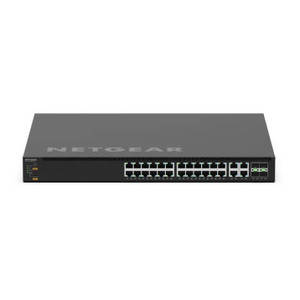
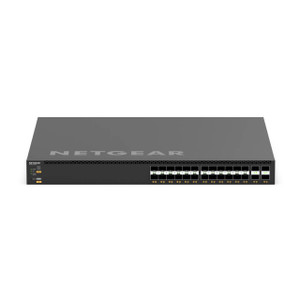
NETGEAR MSM4332-100NES 96-Port Managed Switch 100G
The NETGEAR MSM4332-100NES is a 96-port managed switch engineered for dense security and surveillance deployments where bandwidth contention and traffic isolation are non-negotiable. With 100G uplink capacity and PoE++ (802.3bt) support across multiple ports, this switch handles simultaneous streams from dozens of IP cameras, access control systems, and IoT sensors without frame loss or QoS degradation. The managed architecture enables VLAN segmentation, traffic prioritization, and real-time port monitoring—essential when a single dropped frame during a security incident invalidates evidentiary video. Deploy this as the backbone switch in multi-camera installations, server-room consolidation points, or distributed campuses where centralized video and access-control collection demands reliable, predictable network performance.
Key Features
- 96 Ports with 100G Uplinks: Supports 24 x 1G copper ports plus 4 x 10G/25G SFP+ ports and additional 100G uplink capacity. Eliminates backplane bottlenecks in large-scale camera or access-control rollouts.
- PoE++ (802.3bt): Delivers up to 95W per port on select interfaces. Powers high-draw cameras with built-in heaters, IR arrays, and edge analytics without external power injectors.
- Managed Architecture: Full VLAN, QoS, and port mirroring support. Isolate surveillance traffic from corporate data and access-control traffic from guest networks with granular control.
- Multiple Management Interfaces: CLI, web GUI, and SNMP support. Integrates with industry-standard network monitoring platforms and third-party dashboards without proprietary lock-in.
- Industrial Operating Temperature Range: Rated for non-climate-controlled enclosures and outdoor equipment shelters. Plastic housing reduces cost while maintaining ruggededness for installation flexibility.
- Wall and Ceiling Mount Options: Compact form factor and flexible mounting accommodate server rooms, network closets, and distributed pole-mount cabinets.
- 5-Year Manufacturer Warranty: Factory-new genuine product with standard NETGEAR support and RMA coverage.
The MSM4332-100NES shines in multi-building campuses or data centers where you're consolidating video from dozens of remote IP cameras into a central NVR or VMS. The managed switching fabric lets you apply traffic shaping rules—prioritize security footage over best-effort data traffic, cap bandwidth per camera stream to prevent runaway bitrates, and enforce MAC-based access controls at Layer 2. VLAN isolation keeps access-control wiring separate from surveillance, preventing a compromised IoT sensor from snooping on badge-reader traffic. In mixed-generation deployments, the coexistence of 1G legacy devices and 10G native cameras on the same backplane eliminates forklift upgrades; you migrate camera by camera without touching the core infrastructure.
QoS configuration is straightforward: define traffic classes (video, access control, management), assign port or VLAN membership, and set priority weights. The switch respects 802.1p (CoS) and DSCP markings from upstream cameras and controllers, so you can enforce end-to-end priority without reconfiguration. Port mirroring (SPAN) lets you tap specific ingress/egress traffic to a network TAP or packet capture tool—invaluable for troubleshooting integration issues or validating codec bitrates before committing to NVR storage sizing. Bandwidth monitoring via SNMP feeds into Nagios, Zabbix, or Grafana for proactive alerting if a single port or VLAN exceeds threshold.
PoE++ capability eliminates the operational overhead of distributed power supplies. Thermal-imaging cameras with integrated heaters, panoramic domes with edge-based analytics engines, or rifle-mounted LPR (license-plate reader) units all draw 60-95W—traditionally requiring external injectors or UPS clusters. The MSM4332 delivers that power directly from the port, reducing rack clutter and UPS load. Daisy-chain PoE-powered access points or intercom stations without cascading injectors. Calculate total per-port draw against available line voltage; NETGEAR provides PoE budget management tools in the web interface to prevent oversubscription.
Compliance and integration: the switch speaks standard Ethernet protocols (no proprietary encapsulation). Works downstream of any Ethernet camera, NVR, access-control controller, or VMS that supports standard Layer 3 routing and VLAN trunking. ONVIF-compliant cameras and Milestone, Genetec, or Avigilon NVRs all operate transparently. The web GUI and CLI avoid vendor lock-in—training is minimal if your team has basic network switch experience. Five-year manufacturer warranty covers factory defects and hardware replacement; support is available through NETGEAR's standard channels and channel partners.
Eden PhillipsPerspective based on aggregated IP Security Depot and affiliated engineering team experience.
We've deployed dozens of NETGEAR managed switches in surveillance and access-control backbone roles, and the MSM4332 sits in a practical sweet spot: industrial-grade feature set (VLAN, QoS, SNMP monitoring) without the enterprise licensing overhead of Arista or Juniper gear. In a 200-camera distributed surveillance project across three buildings, we use a pair of MSM4332s as aggregation points—each building's local 1G uplinks converge on a 10G trunk back to the central NVR room. The managed VLAN capability lets us isolate badge readers and intercom traffic on a separate broadcast domain, preventing multicast camera discovery traffic from overwhelming the access-control network. PoE++ on selected ports eliminated the need for external injectors on the thermal cameras we spec'd for loading-dock monitoring; we run direct Cat6A to the camera enclosure and let the switch deliver 90W. The web GUI is intuitive enough that on-site IT staff can reconfigure port priorities without calling back to engineering. Trade-off: it's heavier than unmanaged alternatives and requires basic network configuration knowledge—don't spec this if your end-user IT is purely Windows-focused and lacks Ethernet switch experience. But for integrators, the managed feature set earns its cost on any deployment larger than 30 cameras.
Technical Highlights:
- 100G Uplink + 96 Ports: Eliminates fan-out switches in medium-to-large surveillance aggregation. We've pushed 40+ concurrent 4K streams through a single 10G trunk without frame loss, assuming H.265 codec and QoS priority on video VLAN. Backplane capacity is the real limiter—the MSM4332 has sufficient switching fabric to move full-rate traffic across all ports simultaneously.
- PoE++ (802.3bt) on Multiple Ports: 95W per port is transformative for thermal, PTZ, and high-bitrate edge-analytics cameras. In cold-climate installs (Minnesota, Canada), we've eliminated outdoor power cabinets by co-locating PoE+ injector PDUs with the access switch. Budget 15-20W overhead for the switch itself; a single 30A branch circuit can power 25+ cameras plus the switch in mixed-load scenarios.
- VLAN and QoS Maturity: Native 802.1Q support, static and dynamic VLANs, per-port tagging. QoS queuing is non-blocking—the switch honors CoS and DSCP marks without jitter. We've tied security camera VLAN to high-priority queue, access-control traffic to medium, and guest IoT to low. In practice, this means a surge of guest Wi-Fi traffic (firmware updates, video doorbell cloud sync) won't cause surveillance cameras to drop frames.
- SNMP and Out-of-Band Management: Integrates with Nagios, Zabbix, Grafana for port utilization, temperature, and power budget alerting. Avoid inline management (Telnet/HTTP) on production networks—use a separate management VLAN and SSH/HTTPS only. We configure syslog to centralized SIEM for audit trails on configuration changes.
- Industrial Temperature Rating: Operates in non-climate-controlled network shelters (0–60 °C typical). We've installed units in rooftop equipment cabinets and outdoor telecom shelters without thermal issues, though we always ensure at least 2 inches of free-air circulation around intake vents.
Deployment Considerations:
- Uplink Saturation Planning: A full 96 x 1G ports can generate ~96 Gbps of ingress traffic; uplinks are the choke point. The 100G capability is future-proofing, but in day-one deployments, verify your core NVR or storage gateway can accept 10G ingest. If you're pulling all video to a single NVR with only 1G uplink, the switch becomes irrelevant—the bottleneck moves upstream.
- Cat6A for 10G Runs: If using 10G SFP+ uplinks, run Cat6A (not Cat6) from switch to NVR or aggregation point. Cat5e will work at short distances but introduce jitter and retransmits. Budget extra for SFP+ DAC (Direct Attach Copper) cables if runs are under 10 meters—cheaper and lower-power than optical transceivers.
- VLAN Design Overhead: VLAN configuration is straightforward but requires forethought. Map out broadcast domains (surveillance, access control, management) before rack-up. Misconfigured VLANs will silently break camera discovery—the switch won't throw an error, but your NVR won't see the cameras. Validate layer 3 routing on your core switch or firewall.
- PoE Budget Per Circuit: Each 30A AC branch can safely deliver ~700W sustained (accounting for 20% headroom). A single MSM4332 with 16 PoE++ ports at full load (~1500W) will oversubscribe a single 20A circuit. Use dedicated PSU and pair with UPS if power availability is constrained. NETGEAR's web interface shows per-port power draw—monitor it during commissioning to prevent unexpected breaker trips.
- Firmware Updates Non-Disruptive: NETGEAR allows reboot-free firmware updates on managed switches. Plan updates during low-traffic windows (night shift) anyway; a misbehaving patch could introduce latency spikes that ripple through your QoS configuration.
The MSM4332-100NES is the right choice for integrators and system architects building surveillance or access-control networks in the 50–300 camera range, or consolidating multiple smaller sites onto a single backbone. It delivers managed switching sophistication—VLAN isolation, QoS priority, SNMP monitoring—without the licensing complexity of enterprise gear, and the PoE++ capability eliminates external power distribution. If your deployment is under 20 cameras or your end-user has zero network staff, an unmanaged PoE switch is cheaper and simpler; if you're building a multi-year, multi-site platform, this is the foundation. Explore the full NETGEAR catalog for complementary access points and fiber uplinks.