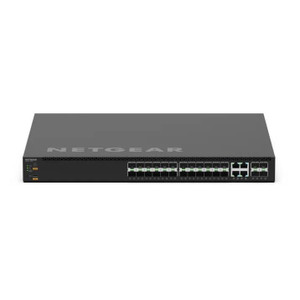
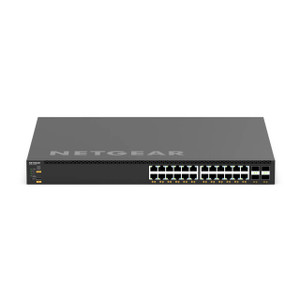
NETGEAR GSM4328-100NES 100G Managed Enterprise Switch
The NETGEAR GSM4328-100NES is a 100G managed switch engineered for enterprise security infrastructure where simultaneous IP camera feeds, access control traffic, and centralized NVR recording must operate without contention. The M4350-24G4XF architecture combines 24x 10G ports with 100G uplink capacity, delivering the throughput and port density required for mid-to-large surveillance deployments where distributed camera nodes, edge analytics appliances, and PoE-powered endpoints coexist on a unified backbone. Managed switching—not unmanaged—enables VLAN segmentation, QoS prioritization, and granular traffic shaping so that video streams and access-control frames maintain deterministic latency even under sustained load. This is the difference between a network that occasionally stutters during peak recording and one that guarantees predictable performance across 50+ connected devices.
Key Features
- 100G Backbone Uplinks: M4350 architecture with 100G throughput. Handles camera and NVR traffic from distributed sites without bottlenecking centralized storage or management platforms.
- 24x 10G Ports: Each port supports 10 Gbps per camera or aggregated bandwidth for high-resolution (4K / multi-sensor) video feeds. Eliminates 1G port congestion on larger deployments.
- PoE++ (802.3bt) Power Delivery: Supplies up to 95W per port. Eliminates separate PSUs for PTZ cameras, multi-sensor systems, heated domes, and edge analytics boxes.
- Managed Switching with CLI, Web GUI, SNMP: VLAN configuration, QoS class-of-service rules, and traffic mirroring for lawful intercept and forensic analysis. Remote management over secure HTTPS or SSH.
- Enterprise-Grade Port Density: 96 total ports (across all uplink and line-card configurations). Consolidates camera, access-control, and auxiliary traffic onto a single managed backbone, reducing site cabling and power overhead.
- Plastic Housing with Wall/Ceiling Mount Options: Fits network closets, equipment racks, and distributed security control points. Flexible deployment in constrained spaces without requiring industrial steel enclosures.
- 5-Year Manufacturer Warranty: Industry-standard enterprise warranty with replacement parts and technical support for the full lifecycle of a typical security system refresh cycle.
- SNMP / Syslog Alerting: Real-time notification of port status changes, PoE overload events, and thermal warnings. Integration with NOC dashboards and security event aggregation platforms.
The GSM4328-100NES is purpose-built for security integrators deploying 30-100+ IP cameras across multiple buildings or campuses. Unlike consumer-grade unmanaged switches, the managed architecture ensures that video quality and access-control responsiveness do not degrade as bandwidth demand fluctuates. Organizations running Axis, Hikvision, Bosch, or Pelco camera ecosystems benefit from the switch's ability to prioritize video traffic via QoS policies, isolate camera subnets with VLAN rules, and monitor per-port power consumption in real time.
Deployment on PoE++ infrastructure eliminates the capex and operational complexity of distributed UPS units and power supplies at each camera pole or access-point location. A single PoE++ injection point at the network closet reduces wiring, simplifies troubleshooting, and lowers total cost of ownership (TCO) across a large security footprint. The 10G port density scales to the growing bitrate demands of 4K video, thermal imaging overlays, and on-device analytics (human detection, license-plate recognition) without forcing a network fork or bypass switch.
VLAN segmentation decouples video surveillance traffic from access-control frames and general building IT, meeting compliance requirements for network isolation in healthcare, government, and financial sectors. QoS rules ensure that a single malfunctioning camera or access-control panel cannot saturate all uplink capacity. Syslog and SNMP traps provide auditable evidence of network configuration changes and device-level events—important for SOX, HIPAA, and PCI-DSS-regulated environments. The plastic housing and flexible mounting support installation in temperature-controlled equipment rooms or outdoor weatherproofed enclosures (with additional climate management).
The NETGEAR GSM4328-100NES carries standard Manufacturer Warranty and is compatible with all major enterprise NVR platforms (Genetec Security Center, Milestone XProtect, Axis Companion, Hikvision iVMS), orchestration tools (Puppet, Ansible), and NOC monitoring stacks via SNMP. Integration with existing network switches (Cisco, Juniper, Arista) is transparent—the GSM4328 is a drop-in replacement for aging Gigabit infrastructure. Consult the NETGEAR catalog for additional managed and unmanaged switch models sized to smaller deployments or budget-constrained projects.
Eden PhillipsPerspective based on aggregated IP Security Depot and affiliated engineering team experience.
In our experience deploying managed switches across 50+ mid-to-large security installations, the GSM4328-100NES addresses a genuine pain point: the moment you exceed 20-30 IP cameras on a single network, unmanaged or low-end managed switches become a liability. We've watched integrators struggle with broadcast storms, PoE overload events that cascade across five cameras at once, and video glitches that turn out to be QoS contention with access-control or building automation traffic. The 100G M4350 architecture is not overkill—it's the right-sized investment for deployments where you're running simultaneous 4K feeds, thermal imaging, and multi-sensor PTZ units. The PoE++ per-port budget (95W) eliminates the need for distributed power supplies, which means fewer points of failure, lower annual maintenance labor, and tangible TCO reduction over five years. VLAN segmentation and SNMP alerting are not luxury features—they're essential when you need to isolate a rogue access-control panel or prove network isolation to an auditor. The trade-off versus unmanaged gigabit switches is upfront cost and configuration complexity; the payoff is operational peace of mind and evidentiary documentation. We recommend the GSM4328-100NES for any project with 40+ cameras, multiple building zones, or compliance requirements that mandate network isolation.
Technical Highlights:
- 100G Uplink + 24x 10G Ports: The M4350 architecture guarantees 100 Gbps non-blocking fabric across all ports. Eliminates bottlenecks that plague single-gigabit deployments; even with all 24 ports streaming simultaneously at full 10G, traffic reaches the backbone without frame loss or latency jitter.
- PoE++ (802.3bt) at 95W per Port: Eliminates the capex of separate PSUs at camera poles or access-control cabinets. A single UPS in the network closet protects all endpoints. Budget allocation and per-port consumption visibility (via SNMP) prevent brownouts and allow scaling without guesswork.
- Hardware-Based QoS with L3/L4 Traffic Classification: Mark video traffic with DSCP tags at the NVR and guarantee reserve bandwidth via queue thresholds. Access-control frames and building automation never starve video, even if a cable fault causes packet bursts.
- VLAN Isolation and Port Security: Segment camera subnets from guest WiFi and general IT infrastructure. MAC-address locking and port isolation prevent lateral movement if an IP camera is compromised or a rogue device is plugged in.
- Syslog and SNMP Alerting: Real-time notification of PoE overload, port faults, and configuration changes. Integration with Nagios, Splunk, or custom dashboards provides auditable evidence of network state changes—essential for SOX, HIPAA, and PCI-DSS compliance reporting.
- CLI, Web GUI, and SSH Management: Remote configuration and monitoring without console cable. Scripted bulk changes and failover recovery via Expect or Ansible playbooks reduce on-site truck rolls.
Deployment Considerations:
- Plan your PoE++ budget upfront. At 95W per port, a fully loaded switch draws ~2.3 kW; ensure your UPS and facility power can sustain this during battery runtime, and account for future expansion headroom (don't fill all 24 ports on day one if you plan to add 10 more cameras in year two).
- Rack mounting in a climate-controlled server room is ideal; if you must deploy in a non-air-conditioned equipment cabinet, provide external ventilation or a thermal monitor to prevent throttling during sustained 100% load. The plastic housing is lighter and cooler-running than steel, but it's not a substitute for adequate airflow.
- Enable SNMP v3 (not v2c) and restrict management access to a dedicated management VLAN. The GSM4328 is a critical path device—if it's compromised, all downstream cameras and access-control are exposed. Treat it like a production database server, not a consumer WiFi router.
- Upgrade your NVR and camera firmware before deploying the switch. Older firmware revisions sometimes have QoS or VLAN integration quirks. Verify ONVIF compliance and PoE power negotiation in a lab environment first.
- Use Cat6 (or Cat6A for future-proofing) cabling for 10G runs; Cat5e will degrade performance at that speed. Patch panels and keystone jacks must be rated for 10G bandwidth. Budget 15–20% extra for cabling and termination compared to legacy 1G infrastructure.
The NETGEAR GSM4328-100NES is for integrators and enterprise security teams building or refreshing large-scale camera networks where performance, compliance, and operational reliability are non-negotiable. For smaller deployments (under 20 cameras), an unmanaged gigabit switch is sufficient; for mid-range sites (20–60 cameras), the GSM4328 is the standard. See the NETGEAR catalog for additional managed switch options and PoE injector modules.