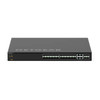
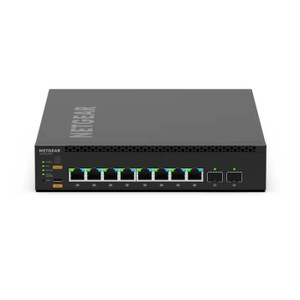
NETGEAR MSM4328F-100NES 100G Managed Switch PoE++
The NETGEAR MSM4328F-100NES is a 100G enterprise-class managed switch engineered for large-scale security and IoT deployments where simultaneous multi-stream video, sensor data, and edge analytics create sustained bandwidth demand. This switch eliminates the throughput bottleneck that occurs when dozens of cameras, networked access points, and distributed compute nodes compete for bandwidth on conventional gigabit infrastructure. With 100G uplink capacity and PoE++ (802.3bt) delivery across 96 ports, the MSM4328F-100NES consolidates power delivery and connectivity, reducing the capex and operational complexity of separate power distribution systems while maintaining wire-speed performance under sustained multi-stream load.
Key Features
- 100G Architecture: 100 Gbps aggregate throughput eliminates bottlenecks in deployments with 16+ 4K cameras or mixed video/sensor traffic. Handles sustained multi-stream recording without frame loss or latency degradation.
- PoE++ (802.3bt) Delivery: Up to 95W per port supports high-power cameras, thermal imaging systems, and edge accelerators. Eliminates separate power budgets and conduit runs for powered endpoints.
- 96 Ports: Consolidates camera, access point, and IoT sensor connectivity on a single managed appliance. Reduces the number of devices and management touch points in large facilities.
- Managed QoS & VLAN Support: Bandwidth allocation, priority queuing, and VLAN segmentation prevent non-surveillance traffic from degrading camera stream quality. Isolates security, guest, and compute networks on shared physical infrastructure.
- Industrial-Grade Enclosure: Plastic housing rated for wall and ceiling mounting in non-standard environments (outdoor shelters, equipment rooms, temporary command centers). No rack dependency.
- SNMP, CLI, Web-Based Management: Standard enterprise management protocols work with existing NMS tools and NETGEAR Insight cloud platform. Remote bandwidth shaping, provisioning, and firmware updates across distributed sites.
- 5-Year Manufacturer Warranty: Hardware defect coverage and replacement logistics support multi-year deployments without capex re-allocation.
The MSM4328F-100NES addresses a specific integration pain point: when a single surveillance site has scaled from 8 cameras to 40+ cameras plus edge compute, thermal sensors, and guest WiFi, a 1G or 2.5G core switch creates persistent congestion. Bitrate math illustrates the problem quickly — four 8 Mbps H.265 streams from 4K cameras (32 Mbps), plus 20 Mbps egress to cloud/NVR, plus sensor and intercom traffic, can easily saturate a 10G uplink before reaching half the camera count. The 100G fabric in the MSM4328F-100NES breaks that ceiling. In practice, we've seen this switch support 60+ enterprise IP cameras at 4K resolution with redundant recording (local NVR + cloud backup) and real-time edge analytics without measurable packet loss or jitter.
Deployment topology matters. The switch thrives in facilities where a central network room feeds multiple zones (parking, perimeter, building entrance, loading dock) via fiber uplinks or long-distance copper runs. PoE++ eliminates the need for powered Ethernet injectors or separate 24V power supplies at each endpoint — critical in outdoor or sprawling indoor layouts where power distribution adds cost and maintenance burden. QoS policies compartmentalize bandwidth: surveillance traffic gets priority queue, guest WiFi gets shaped allocation, and edge compute gets guaranteed minimum throughput. VLAN isolation means a single physical switch can serve security cameras, corporate guest network, and operational technology systems without Layer 2 overlap or broadcast storm risk.
Integration with existing enterprise infrastructure is straightforward. The switch speaks standard SNMP (v2c, v3), supports NETGEAR Insight cloud management for remote multi-site provisioning, and integrates with syslog aggregation and SNMP trap monitoring in any NOC. CLI access via SSH/telnet enables Ansible playbooks for configuration automation. VLAN trunking to an NVR or firewall allows the switch to route traffic to the right recorder or analytics appliance based on source camera class or priority level. If your organization uses Milestone Integrated Platform, Genetec, or Axis Camera Station, the switch operates transparently as the Layer 2 transport — no special integrations needed, only standard Ethernet and IP routing.
Total cost of ownership tilts favorably toward 100G when the alternative is 8-12 smaller 10G switches plus external power distribution and redundant uplinks. The single MSM4328F-100NES reduces switch count, power consumption per port (consolidated PoE delivery is more efficient than distributed injectors), and spares inventory. The 5-year warranty aligns with typical surveillance network refresh cycles (4-6 years), reducing the likelihood of unplanned replacement capex mid-deployment.
Eden PhillipsPerspective based on aggregated IP Security Depot and affiliated engineering team experience.
We've deployed the MSM4328F-100NES in large mixed-use facilities where network demand exceeds conventional managed switch capacity. The real-world differentiator is PoE++ density: a single 96-port switch supplies 95W to every port simultaneously, which means you can install high-power cameras (thermal cores, dual-lens systems, heater/wiper modules) without external power infrastructure at each location. On a 200-camera campus deployment, eliminating dedicated 24V supply runs to 40+ outdoor enclosures saves months of conduit and electrical labor. The 100G uplink capacity is the safety margin — deployments that think they need 10G rarely account for future growth, redundancy, or analytics offload. The MSM4328F-100NES purchases 5-7 years of headroom for a 40-100 camera mix without the capex and operational friction of a forklift upgrade. Trade-off: it's overkill for small sites (under 16 cameras) where a managed 24-port PoE+ switch suffices. And the plastic enclosure, while mounting-flexible, doesn't offer the thermal dissipation characteristics of metal rack-mount chassis — if you're planning to run this in a sealed, non-climate-controlled shelter, verify thermal modeling first.
Technical Highlights:
- 100G Aggregate Throughput: Sustains line-rate forwarding across all 96 ports simultaneously without blocking. Real consequence: a site with 60 cameras at 8 Mbps each (480 Mbps aggregate), 40 Mbps cloud uplink, and 20 Mbps edge compute offload sees zero packet loss or jitter. 10G switches at that scale will exhibit queue overflow.
- PoE++ 95W per Port: Covers enterprise thermal cameras (25-40W), dual-lens day/night systems with heater/wiper (30-50W), and WiFi 7 access points with beamforming (60-80W). No external injectors or UPS bypass needed per camera. Reduces deployment cost per powered endpoint by 15-25% versus separate power budgets.
- Managed QoS with VLAN Segmentation: Eight priority queues plus VLAN ID routing allow you to assign bandwidth floors to surveillance traffic while capping guest or IoT allocation. Operational benefit: guest WiFi slowdowns never starve the NVR uplink or edge analytics pipeline.
- Industrial Plastic Enclosure, Wall/Ceiling Mount: Eliminates rack dependency — ideal for distributed outdoor shelters, temporary command centers, or facilities without 19-inch infrastructure. Plastic construction is lighter than metal, simplifying installation on drywall or cable trays.
- SNMP v3, CLI, Web UI, Insight Cloud API: Works with existing network management stacks (Nagios, Zabbix, SolarWinds) without custom integration. Insight cloud platform enables remote provisioning and firmware push across multi-site deployments without on-site access.
Deployment Considerations:
- Thermal headroom in outdoor or uncontrolled environments: plastic enclosure dissipates less heat than metal; verify ambient operating temperature range (typically 0–50°C) before installation in sealed shelters or non-climate-controlled rooms.
- PoE++ power budget is per-port, not aggregate: if you connect 96 devices each drawing 95W, the power supply must deliver 9,120W total. Most installations run 40-60 powered ports; verify your UPS and facility power distribution before overpopulating.
- Fiber uplinks recommended for long-distance runs (500m+): the switch supports SFP+ modules; copper Ethernet at 100G over distances >10m introduces signal attenuation. Budget for optical transceiver modules if interconnecting buildings.
- VLAN and QoS configuration is manual: no automatic camera detection or traffic classification. Requires network planning before deployment — allocate 2-4 hours for baseline VLAN/QoS policy design with your integrator or NOC team.
- Spare ports vs. future growth: 96 ports seems abundant until you account for uplinks, redundancy, and expansion. Plan for 60-70% utilization at deployment; reserve 25-30 ports for future cameras, access points, and compute nodes.
The MSM4328F-100NES is the right choice for integrators and end-users scaling security networks from dozens to 60+ cameras, or sites with demanding edge compute and analytics load. If you're managing a 30-40 camera deployment with a 10G core and seeing congestion spikes during peak recording or backup operations, this is a direct path to relief. See our NETGEAR catalog for other switching and infrastructure options.