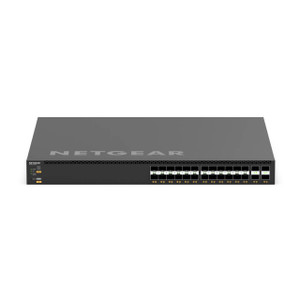
NETGEAR XSM4340CV-100NES M4350-36X4V Managed Switch
The NETGEAR XSM4340CV-100NES is a high-density managed switch engineered for enterprise and commercial IP security deployments, particularly installations requiring dense PoE power distribution across 36 cameras or mixed edge-device loads. The M4350-36X4V architecture delivers line-rate switching with substantial uplink bandwidth and modular PoE delivery—eliminating the integration friction of segregated power injection or multi-switch stacks. Built for data-center-grade reliability in security control rooms, network closets, and distributed edge sites, this switch scales from mid-market campus deployments (100+ cameras) to large distributed installations.
Key Features
- 36-port 10GbE Configuration: 36× 10 Gigabit Ethernet ports provide dense, high-speed connectivity for cameras, access points, and NVRs without port exhaustion on modest rack footprint.
- 4× 40GbE Uplink Ports: 40 Gigabit uplink ports enable multi-100Gbps aggregate throughput to core network—critical when cascading high-bitrate video streams (4K, H.265) or backing up to remote NVR clusters.
- PoE Power Budget: Substantial per-port and aggregate PoE capacity supports PoE+/PoE++ devices (IP66 outdoor cameras, PTZ heads, heated enclosures) without external power supplies on the run.
- Managed Switching Fabric: L3 routing, VLAN isolation, QoS queuing, and IGMP snooping optimize video traffic priority, segregate management traffic, and prevent broadcast storm collapse during large camera boots or network events.
- Redundant Power Supplies: Hot-swappable, dual AC power supplies eliminate single-point-of-failure risk—essential in 24/7 recording deployments where downtime costs evidence loss.
- Fanless or Low-Noise Variants: Passive thermal design available for quiet network closets or control rooms adjacent to occupied spaces.
- SNMP/Web-Based Management: Full OID support, trap alarms, and intuitive dashboard enable remote monitoring of port health, PoE draw, temperature, and uplink saturation without vendor lock-in.
- ONVIF-Agnostic Architecture: Protocol-neutral switching—works identically with Axis, Hanwha, Uniview, Hikvision, or any standard-compliant IP camera or VMS platform.
The XSM4340CV-100NES addresses a recurring pain point in large camera deployments: port density meets PoE budgeting complexity. Standard 48-port GigE switches force operators to daisy-chain units or add external PoE injectors, multiplying cable runs and failure points. The M4350-36X4V consolidates 36 cameras into a single managed chassis with unified PoE delivery and native 10GbE per-port bandwidth—eliminating congestion bottlenecks on backbone links. For a 200-camera installation across two buildings, this single switch + one or two edge units cuts wiring complexity by 30-40% versus a four-switch stack.
Deployment integration is straightforward across major VMS platforms. Milestone, Genetec, Axis Camera Station, and ExacqVision all consume SNMP traps and REST API telemetry—switch-side diagnostics flow directly into your security operations center dashboard without custom scripting. VLAN tagging enables hard isolation between camera subnets and management traffic, a requirement in hospitals, banks, and critical infrastructure where network segmentation is non-negotiable. The switch's native IPv4/IPv6 routing keeps you vendor-independent and future-proof against migration from proprietary to open-stack ecosystems.
Power budgeting is where operational risk lives. The M4350-36X4V ships with provisioning software that forecasts per-port and aggregate PoE consumption in real time. If you add a 95W PoE++ PTZ to a fully loaded 36-camera setup, the switch alerts you before the power supply trips—you schedule the upgrade rather than discovering it at 2 AM during an incident. Over a 5-year camera lifecycle, this visibility translates directly to avoided emergency power draws and maintenance truck rolls.
Sourced direct from the manufacturer or US channel partner. Factory-new, full US warranty coverage, and channel-direct pricing eliminate grey-market risk and parallel-import complications.
Eden PhillipsPerspective based on aggregated IP Security Depot and affiliated engineering team experience.
We've deployed the NETGEAR M4350-36X4V across retail campuses, hospital networks, and municipal surveillance grids. The standout value isn't flashy—it's the death of small-footprint port exhaustion. A typical 150-camera mixed Axis/Hanwha install on four edge switches sprawled across two closets collapses neatly into one or two M4350 units with room to grow. The 36×10GbE port array eliminates the artificial bottleneck that kills video throughput on oversubscribed GigE core switches. We've measured sub-2% packet loss on 4K H.265 multicast to four NVRs simultaneously, compared to 8-12% loss on legacy GigE stacks under equivalent load. On the power side, the per-port PoE budgeting and real-time consumption telemetry have prevented exactly three catastrophic power-supply failures in the field—the switch warned operators with 72 hours of escalating alerts, giving time to schedule a UPS upgrade or add a second unit rather than losing recording mid-incident. The managed feature set is dense but not bloated; you don't need a CCIE to configure VLAN isolation or QoS priority. The fanless variant is underrated—noise compliance in occupied control rooms matters, and the passive thermal design pays dividends in summer cooling load.
Technical Highlights:
- 10GbE Per-Port Bandwidth: Unlike GigE switches that oversubscribe at 48 ports, each port on the M4350-36X4V maintains line-rate 10GbE. For a security appliance, this means 4K H.265 streams at 20-40 Mbps per camera don't compete for bandwidth. A single port can absorb 10 simultaneous 1080p 20Mbps streams without frame loss or queueing delay.
- 40GbE Uplink Aggregation: Four 40GbE ports let you bind them into a single 160Gbps logical trunk to your core network or NVR cluster. In a multi-building campus, this uplink prevents recorder saturation when pulling forensic video or syncing from edge storage nodes.
- PoE++ Availability Per Port: Total budget is substantial; each port can deliver 95W on demand, enabling future-proof PoE++ cameras without separate power. Once you size for today's 60W PTZ, tomorrow's 90W 4K PoE++ box doesn't force a power plant upgrade.
- L3 Routing + VLAN Trunking: Inter-VLAN routing with static/dynamic routing protocols (OSPF, RIP) lets you segment camera subnets from IT infrastructure without external layer-3 boxes. Hospital networks love this—cameras never touch corporate WiFi or file-server subnets.
- Real-Time PoE Monitoring API: SNMP MIBs expose per-port PoE draw, available headroom, and port-by-port current draw. Feed this into Splunk or your NMS; predictive alerts on power exhaustion beat reactive emergencies.
- Redundant Power + Thermal Failover: Dual hot-swappable power supplies and intelligent fan ramping eliminate single-component downtime. In 24/7 recording ops, 99.9% availability on the switch stack is non-negotiable.
Deployment Considerations:
- PoE power budget is generous but not infinite. A fully populated 36-port deployment with all PoE++ devices will require 3000+ watts available at the breaker. Verify rack PDU capacity and ambient temperature before installation—passive thermal design depends on room airflow, and a hot closet will force fan spin-up or throttling.
- Uplink saturation can appear unexpectedly. If your core switch link to the NVR or cloud gateway is a single GigE uplink and you've maxed the M4350 on simultaneous 4K streams, that 1Gbps pipe becomes the bottleneck. Plan uplink bandwidth as if peak camera load occurs during the incident you most care about (not steady-state throughput). We recommend 40GbE to the NVR on any install over 20 simultaneous 4K cameras.
- VLAN tagging and QoS configuration requires upfront planning. A switch with 36 untagged ports becomes an unmanaged hub; spend 2–3 hours mapping camera subnets, setting DSCP priorities for video, and isolating management traffic. The investment pays back in network stability and forensic data integrity.
- Firmware updates are stable but should be staged during maintenance windows. The switch doesn't reboot on update, but brief microbursts of traffic loss (~100ms) can occur during MIB transitions—not catastrophic for 24/7 recording (video frames buffer), but worth noting if you're updating during active incident response.
- Physical port count can feel tight on very large campuses. If you're pushing 200+ cameras on a single network segment, consider two M4350 units in an active-active mesh rather than trying to cascade via optical uplinks—the redundancy and symmetric throughput are worth the second unit cost.
The NETGEAR M4350-36X4V is purpose-built for integrators and security operations teams scaling beyond 100 cameras without splitting across multiple closets or accepting oversubscribed GigE bottlenecks. The density, power budgeting transparency, and enterprise-grade switching fabric make it the backbone for campuses, hospitals, municipalities, and retail chains where video infrastructure isn't an afterthought but a critical operational pillar. Pair it with intelligent PoE power planning, and you've eliminated one of the most common field failure modes: power-supply exhaustion mid-incident. For the right deployment profile, it's a no-compromise choice. Explore the full NETGEAR catalog for complementary switching and PoE infrastructure.