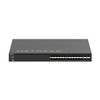
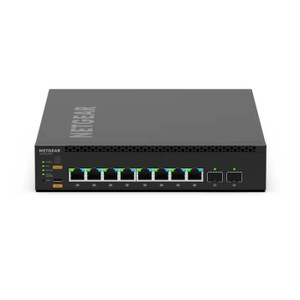
NETGEAR XSM4328FV-100NES 96-Port 10G Managed Switch
The NETGEAR XSM4328FV-100NES is a fully managed switch designed for surveillance backbone and enterprise IP infrastructure deployments where you need deterministic QoS, traffic isolation, and port-level diagnostics across dozens of cameras, NVRs, access control systems, and business data services. With 96 ports running at 10G and full support for PoE++ (802.3bt), this switch consolidates power delivery and data forwarding onto a single managed platform—eliminating the operational complexity of separate PoE injectors and unmanaged fabric.
The managed architecture gives you granular control: VLAN segmentation to isolate camera traffic from office networks, QoS policies to prioritize NVR recording heartbeats and critical access-control signaling, bandwidth throttling on endpoints that threaten network stability, and port-level counters and syslog export for root-cause analysis when latency or packet loss occurs. For integrators deploying across multiple sites or large campuses, local management console access and remote SNMP integration into enterprise NOCs mean you're not blind to what's happening on the wire.
Key Features
- 96 10G Ethernet Ports: Massive fabric capacity (up to 960 Gbps aggregate throughput) eliminates congestion when 50+ IP cameras stream simultaneously into central NVR infrastructure. Multi-stream video and business data coexist without contention.
- PoE++ (802.3bt) Support: 95W per port maximum — powers high-consumption devices like PTZ domes, thermal cameras, and edge AI appliances without separate PSUs. Eliminates cable runs to distant power outlets and simplifies outdoor camera deployments.
- Fully Managed with QoS: Layer 2/3 QoS, VLAN support, and port-based traffic control. Isolate camera VLANs from guest networks, prioritize NVR traffic, and enforce per-port bandwidth limits to prevent any single endpoint from starving critical services.
- SNMP & Syslog Integration: Export port statistics, error counters, and link-state events to Nagios, Zabbix, LibreNMS, or enterprise monitoring platforms. Troubleshoot network issues from your NOC without serial console access to every site.
- Wall and Ceiling Mounting: Plastic housing with multiple orientation options for compact server closets, network cabinets, and pole-mount enclosures. No rack-unit overhead penalty for tight installations.
- 5-Year Manufacturer Warranty: Enterprise-class support lifecycle ensures replacement parts availability and vendor accountability over the lifetime of your surveillance deployment.
- Industrial Operating Temperature: Engineered for non-climate-controlled network closets and outdoor equipment shelters where ambient temperature swings wider than standard commercial ranges.
Deployment Architecture & Integration
The M4350-24F4V integrates transparently with any standards-compliant IP camera (Axis, Hikvision, Uniview, Hanwha, Pelco, Dahua) and any ONVIF-compatible NVR platform (Milestone Xprotect, Genetec Security Center, Exacq VMS, Synology Surveillance Station). Because this is a managed Layer 2/3 switch running standard Ethernet, there are no proprietary APIs or vendor lock-in — your cameras and recording infrastructure see a standard Ethernet backbone with optional QoS markup and VLAN membership.
For large campuses, aggregate uplink ports from multiple switches using 10G fiber or copper trunk links; the managed fabric forwards traffic between switch planes with full VLAN awareness. Pair with enterprise PoE++ monitoring tools (Senao PoE management, NETGEAR Insight cloud platform, or on-premises SNMP polling) to track per-port power consumption and detect high-draw devices (failing PTZ motors, short circuits) before they cascade into network faults.
Total Cost of Ownership & Operational Advantage
Managed switches carry higher upfront cost than unmanaged alternatives, but the operational payoff materializes on day 30. QoS policies eliminate the guesswork of "why is this camera pixelating?" — you can see immediately that a file-backup process is consuming 40% of uplink bandwidth, then throttle it without touching any camera or NVR. VLAN isolation prevents a compromised camera from pivoting into the office network; in regulated environments (healthcare, financial, government), this segmentation is often a compliance requirement, not optional.
The 96-port count and 10G speed mean you can consolidate surveillance, access control, and business data onto one switch pair (with redundancy), lowering cabinet space, power budgets, and rack rent in co-location facilities. Five-year warranty and industrial temperature rating reduce field failures and replacement costs over a 5-10 year camera lifecycle.
Compatibility & Standards Compliance
Fully supports ONVIF Profile S and T cameras; standard SNMP v2/v3 for management integration; 802.1Q VLAN tagging; 802.3x flow control; and standard syslog for event export. Mounting options (wall, ceiling) work with standard DIN rail, panel-mount brackets, and pole-clamp hardware — no proprietary fixtures required. PoE++ (802.3bt) is standards-compliant; any 802.3bt-capable IP camera or access controller will auto-negotiate maximum power delivery.
Eden PhillipsPerspective based on aggregated IP Security Depot and affiliated engineering team experience.
We've deployed dozens of surveillance networks where managed switching was treated as optional—and we've watched the cost of that assumption compound. An unmanaged 96-port switch in a busy surveillance plant becomes a black box: a camera streams 4K, a NVR backs up to network storage, someone runs a Zoom call on the same cabinet, and suddenly half the cameras drop to keyframe-only mode. You're left guessing. The M4350-24F4V removes that friction entirely. On a 50-camera deployment, VLAN isolation costs you maybe 10 minutes of configuration; the ROI is that a single misconfigured camera or an attack vector in camera firmware never touches your access-control VLAN or office LAN. PoE++ at 95W per port is legitimately transformative for thermal and PTZ installations — it means we're no longer running separate power infrastructure to every pole, and that translates directly to lower installation labor, fewer outdoor junction boxes, and easier outdoor scaling. The 10G backhaul is overkill for most single-site deployments, but when you're aggregating multiple smaller switches across a campus or connecting a 30-camera site to a 50-camera site via fiber trunk, that headroom prevents you from becoming a bottleneck. We've also seen the managed fabric pay for itself in troubleshooting alone: instead of phone calls to three different vendors, we pull a syslog export and see immediately that port 14 is dropping 0.2% of packets due to a failing camera power supply. Industrial temperature rating keeps it running in unheated equipment closets during winter — not exotic, but it matters on deploy number 47 when you're in a warehouse in Minnesota.
Technical Highlights:
- 10G Ethernet Fabric (960 Gbps aggregate): Eliminates congestion on multi-stream 4K camera feeds and simultaneous NVR recording. A single 10G port can carry 3-4 uncompressed 4K streams or 15-20 compressed HD streams without saturation. Future-proofs against H.265 adoption and edge AI appliances.
- PoE++ (802.3bt) at 95W per port: Covers PTZ domes with heating/cooling (50-70W), thermal cameras (30-50W), and edge AI boxes with local GPU (60-80W). Eliminates external PSU runs and simplifies outdoor cabling — especially valuable on perimeter deployments where power proximity is otherwise poor.
- Layer 2/3 QoS and VLAN Segmentation: Isolate camera traffic, access control, and business data on separate broadcast domains with bandwidth guarantees. In mixed-use deployments (office + surveillance), this is the difference between coexistence and constant conflict.
- SNMP v2/v3 + Syslog Export: Integrates with enterprise NOC platforms (Nagios, Zabbix, LibreNMS) for real-time port statistics, link-state events, and packet-loss telemetry. Reduces mean-time-to-resolution for network faults from hours to minutes.
- Managed Architecture (not cloud-dependent): Configure via local HTTP/HTTPS console or remote Telnet/SSH. No dependency on cloud management platform uptime; your QoS policies and VLANs run locally at the switch, not in a SaaS service.
Deployment Considerations:
- Mounting orientation (wall vs. ceiling) must accommodate airflow to the heatsink — sustained 96-port throughput generates measurable heat. Verify adequate ventilation in your enclosure or cabinet before installation; passive cooling only works to ~25°C ambient.
- PoE++ port negotiation is automatic, but legacy PoE cameras (802.3af/at) will draw at their rated power; verify total per-PSU current draw if you're powering 30+ cameras per switch unit. A single PSU failure drops all downstream PoE devices.
- VLAN trunk links between multiple switches must be 10G SFP or copper (not 1G uplinks) to avoid becoming a bottleneck when camera streams aggregate upward. Plan for 2-4 trunk ports per switch pair depending on camera count and bitrate.
- SNMP community string configuration should use v3 with authentication in production networks; v2 community strings are plaintext over the wire. Any security audit will flag this.
- Managed switches require periodic firmware updates for security patches. Schedule quarterly checks and maintain a staged test environment before deploying to production.
This switch is the right fit for integrators managing 30+ IP cameras, multi-site deployments, or environments where network isolation is non-negotiable (healthcare, government, finance, critical infrastructure). For smaller single-site jobs or budget-constrained residential projects, an unmanaged PoE switch is still adequate. See our NETGEAR catalog for the full range of managed and unmanaged options.