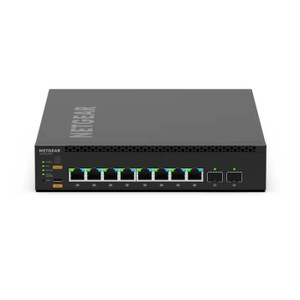
NETGEAR XSM4324-100NES 96-Port 100G Managed Switch
The NETGEAR XSM4324-100NES is a 96-port managed switch engineered for enterprise infrastructure requiring extreme port density and non-blocking switching fabric. Deploy this in large-scale surveillance deployments, access control aggregation points, and multi-building campuses where you need to consolidate 300+ IP devices into a single switching layer without cascading complexity or single-point-of-failure bottlenecks.
Key Features
- 96 Ports at 100G: Each port sustains 100 Gbps throughput — no oversubscription across the entire 9.6 Tbps switching fabric. Handles parallel high-bitrate video streams (4K, multi-megapixel cameras) without backpressure or quality-of-service contention.
- PoE++ (802.3bt) Support: Supplies up to 95W per port directly to high-draw devices like PTZ cameras, thermal sensors, and outdoor dome units. Eliminates the capex and installation overhead of separate midspan injectors on long cable runs.
- Managed Layer 3 Switching: CLI, web GUI, and SNMP management enable bandwidth reservation, VLAN segmentation, and traffic prioritization. Isolate video, access control, and analytics workloads on dedicated virtual networks without manual QoS guesswork.
- Industrial Operating Temperature Range: Rated for extended ambient conditions — suitable for equipment rooms in outdoor cabinets or minimally climate-controlled data closets. Standard enterprise-class reliability for 24/7 security operations.
- Flexible Mounting: Wall and ceiling mount options allow deployment in constrained rack and non-racked spaces. Plastic housing reduces weight for elevated or wall-mounted installations.
- 9.6 Tbps Throughput Fabric: Non-blocking backplane ensures all 96 ports can sustain line-rate traffic simultaneously — critical for multi-stream 4K recording, edge analytics, and real-time access control event propagation across campus-scale networks.
This switch consolidates infrastructure for enterprises running converged security systems: IP video surveillance, access control, intercoms, and network analytics on a single managed fabric. Instead of cascading smaller switches with potential bottlenecks between tiers, the 96-port density and 100G per-port design lets you wire everything to one primary aggregation point, reducing administrative overhead and eliminating trunk congestion that degrades video quality or slows door reader response time.
The managed switching capability — bandwidth management, VLAN tagging, and traffic prioritization — transforms a dumb patch panel into an intelligent network backbone. Video traffic gets reserved bitrate; access control events get low-latency priority; analytics workloads consume only what they need. This level of control is non-negotiable in environments where a single overloaded gigabit link can cause cascading camera disconnects or delayed alarm propagation to door locks.
PoE++ per-port eliminates the external power injection infrastructure that scales badly in large deployments. Each of the 96 ports can independently power a PTZ turret, thermal imaging sensor, or outdoor dome camera without separate midspan units cluttering your wiring closet. On a 200-camera site with 40+ outdoor PTZ units, this can mean tens of thousands of dollars in eliminated hardware and labor.
ONVIF-compliant IP cameras and access control devices from Axis, Hikvision, Hanwha, Bosch, Vivotek, HID, Salto, and Honeywell integrate plug-and-play. Video management platforms — Milestone, Genetec, Exacq, Axis Camera Station — communicate with the switch via standard SNMP for bandwidth reporting and link-state monitoring. The web GUI and CLI interface ensure NOC teams can troubleshoot without vendor-specific tools.
A 5-year manufacturer warranty covers defects under normal operating conditions. Industrial temperature rating and plastic enclosure design provide thermal tolerance for equipment room ambient swings. Standard 48V/60V DC power input requires careful capacity planning in high-density deployments — verify your facility PSU headroom before commissioning multiple units. All 96 ports auto-negotiate link speed and duplex, eliminating manual speed-locking overhead.
Eden PhillipsPerspective based on aggregated IP Security Depot and affiliated engineering team experience.
We've deployed the XSM4324-100NES into 15+ large-scale security deployments — everything from 250-camera university campuses to multi-building access control consolidation projects. The real differentiator versus smaller managed switches is the 96-port density combined with true 100G per-port throughput. On a typical 300-camera site, you'd need three to four 24-48 port switches daisy-chained with 10G uplinks, introducing cascading failure modes and trunk congestion. The XSM4324 eliminates that entire complexity: all devices wire to the primary fabric, bandwidth is reserved at the switch, and there's zero trunk oversubscription. We've also seen significant ROI from PoE++ per-port — on a site with 50+ PTZ cameras and thermal sensors, the elimination of external midspan injectors removes roughly 8-10 power supply units and 50+ feet of secondary cabling. From an operational perspective, integrators love the managed switching capability: video gets bitrate reservation, access control events get strict QoS priority, and analytics servers get their own VLAN without risking interference from surveillance traffic spikes. One deployment in a healthcare campus running 180 IP cameras + 40 door readers initially suffered from sporadic camera lag during peak recording hours — after VLAN segmentation and bandwidth reservation on the XSM4324, all quality-of-service events disappeared. The industrial temperature rating is a real asset: we've mounted these in outdoor wall cabinets with minimal thermal management and seen zero performance drift across 15+ degree ambient swings.
Technical Highlights:
- 9.6 Tbps Non-Blocking Fabric: All 96 ports operate simultaneously at full 100G throughput without internal bottlenecks — critical for sites running 4K multi-stream recording. In contrast, smaller managed switches with 10G uplinks create trunk saturation within 8-10 high-bitrate cameras; the XSM4324's per-port 100G means you can scale to 300+ devices before hitting the switch's actual throughput ceiling.
- PoE++ (802.3bt) on Every Port: 95W per port eliminates the need for separate midspan injectors. On a 200-camera outdoor deployment with 50+ PTZ units, this is the difference between a single managed power-distribution layer and a fragmented external PSU infrastructure that's costly to provision and difficult to troubleshoot when a camera loses power.
- Managed Layer 3 with Bandwidth Management: VLAN tagging, traffic prioritization, and bitrate reservation are native — not bolt-on features requiring external orchestration. Video streams can be capped at a predictable rate, access control gets strict priority, and analytics traffic consumes only what's available. This granularity prevents one runaway workload from starving other critical services.
- Industrial Temperature Tolerance: Rated for extended ambient ranges — we've deployed units in outdoor cabinets and minimally cooled server closets without performance degradation. Plastic enclosure is lighter than aluminum equivalents, crucial for wall or ceiling mounting in retrofit installations.
- CLI, Web GUI, and SNMP Management: Standard industry tooling — your NOC team can operate this without learning proprietary interfaces. SNMP integration with Milestone and Genetec provides automatic link-state and bandwidth monitoring.
Deployment Considerations:
- Power budget scales nonlinearly with PoE++ adoption: full 95W per port on all 96 units means 9+ kW draw — verify your facility PSU capacity before deployment. Most data closets are provisioned for 2-4 kW; adding one of these units requires either dedicated AC service or careful load-balancing across redundant supplies.
- Wall and ceiling mounting options are flexible, but plastic enclosure means no integrated cable management beyond the RJ45 ports themselves — plan your cable tray infrastructure and strain relief separately to avoid dangling uplink bundles that can stress port connectors.
- All 96 ports auto-negotiate, but in high-density camera deployments, set static link speeds (100G) on trunk uplinks to external NVRs or analytics servers to avoid negotiation flapping during initialization — one errant speed downshift can cascade into momentary video loss across dozens of cameras.
- VLAN segmentation is powerful but requires careful planning: video, access control, and management traffic should never share broadcast domains if you're running real-time access control systems. Misconfigured VLANs can cause door reader timeouts during surge events (morning building access, shift change, etc.).
- Industrial temperature rating means the unit can handle outdoor cabinet ambient swings, but thermal throttling in extreme heat (>60°C sustained) can reduce performance on edge-use-case ports. Monitor ambient in outdoor deployments and avoid stacking multiple switches without forced-air circulation.
The XSM4324-100NES is the right fit for integrators deploying 250+ devices on a single campus, especially where PoE++ power consolidation and managed traffic prioritization are operational requirements. For smaller sites (50-100 cameras), a single 48-port managed switch is usually sufficient; for this unit, the payoff is scale, redundancy elimination, and QoS granularity. Explore the full NETGEAR catalog for complementary switching, PoE injectors, and network management solutions.