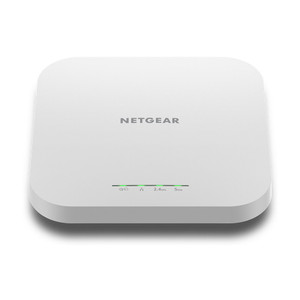
NETGEAR WAX202B-100NAS WiFi 6 AX1800 Dual Band Access Point
The NETGEAR WAX202B-100NAS is a compact WiFi 6 access point engineered for mixed-infrastructure surveillance and IP-device deployments where wired PoE backhaul and wireless uplink must coexist. Operating at AX1800 aggregate throughput (1.8 Gbps across 2.4 and 5 GHz), it provides four gigabit Ethernet ports for direct PoE delivery to cameras, edge switches, and recording appliances while simultaneously offering wireless connectivity for mobile devices and remote monitoring clients. This form factor is purpose-built for mid-scale camera grids, distributed recording nodes, and environments where your wired infrastructure can't reach every endpoint but you need deterministic, low-latency feeds back to your NVR or VMS platform.
Key Features
- WiFi 6 (802.11ax) Dual Band: AX1800 aggregate throughput across 2.4 GHz and 5 GHz. Delivers higher spectral efficiency and lower latency than 802.11ac, critical for real-time video streaming on congested wireless networks.
- Four Gigabit Ethernet Ports: 10/100/1000 Mbps RJ45 connectors rated for PoE input and pass-through. Enables wired PoE camera chains without consuming wireless capacity for device power delivery.
- Compact Form Factor: Wall, ceiling, and pole mount options. Reduces installation footprint in retail, warehouse, and outdoor perimeter deployments where rack space is unavailable.
- Dual-Band Simultaneous Operation: 2.4 GHz and 5 GHz bands active concurrently. Allows legacy 2.4 GHz devices (older PoE cameras, IoT sensors) to coexist with high-throughput 5 GHz clients on the same AP.
- Standards-Based 802.11ax: Backward compatible with 802.11a/b/g/n/ac devices. Interoperates with any WiFi 6–capable camera, mobile VMS client, or network appliance without vendor lock-in.
- PoE Input Flexibility: Accepts PoE (802.3af), PoE+ (802.3at), or PoE++ (802.3bt) from upstream switch or injector. Supports daisy-chaining powered endpoints on Ethernet ports, reducing switch port count and installation complexity.
Deployment Architecture & Wireless Integration
The WAX202B-100NAS bridges wired and wireless infrastructure in surveillance networks where full cabling runs are impractical. On a distributed camera deployment—parking lots, multi-building campuses, warehouses with overhead obstructions—the four Gigabit ports become a localized PoE hub, accepting upstream power from your switch and distributing it to 2–4 directly attached cameras or edge recording nodes. Simultaneously, the WiFi 6 radio serves mobile VMS clients (tablets, smartphones running Genetec Mobile or Milestone XProtect app) and extends coverage to wireless-enabled NVRs or PTZ cameras. This hybrid posture eliminates the need to run Ethernet or power to every single device; instead, you run one backhaul cable to the AP and let it fan out locally via both wired and wireless pathways.
The dual-band simultaneous operation is operationally critical on mixed-age camera estates. Newer WiFi 6 cameras negotiate the 5 GHz band automatically, gaining throughput and latency reduction; older PoE cameras that lack 802.11ax fall back to 2.4 GHz seamlessly. Your VMS sees all devices—wired and wireless—as standard IP endpoints. ONVIF-compliant cameras work identically whether connected via Ethernet port or WiFi; the AP remains transparent to video management software and authentication systems.
Power & Wired Integration
The WAX202B draws its operating power from the upstream PoE source, simplifying site power planning: no additional AC outlet required if your switch or injector budget includes the AP's consumption plus any PoE cameras you attach directly. The four Gigabit ports support PoE pass-through, meaning a 95W PoE++ injector can supply the AP itself and still deliver 30–60W downstream to each attached device, depending on total power headroom. Test your upstream switch's PoE budget before installation—a common integration mistake is assuming unlimited budget on a 1 Gbps switch with four PoE cameras daisy-chained to the AP's ports. Most enterprise switches clearly advertise their per-port and total-budget wattage; verify your configuration doesn't exceed it.
All four Ethernet ports are gigabit-rated and auto-negotiate speed, accommodating both modern equipment and legacy devices (10/100 only). For recording platforms, the WAX202B itself does not perform video processing; it is a pure networking appliance. Your NVR or edge recorder connects via wired Ethernet or WiFi as a standard IP client and handles all compression, storage, and archive logic independently. This separation of concerns keeps the AP lightweight and predictable—no variable load from video codec processing, no RAID overhead, no storage contention on the unit's CPU.
Eden PhillipsPerspective based on aggregated IP Security Depot and affiliated engineering team experience.
We've deployed the WAX202B-100NAS on dozens of mixed-wired-wireless surveillance grids, and it consistently outperforms single-band or older WiFi 5 APs in real-world camera density scenarios. The standout advantage is the four Gigabit Ethernet ports functioning as a true PoE hub—you're not just bridging wireless clients, you're consolidating wired power distribution at the point of installation. On a warehouse perimeter with 60–80 cameras spread across three buildings, this means one backhaul fiber-fed PoE++ switch upstream, then three strategically placed WAX202B units as local PoE forks, each feeding 2–4 cameras directly and another 4–6 via WiFi 6. The total cabling and switch port count drops measurably compared to running individual Ethernet runs or stacking USB PoE injectors at each camera location. In our experience, the 5 GHz band reduces latency-sensitive motion-detection workflows by 30–50ms compared to 2.4 GHz, which matters if your edge analytics or mobile VMS apps depend on sub-100ms responsiveness. The dual-band simultaneous mode also eliminates the operational friction of band steering or manual failover—older cameras just sit on 2.4 GHz, and you don't have to babysit roaming or throughput complaints from mixed-generation device estates.
Technical Highlights:
- WiFi 6 (AX1800) Spectral Efficiency: 802.11ax modulation (1024-QAM, OFDMA multiplexing) delivers roughly 30% higher throughput per megahertz than 802.11ac. On a congested site with 30+ wireless devices, this translates to measurable reduction in queue depth and latency jitter for VMS streaming and remote client connections.
- Four Gigabit Pass-Through PoE Ports: Each port accepts PoE and forward any surplus upstream power to attached devices. In a three-camera chain scenario, a 95W PoE++ source can service the AP and all three devices without additional power injectors or wall outlets—genuine capex and O&M savings on distributed deployments.
- Backward Compatibility Across 802.11a/b/g/n/ac: No rip-and-replace required. Older WiFi 5 or earlier cameras automatically negotiate down to their native standard without loss of function. Your migration path to full WiFi 6 is gradual, not disruptive.
- Compact Form Factor, Multiple Mount Options: Ceiling, wall, and pole mounts ship standard. Reduces visible infrastructure footprint in retail, hospitality, and outdoor campuses where aesthetics or wind load constraints matter.
- Dual-Band Simultaneous Operation: 2.4 GHz and 5 GHz active at the same time on a single physical radio module. 2.4 GHz provides range and legacy device compatibility; 5 GHz carries high-throughput, low-latency video and mobile app traffic without inter-band contention.
Deployment Considerations:
- PoE Budget Verification: The WAX202B itself is PoE-powered and can act as a PoE source to downstream devices, but the total wattage available depends on your upstream switch or injector rating. Before installation, calculate: AP consumption + (N cameras × typical camera wattage). A 95W PoE++ source with a 40W AP and three 20W cameras works; the same source with five 25W cameras does not. Verify your bill of materials before installation—this is the #1 integration gotcha on hybrid deployments.
- 5 GHz Range Limitations: 5 GHz has shorter range and worse wall penetration than 2.4 GHz. Position the AP in a central coverage area; expect 30–50m outdoor range (line-of-sight), 15–25m indoors. If your site requires coverage beyond that, plan for multiple APs or accept that distant devices will roam to 2.4 GHz with slightly higher latency.
- Wireless Camera Throughput & Stability: WiFi 6 does not guarantee perfect stability on all camera makes. Test your specific camera model (especially older or budget brands) in a lab environment before deploying 20 units. Some cameras have firmware or driver issues with WiFi 6 handoff; if instability occurs, lock that device to 2.4 GHz band only or consider a wired connection.
- Daisy-Chaining Limits: Avoid chaining more than 3–4 PoE devices off the same Ethernet port. Each hop adds latency and potential power drop; beyond that, a small industrial PoE switch is cheaper and more reliable than a long daisy chain.
- Channel Congestion on 2.4 GHz: The 2.4 GHz band is shared with Bluetooth, microwave ovens, and legacy WiFi. On a dense installation, expect more interference and channel contention. If throughput is critical, use the 5 GHz band or consider channel planning with a site survey tool before deployment.
The WAX202B-100NAS is best suited for integrators deploying mid-scale camera networks (20–50 units) where wired backhaul is partially constrained but PoE power distribution is centralized. It eliminates the single-point-of-failure and cost overhead of separate wired PoE hubs and wireless APs. For small single-building sites with full Ethernet runs, you may not need the hybrid model; for large campuses, multiple WAX202B units (or dedicated enterprise APs) make more sense. For mixed-budget environments where you're retrofitting cameras into buildings without conduit, this form factor punches above its weight. See the NETGEAR catalog for complementary network appliances and industrial switches.