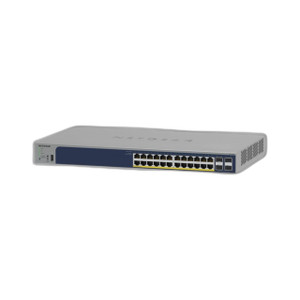
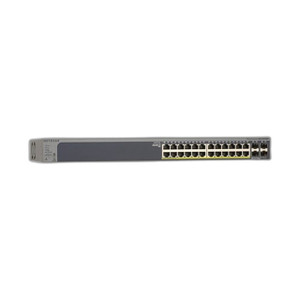
NETGEAR GS724TPP-300NAS 24-Port Gigabit PoE+ Smart Switch
The NETGEAR GS724TPP-300NAS is a managed Layer 2/3 Gigabit PoE+ switch designed for mid-scale commercial surveillance, access control, and IP phone deployments. With 24 PoE+ ports delivering up to 380W aggregate power and 2 SFP uplink slots for fiber or long-distance copper runs, this switch consolidates power delivery and network distribution on a single platform. Cloud management via NETGEAR Insight eliminates on-premises controller overhead, while VPN and advanced QoS keep latency-sensitive traffic (door strikes, camera streams) prioritized and secure.
Key Features
- 24 PoE+ Ports (380W Total Budget): Each port supplies up to 30W per PoE+ 802.3at standard—sufficient for high-power IP cameras (Axis/Hanwha 5-8MP domes with IR), PoE+ IP phones, and wall-mounted access-control readers. 380W aggregate means you can power roughly 12–16 simultaneous full-draw cameras without secondary power injection.
- 2 SFP Uplink Ports: Gigabit SFP slots support both multi-mode fiber (LC) and long-distance single-mode runs. Isolates backhaul traffic from edge PoE branch on high-density 24-port deployments without choking throughput.
- Managed Layer 2/3 Switching: VLAN support, static routing, and 802.1p QoS enable you to segment camera traffic (isolated VLAN), access-control heartbeat (high-priority queue), and data clients (best-effort) on a single physical plant. Reduces cabling and switch-count on medium installations.
- Cloud Management (NETGEAR Insight): Remotely configure, monitor uptime, and push firmware updates across distributed sites without a central NMS appliance. Multi-site dashboard tracks PoE power draw per port in real time—invaluable for capacity planning on growing systems.
- Fanless / Low-Noise Operation: No active cooling required in typical office/utility closet environments. Eliminates one more point of failure and reduces operational noise on installations near tenant spaces.
- Compact 1U Footprint: Stacks into standard 19-inch racks alongside NVRs and network appliances. Minimal floor space, suitable for branch offices and small server rooms.
- Surge & Overcurrent Protection: PoE port isolation and SPD (surge protective device) on input power reduce risk of cascading failure from lightning or power transients on camera lines.
- SNMP & Syslog Support: Standard-issue network monitoring hooks—integrates with Nagios, Zabbix, or enterprise Solarwinds deployments for unified alerting on switch health and PoE fault events.
The GS724TPP-300NAS bridges the gap between unmanaged PoE switches and enterprise-class core infrastructure. On a 12-camera perimeter system with IP door controllers and a backup internet handoff via SFP fiber, the 380W budget comfortably handles peak concurrent draw. VLAN segmentation isolates camera streams from data traffic, preventing a runaway analytics server from saturating the PoE budget or starving bandwidth to video recorders. Cloud management means you're not rolling out to a site to reboot a switch that's silently misconfigured; you see PoE faults and power-budget exhaustion in real time on your phone.
Deployment scenarios span retail chains (multi-location camera + access rollout), manufacturing floors (IP cameras on fork-lift routes, PoE IP phones in warehouse), and smaller municipal buildings (lobby entry camera + PoE intercom + door controller on one switch, fiber uplink to central NVR). The 30W per-port ceiling means you can run Axis P3304-LVE (5MP 95° indoor/outdoor, ~5W) or Hanwha XNB-8001 (1080p, ~8W) simultaneously without thinking about load-shedding. Power-hungry domes (Pelco IMM Flex, 25–30W with heater/wiper) consume the full allocation, so mixed deployments require honest capacity math.
Integration is straightforward: all 24 ports auto-negotiate Gigabit and PoE handshake per IEEE 802.3at; connected cameras appear on the network within seconds. ONVIF compliance ensures Axis, Hanwha, and Hikvision cameras cooperate with Milestone, Genetec, and Avigilon VMS platforms without driver fuss. The SFP uplinks accept commodity Gigabit modules—SX (multimode, ~60m) or LX (single-mode, 10km+)—so you're not locked into vendor-specific fiber optics. SNMP traps alert you the instant a PoE port faults or the device approaches 75% power draw, feeding that telemetry into your existing network operations center if you have one.
NETGEAR hardware ships with a manufacturer warranty covering parts and 24/7 phone support. No proprietary firmware locks or serial-number activation—the unit works out of the box with any IP camera or PoE device that respects the 802.3at spec. If your deployment grows beyond 24 cameras, cascade additional GS724TPP units via SFP fiber or 10G uplinks without redesigning your access-control network.
Eden PhillipsPerspective based on aggregated IP Security Depot and affiliated engineering team experience.
We've deployed the GS724TPP-300NAS across branch-office surveillance rollouts and mid-scale access-control networks, and it consistently delivers the right balance of managed switching and PoE bulk power without over-engineering. The real differentiator is the 380W PoE budget paired with cloud-based management—on a 12–16 camera network, you're not wrestling with separate PoE injectors or spinning up a local Insight controller appliance. The Insight dashboard shows you, in real time, which ports are drawing how much current, which cameras are negotiating 15W versus 30W, and when you're approaching headroom limits. That operational visibility prevents the classic problem: a new IR dome gets installed, PoE budget exhaustion silently kicks in, and an existing camera reboots every 90 seconds because its power supply is brown-out tolerant but not failing gracefully. We've also seen the VLAN and QoS tooling prevent bandwidth starvation on sites where data traffic (guest WiFi, office systems) shares the same uplink pipe as camera streams. A single VLAN for video + differentiated queue for access-control heartbeat = no surprise latency spikes on door readers.
Technical Highlights:
- 380W PoE+ Budget (802.3at per-port, 30W max): Sufficient for one Axis P3265-LVE (5MP outdoor, ~10W) + one Hanwha XNV-8080 (1080p outdoor, ~12W) + one Pelco IMM Flex (25–30W with heater) running simultaneously on three ports. Do the math on your mixed camera types early, and test PoE negotiation on the actual models you spec—some older PoE devices draw less than rated max, freeing headroom for future expansion.
- 2 SFP Uplink Slots (Gigabit multi-mode or single-mode): Allows you to run fiber to a distant NVR or core switch without upsetting copper distances or PoE injection logic. SX modules (multimode, ~550m typical) cost ~$20; LX (single-mode, 10km+) run ~$40–60. No vendor lock-in — any 1000BASE-SX/LX module works.
- Managed L2/3 (VLAN, Static Routes, 802.1p QoS): Isolate camera VLAN from data clients, tag access-control and NVR traffic as high-priority queue, and ensure a rogue analytics server or guest WiFi bridge can't starve bandwidth to cameras. Not a chassis-based core switch, but sufficient for branch offices and small HQs.
- Cloud Insight Management: Remote firmware updates, port-level power monitoring, and SLA alerting without needing to SSH into the box or maintain a Citrix/VPN tunnel for configuration. Multi-site deployments (10+ branches) consolidate on a single Insight dashboard—invaluable for distributed chains or franchise networks.
- Fanless Design: No acoustic noise, no dust filters to clean, one fewer failure point in a confined utility closet. In a room with backup generators or HVAC roar, it's barely noticeable.
Deployment Considerations:
- 380W is Your Hard Ceiling: If you have 8 simultaneous 30W PoE loads (full-draw PTZs or heated domes), you've exhausted budget and the 9th device won't power up. Know your camera mix and worst-case concurrent demand before installation. Test boot sequences of all PoE devices on a lab bench to catch devices that inrush higher than rated steady-state.
- SFP Uplinks Are Not Redundant Paths by Default: Both SFP ports can carry traffic simultaneously, but if your primary uplink is copper on the 24 Gigabit ports and you're relying on SFP as failover, you must configure static routing or spanning-tree manually. Insight helps with that, but test failover before going live on critical sites.
- Insight Cloud Requires Internet Connectivity: If your site has spotty WAN uptime, the switch still operates locally (VLAN, QoS, PoE delivery) without cloud contact, but alerting and remote config pushes will lag. On remote warehouses with 4G hotspot only, keep a out-of-band serial console handy and a saved config backup for offline troubleshooting.
- Rack Mount Requires Brackets (Not Included): The unit is compact, but you'll need a standard 19-inch switch bracket kit (~$15) to mount it securely in a rack alongside an NVR. Patch cables and SFP modules are separate line items.
- PoE Port Isolation Is Per-Port, Not Switchable: If a camera shorts its Ethernet line, that PoE port auto-disables to protect the power supply, but it's a manual re-enable (via Insight or CLI). Spares can sit for 10–15 seconds before the port recovers; design handoff procedures accordingly on mission-critical access-control loops.
The GS724TPP-300NAS is the standard pick for integrators deploying 12–20 IP cameras plus access-control and IP phone infrastructure on a single branch or HQ location. If you're managing a multi-site franchise or retail chain, Insight's multi-location orchestration pays for itself in reduced truck rolls and faster troubleshooting. Start with one unit; if the network grows beyond 24 ports, add a second via SFP fiber without disrupting your existing camera and access-control VLAN segmentation. See the NETGEAR catalog for additional switching and infrastructure solutions.