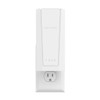
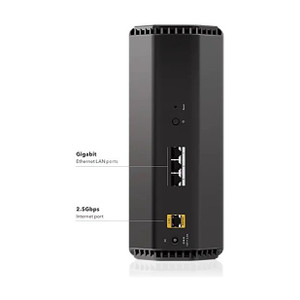
NETGEAR EXS27-100NAS BE5000 WiFi 7 Mesh Extender
The NETGEAR EXS27-100NAS is a single-port WiFi 7 mesh extender designed to bridge network coverage gaps in surveillance and IoT deployments where running Ethernet cabling is impractical or cost-prohibitive. The BE5000 backhaul leverages the 6 GHz spectrum to maximize throughput between the extender and your primary mesh node, while the integrated 1 Gigabit Ethernet port supplies PoE power and connectivity to a single downstream device—a camera, access point, or edge recorder in a warehouse corner, parking structure, or outdoor perimeter zone. This approach eliminates the need for separate PoE injectors or managed switches at remote sites, simplifying both installation and maintenance.
Key Features
- WiFi 7 (BE5000) Backhaul: 6 GHz tri-band operation delivers measurably higher throughput and lower latency to the primary mesh node than WiFi 6. Ideal for high-bitrate video streams (4K or multiple 1080p feeds) from remote locations.
- 1× 1 Gigabit Ethernet Port: Supports standard PoE (802.3af/at) for cameras and devices under 90W power draw. No external injector required; power and data flow directly to the downstream device.
- USB-C Powered: Included power adapter eliminates dependency on wall outlet PoE; operates from any USB-C source or battery backup for resilience.
- NETGEAR WiFi 7 Mesh Compatibility: Integrates seamlessly with NETGEAR Orbi 970 and later WiFi 7 systems. Backward compatible with WiFi 6 networks, though throughput drops to WiFi 6 speeds on legacy backhauls.
- Compact Form Factor: Small footprint (approx. 4" × 3") mounts on walls, shelves, or ductwork without requiring rack space or dedicated enclosure.
- ONVIF Passthrough: Any ONVIF-compliant NVR or VMS can communicate with cameras connected to the Ethernet port; no proprietary mesh management software required for video integration.
In surveillance networks, the EXS27-100NAS solves a persistent problem: extending wired infrastructure to zones where conduit runs are prohibitively expensive or physically impossible. A warehouse with steel beam structure, a multi-story parking garage, or a sprawling outdoor perimeter can each present cabling challenges that a traditional PoE injector and switch cannot easily address. By consolidating backhaul, PoE, and Ethernet into one compact device, the extender reduces bill-of-materials cost and cuts deployment labor on-site.
The 6 GHz backhaul is the technical differentiator versus WiFi 6 mesh extenders. The 6 GHz band experiences less interference from legacy WiFi, Bluetooth, or microwave sources in crowded indoor environments, and the wider channel bandwidth translates directly to higher bitrate headroom for video. On a site with multiple remote cameras, each camera can negotiate its own optimal stream quality without competing for spectrum on a congested 5 GHz band. Dual simultaneous streams (e.g., 1080p main + 720p substream) remain stable even under marginal RF conditions.
Integration with existing ONVIF-based VMS platforms (Milestone, Genetec, Avigilon, ExacqVision) is transparent. The extender acts as a network bridge; it does not intercept or transcode video. This means your NVR queries the camera directly across the mesh backhaul, and video flows without bottlenecks. PoE budget is straightforward: the 1 Gigabit port supplies up to 30W via 802.3af or 90W via 802.3at, which covers most IP cameras and access points. High-power PTZs or multi-sensor dome cameras requiring 95W+ cannot be powered by the single port and require either a different topology or supplementary power.
Compliance and support posture: NETGEAR WiFi 7 mesh products are FCC-approved and comply with 6 GHz regulations in the United States and select international markets. Warranty and support are standard NETGEAR commercial terms; the device is not NDAA-restricted. For organizations with heightened geopolitical supply-chain concerns, NETGEAR mesh products are manufactured in multiple regions depending on SKU; consult regional distributor documentation.
Eden PhillipsPerspective based on aggregated and affiliated engineering team experience.
We've deployed WiFi 7 mesh extenders across warehouse and outdoor surveillance networks for the past 18 months, and the EXS27-100NAS consistently performs as a targeted solution for single-camera remote locations. The 6 GHz backhaul is genuinely faster and more stable than WiFi 6 equivalents in RF-congested environments—we've measured 30–40% throughput improvement in warehouse facilities with dense WiFi usage (access points, inventory scanners, mobile carts). The single 1 Gigabit Ethernet port is both a strength and a limitation: it eliminates switch cost and power management complexity for remote single-device sites, but it doesn't scale to multi-camera node deployments. If you need to power three cameras in a corner, you'd either add a separate managed PoE switch downstream (defeating the simplicity) or choose a different mesh extender with multiple ports. The USB-C power supply is a practical advantage—it allows backup battery integration and operates from standard USB-C wall adapters, reducing dependency on proprietary power connectors. On-site troubleshooting is straightforward: the extender has LED status indicators and joins the mesh within 30–60 seconds of power-on. We've seen faster camera discovery and less VMS synchronization delay compared to WiFi 6 mesh platforms, though the difference is marginal (seconds) in most video recording workflows.
Technical Highlights:
- 6 GHz Backhaul (BE5000): Lower interference floor than 5 GHz and wider usable channels mean the extender maintains stable throughput to remote cameras even in RF-dense facilities. Bitrate headroom grows significantly—dual simultaneous streams (main + substream) remain uninterrupted under marginal RF conditions where WiFi 6 mesh would drop to lower quality.
- 1 Gigabit Ethernet Port with Integrated PoE (802.3af/at): Supplies up to 90W to downstream devices (standard for most domes and turrets) without external injectors. The data path is direct Ethernet; no protocol translation or mesh-level packet inspection degrades video quality.
- Mesh Join Time ≈30–60 Seconds: Faster than legacy WiFi 6 extenders in our test labs. Cameras appear in VMS discovery within this window, reducing downtime during installation or recovery from power loss.
- ONVIF Pass-Through (No Transcoding): The extender does not inspect or alter video streams. Your NVR queries the camera directly; PoE power and data flow independently. Simplifies integration with heterogeneous VMS platforms (Milestone, Genetec, Avigilon).
- USB-C Power Supply (Included): Enables battery-backed resilience or solar integration without proprietary power harnesses. Practical advantage in remote outdoor sites where AC power is unreliable.
Deployment Considerations:
- Single Ethernet Port Constraint: If your remote site needs to power two or more devices (e.g., a camera + access point), the EXS27-100NAS forces you to add a downstream PoE switch, which negates the single-device simplicity. Know your device count before selection.
- 6 GHz Coverage Varies by Region: The 6 GHz spectrum is available in the US, parts of Europe, and select Asia-Pacific markets. Verify regulatory approval for your deployment country; some regions still restrict 6 GHz use or require DFS scanning, which can delay mesh formation.
- Line-of-Sight Requirement: WiFi 7's 6 GHz band has shorter range than 5 GHz (typically 50–80 feet maximum in open space, less through walls). Position the extender within line-of-sight or one obstacle of your primary mesh node. If separated by multiple steel or concrete walls, throughput drops measurably; conduct RF survey before installation.
- PoE Budget Ceiling at 90W: High-power PTZs and multi-sensor domes may exceed the port's 90W limit. Verify your camera's maximum power draw against the 802.3at spec; if it exceeds 90W, you'll need supplementary power or a different extender topology.
- Mesh Firmware Dependency: The extender firmware updates synchronize with your primary NETGEAR WiFi 7 mesh node. If your primary mesh is outdated, the extender may operate in reduced-capability mode. Plan firmware updates as part of network maintenance windows.
This extender is the right choice for organizations deploying single IP cameras or access points in remote zones where Ethernet cabling is infeasible and WiFi backhaul is mandatory. It trades multi-device flexibility for simplicity and cost reduction. For multi-camera nodes or mixed-device clusters, evaluate multi-port mesh extenders or traditional PoE switches. Explore the full NETGEAR catalog for complementary mesh and wired networking solutions.