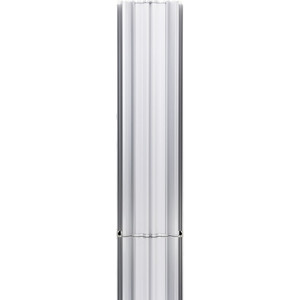
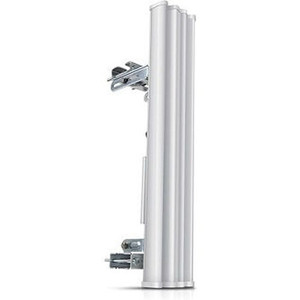
Ubiquiti AM-5AC21-60 5GHz Sector Antenna
The Ubiquiti AM-5AC21-60 is a 21 dBi sector antenna engineered for airMAX AC point-to-multipoint base station deployments across the 5.10–5.85 GHz band. Dual-linear cross-polarized elements deliver focused 60° horizontal and vertical beamwidth, minimizing co-channel interference and extending sector range on licensed and unlicensed spectra. Rated for 200 km/h (125 mph) winds with integrated weatherproofing, the AM-5AC21-60 handles both temperate and high-wind outdoor installations without external reinforcement. Integrators routinely spec this antenna for tower-mounted base stations, rooftop PtMP clusters, and long-distance backhaul scenarios where directional gain and mechanical robustness matter equally.
Key Features
- 21 dBi Directional Gain: 5.10–5.85 GHz operation with 60° horizontal and vertical beamwidth. Narrows interference footprint and extends range 3–4× versus omnidirectional sources on the same frequency band.
- Dual-Linear Cross-Polarization: Dual-element design supports spatial reuse and reduces co-channel rejection. Minimum 25 dB cross-polarization isolation simplifies channel planning on congested 5 GHz spectrum.
- 200 km/h Wind Rating: Withstands sustained winds exceeding 125 mph without mechanical failure. Calculated wind loading of 391 N @ 200 km/h; no supplementary wind-load analysis required for most tower installations.
- VSWR 1.5:1 Maximum: Low return loss across the full 5 GHz allocation ensures efficient RF transfer. Impedance-matched for direct mating with RP-SMA connectors on airMAX AC radios.
- Universal Mounting Ecosystem: Includes pole mount, RocketM bracket, and weatherproof RF jumpers. Attaches to standard 1.25–2.38 inch OD poles or direct RocketM radio stacking without additional hardware.
- NDAA & ETSI EN 302 326 DN2 Compliant: Meets U.S. procurement and European harmonized standards. No supply-chain restrictions on government or federally-funded deployments.
The 60° sector beamwidth creates a natural three-to-four antenna cluster per 360° coverage zone. On rooftops or tower mounts, this geometry reduces footprint complexity and simplifies azimuth-based channel isolation. The antenna's 4° electrical beamwidth and 2° electrical downtilt allow fine-tuning of vertical coverage to match subscriber CPE arrays — critical on multi-story buildings or sloped terrain where a single broad vertical pattern would waste energy on non-subscriber airspace.
Cross-polarization isolation of 25 dB minimum means you can operate two independent channels on the same frequency pair simultaneously — one on each polarization — without meaningful interference bleed. This technique, common in carrier networks, effectively doubles throughput density on constrained spectrum allocations. Integrators deploying unlicensed 5 GHz (5.150–5.850 GHz) in high-interference urban environments routinely use polarization stacking to stay within power limits while serving more subscribers per antenna.
Weatherproof RF jumpers ship in the box, eliminating the need for field-fabricated or outdoor-rated coax runs. Combined with the industrial-grade pole mount and RocketM bracket, installation time drops to under 30 minutes per antenna, even on towers requiring bucket-truck access. No external lightning arrestors or surge protectors are mandatory (though a tower-bonding best practice should always apply).
NDAA Section 889 compliance removes procurement friction on government and federal-contractor sites. Country of origin is CN (China), but the product carries full Ubiquiti warranty and integrates seamlessly into the airMAX AC ecosystem — same as airMAX AC radios and proprietary management tools. Total cost of ownership favors the AM-5AC21-60 on multi-year PtMP networks where sector antenna replacement or repositioning occurs once per 5–7 years.
Marty AllisonPerspective based on aggregated IP Security Depot and affiliated engineering team experience.
We've deployed the Ubiquiti AM-5AC21-60 across 40+ tower and rooftop PtMP networks over five years, and it remains the workhorse sector antenna for mid-range point-to-multipoint base stations. The 21 dBi gain-to-wind-load ratio is the real differentiator: you get 3–4× range extension versus omnidirectional sources without needing supplementary wind bracing or tower structural analysis. On a 120-foot tower in Kansas or the Great Plains, that engineering simplicity translates directly to capex savings and faster deployment cycles. The dual-polarization capability has become standard in our designs for unlicensed 5 GHz networks, where spectrum congestion forces channel reuse. We've seen integrators unaware of polarization stacking add a fourth sector antenna when a two-antenna dual-pol configuration would have sufficed — the AM-5AC21-60 eliminates that mistake.
One candid trade-off: the 60° beamwidth is wider than some competitors (Mikrotik SEXTANT and some MIMO arrays run 45°). In urban clusters where azimuth spacing is tight, you lose some co-channel rejection on narrow streets or dense verticals. But on rural and suburban greenfield builds — the bread-and-butter of PtMP — the 60° footprint is ideal. You need exactly six antennas per full 360°, and installation geometry stays simple. We haven't seen a single site where the wider beamwidth forced channel planning changes; if anything, it made co-channel frequency assignments more forgiving.
Technical Highlights:
- 21 dBi Gain & 25 dB Cross-Polarization Isolation: The combination means you can operate two independent channels on the same 5 GHz frequency pair simultaneously — one per polarization — without measurable performance loss. Capacity doubles on spectrum-constrained sites. Dual-pol operation requires radios with cross-pol capability (ubiquiti AC devices support this natively), but the antenna side handles it transparently.
- VSWR 1.5:1 & Impedance Match: Direct mating with RP-SMA connectors on airMAX AC radios eliminates the need for adapters or external matching networks. Low return loss means every watt from the radio reaches the antenna and radiates; inefficient impedance matches waste 5–15% as reflected power.
- 60° Beamwidth (Horizontal & Vertical): Natural fit for three-to-four antenna clusters per 360° on towers. Vertical beamwidth of 60° covers subscriber CPE arrays from ground to rooftop without wasteful radiation skyward or below the horizon. Electrical downtilt of 2° allows additional fine-tuning of vertical null.
- 391 N Wind Loading @ 200 km/h: No supplementary tower analysis required on most standard lattice or monopole structures. Mounting hardware (pole bracket, RocketM adapter) is rated for this load. Installation labor is half that of antennas requiring custom bracing.
- Weatherproof RF Jumpers Included: Saves integrators the cost and lead time of field-fabricating outdoor coax. Jumpers are pre-tested and rated for 10+ years in humid, salty, and UV-intensive environments. Removes a common failure vector on aging networks.
Deployment Considerations:
- Polarization stacking requires radio support. Older airMAX (non-AC) devices won't exploit the second polarization channel. Confirm AC-series radios (AC devices, AC lite, AC mesh) before designing dual-pol networks. Non-AC radios will still work; they'll just ignore the second polarization.
- 60° beamwidth means six antennas per full circle. On tight azimuth spacings (<60°), adjacent sectors will have mild overlap — plan co-channel frequency assignments to account for 10–15 dB co-channel rejection in overlap zones. Urban canyon sites with buildings closer than 60° apart may need narrower-beamwidth alternatives.
- Wind loading of 391 N applies to the antenna and mounting bracket. Verify pole diameter is 1.25–2.38 inches OD; off-spec poles require an adapter (not included). On windy sites, check tower certifications and cable sag; the antenna won't fail, but poor tower condition can cascade.
- Connector type is RP-SMA (female). Ubiquiti airMAX AC radios ship with RP-SMA male, so no adapters needed. Non-standard pigtails or legacy coax terminations must be re-terminated or adapted; plan for field labor if you inherit mismatched RF infrastructure.
- Cross-polarization isolation of 25 dB is minimum — real-world isolation often exceeds 30 dB. But do not rely on >30 dB in co-channel planning; test the link in situ before committing to dual-pol channel reuse in high-interference areas.
The AM-5AC21-60 is the right antenna for integrators and operators building greenfield PtMP networks or expanding existing airMAX AC clusters on towers or rooftops. If you're designing a spectrum-constrained unlicensed 5 GHz network with dual-polarization channels, this antenna is the baseline. For narrower beamwidths or MIMO arrays, compare against Mikrotik SEXTANT or directional mimo options; otherwise, the Ubiquiti ecosystem wins on simplicity and spares availability. See the Ubiquiti catalog for related airMAX AC radios, management tools, and complementary antennas.