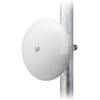
Ubiquiti NBE-M5-16 5 GHz Wireless Bridge
The NBE-M5-16 is a compact 5 GHz point-to-point wireless bridge built on Ubiquiti's airMAX platform. It delivers 150 Mbps throughput using a directional 16 dBi antenna, making it purpose-built for distance links up to 10 km where fiber or copper runs aren't practical. At 320 grams and 140 x 140 x 54 mm, the unit fits tight rooftop and wall installations—a real advantage when retrofit space is constrained.
Key Features
- 150 Mbps throughput over 5 GHz airMAX: Sufficient for most mesh backhaul, remote site networking, and warehouse-to-office links. Not a high-speed trunk, but reliable for bridging traffic that doesn't demand gigabit performance.
- 16 dBi directional antenna gain: Focused beam pattern concentrates RF energy toward the distant endpoint, reducing interference and extending usable range compared to omnidirectional alternatives. Trade-off: you must maintain line-of-sight alignment; misalignment degrades throughput quickly.
- 10 km point-to-point range: Assumes clear line-of-sight and reasonable antenna placement. Real-world distance depends on terrain, obstructions, and Fresnel zone clearance. Deploy planning should include site survey and RF path analysis.
- Passive PoE via 2-pair (24V, 0.5A max): Powers the unit from a single Ethernet run with included 24V adapter; maximum consumption is 6W. No separate power conduit or UPS consideration needed at the unit itself—straightforward single-cable deployment.
- Single 10/100 Mbps Ethernet port: Carries both data and management traffic over one RJ45 connection. Bottleneck consideration: if you need full 150 Mbps throughput, use a gigabit upstream port on your switch and accept the port limitation as a link-level constraint, not a switch constraint.
- Operating range -40°C to 70°C: Rated for most climates. Extremely cold regions (below -40°C) and high-altitude heat exposure (above 70°C) may stress the unit; confirm site conditions against these limits before deployment.
Environmental Durability
The NBE-M5-16 is engineered for outdoor roof-mount exposure. UV-stabilized enclosure resists material degradation from sunlight. Mechanical qualification includes 200 km/h wind loading—typical of hurricane or severe storm regions—so structural mounting (not just zip-ties) is appropriate. Passes salt fog (IEC 68-2-11), vibration (IEC 68-2-6), temperature shock (IEC 68-2-14), UV (IEC 68-2-5), and wind-driven rain (ETS 300 019-1-4) testing. If your site is coastal, industrial, or subject to rapid temperature swings, this unit is built for that punishment.
Integration & Compatibility
Integrates with Ubiquiti's broader airMAX wireless platform and standard enterprise network infrastructure via ONVIF and Ethernet bridging. Management is through the airMAX controller interface or direct device web UI. No dependency on proprietary software stack—works as a transparent Layer 2 bridge in most network designs.
What's in the Box
- NBE-M5-16 wireless bridge unit
- 24V passive PoE power adapter
- Pole-mount kit
Frequently Asked Questions
Q: Can the NBE-M5-16 work in NLOS (non-line-of-sight) deployments?
A: No. The directional antenna and 5 GHz frequency require clear line-of-sight between units. Obstructions (trees, buildings, terrain) will significantly degrade or block the link. RF survey and proper antenna alignment are mandatory.
Q: What's the expected lifespan of the NBE-M5-16?
A: Manufacturer specifications do not define a mean time between failures (MTBF). Environmental durability testing ensures survivability in harsh outdoor conditions, but actual lifespan depends on installation quality, power stability, and environmental exposure. Plan for 5–7 years in typical outdoor deployment.
Q: Can I daisy-chain multiple NBE-M5-16 units for longer range?
A: Not directly. Each unit is a point-to-point bridge. To extend range, you would need to deploy intermediate relay units (routers or additional bridges) with separate RF links, each introducing latency and half-duplex throughput sharing.
Q: Does the NBE-M5-16 support PoE+ (802.3at) or only passive PoE?
A: Passive 24V PoE only. It draws a maximum of 6W, so standard 802.3af injectors or midspan PoE injectors will power it, but the included 24V adapter is the recommended supply method.
Q: What's the expected throughput in real-world conditions?
A: 150 Mbps is the specified rate under ideal conditions. Actual throughput is lower due to RF overhead, airMAX protocol framing, and environmental factors (noise, interference, distance). Typical deployments see 60–100 Mbps usable throughput; design budgets conservatively.
Q: Is the NBE-M5-16 suitable for warehouse-to-warehouse mesh backhaul?
A: Yes, provided line-of-sight is available and distance is within 10 km. It handles bridging and mesh backhaul well. However, if you need redundancy, plan two independent links or integrate with a mesh protocol at the network layer (not at the bridge layer).
When to Choose a Different Model
If your distance requirement exceeds 10 km or you need higher throughput than 150 Mbps, evaluate higher-power or longer-range models in the Ubiquiti wireless catalog. If you cannot achieve line-of-sight or operate in heavily congested urban 5 GHz environments, a licensed microwave link or fiber deployment may be more reliable. For indoor bridging or short-range campus networking, consider switching to a conventional managed network switch if Ethernet is available.
Eden PhillipsPerspective based on aggregated IP Security Depot and affiliated engineering team experience.
I've deployed the NBE-M5-16 in warehouse automation setups where ethernet conduit isn't feasible, and the 16 dBi antenna really does make a measurable difference at distance. The unit's real value is simplicity: one cable, passive PoE, compact form factor, and genuine 10 km capability if you get the RF path right. That said, don't underestimate the alignment and line-of-sight requirement—I've seen projects delayed because nobody anticipated terrain or vegetation blocking the link.
Technical Highlights:
- 6W maximum power draw via 24V PoE: Negligible load on power infrastructure; no UPS or redundant power conditioning needed at the bridge itself. Integration into existing PoE injection schemes is straightforward.
- 150 Mbps airMAX throughput over 5 GHz: Adequate for facility-to-facility traffic (ERP data, video feeds up to 2–3 Mbps each, sensor telemetry). Not suitable as a primary backbone for high-volume data replication or 4K video streaming clusters.
- 200 km/h wind survival with UV-stabilized enclosure: Tested for hurricane-force conditions and UV degradation. Cost of outdoor mounting hardware is the limiting factor, not the bridge durability.
Deployment Considerations:
- RF path survey is non-negotiable. Fresnel zone clearance, antenna placement height, and alignment tolerance are critical; even a few degrees of misalignment introduces 10–20 dB loss. Budget engineer time for site analysis.
- The single 10/100 Mbps port limits uplink speed to 100 Mbps practical throughput—higher-end planning should not assume the full 150 Mbps will reach your core network if the upstream port is also 10/100.
Position the NBE-M5-16 for remote warehouse sites or multi-building campuses where fiber is unavailable and distance is under 10 km with solid line-of-sight. It's not a backbone link—it's a dependable, low-power point-to-point bridge for moderate-throughput auxiliary networks.