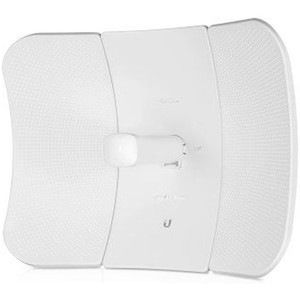
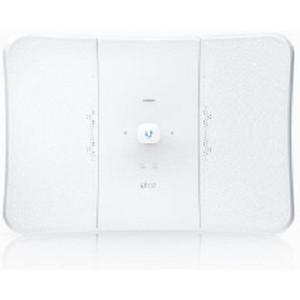
Ubiquiti LTU-LR 5 GHz Long-Range Wireless Bridge
Overview
The LTU-LR is a 5 GHz point-to-multipoint (PtMP) customer premises equipment (CPE) client engineered for outdoor long-range wireless deployments. Operating across U-NII frequency bands (5150–5250 MHz, 5250–5350 MHz, 5470+ MHz), it delivers maximum throughput of 900+ Mbps and functions as a CPE in PtMP environments paired with the LTU-Rocket BaseStation, or in point-to-point (PtP) mode with supported firmware. The LTU-LR (often searched as LTU LR) is built for scenarios where traditional wired infrastructure is impractical—rural sites, temporary deployments, or multi-site campus networks where fiber or copper runs would be prohibitively expensive.
Key Features
- 900+ Mbps Maximum Throughput: Sufficient for simultaneous video surveillance, data transfer, and voice over IP across small to mid-sized remote sites without bottlenecks. Real-world throughput depends on range, interference, and RF conditions, but this headroom prevents the wireless link from becoming a choke point in your network architecture.
- 5 GHz U-NII Band Operation: Operates in regulated frequency bands (5150–5250 MHz, 5250–5350 MHz, 5470+ MHz), avoiding the congested 2.4 GHz spectrum where interference from Wi-Fi, microwave ovens, and cordless phones degrades performance. 5 GHz also supports narrower channel widths and higher data rates, critical for reliable long-range links.
- Auto Distance and Power Adjustment: The LTU-LR automatically optimizes transmit power and signal parameters based on distance and link conditions, reducing unnecessary power consumption and RF interference to adjacent networks. This extends battery runtime on mobile deployments and minimizes co-channel interference in dense multi-site environments.
- PoE Power (24V 0.5A): Draws minimal power via passive PoE, eliminating the need for separate power supplies at the installation point. A standard PoE injector is included; total power budget is low enough to run from existing 24V infrastructure in many industrial and campus deployments, simplifying installation logistics.
- Bridge and Router Operating Modes: Configurable in PtMP CPE mode as either a transparent bridge (Layer 2 forwarding) or a router (Layer 3 IP gateway). Bridge mode is transparent to existing DHCP and DNS; router mode lets you assign a separate IP subnet to the remote site, useful when you need network segmentation or dual-WAN failover scenarios.
- Bluetooth Management via UISP App: Configure and monitor the LTU-LR without a separate wired Ethernet connection during commissioning—use Bluetooth and the UISP mobile app on iOS or Android. Web UI and standard modern browser access (on the unit's IP address) available once the link is established. This cuts on-site setup time and eliminates the need for a field laptop with Ethernet.
- PtP Firmware Support (v1.5.1+): Stock firmware operates as PtMP CPE, but upgrading to firmware 1.5.1 or later unlocks point-to-point mode, allowing the LTU-LR to pair directly with another LTU-LR or compatible Ubiquiti PtP equipment without a central BaseStation. Useful for mesh extensions or simple two-site links where PtMP infrastructure isn't yet in place.
Integration and Compatibility
The LTU-LR is purpose-built as a CPE for Ubiquiti LTU-Rocket BaseStation deployments. Firmware 1.5.1 and later enable PtP mode, expanding integration to any compatible Ubiquiti point-to-point wireless equipment. Management integrates with the UISP platform (Ubiquiti's network management and automation suite), which provides centralized provisioning, monitoring, and firmware updates across multiple LTU-LR units. Web UI and Bluetooth access support standalone configuration, making it viable for small deployments that don't yet warrant a full UISP installation.
What's in the Box
- 1x LTU-LR unit
- 1x Pole mount kit
- 1x 24V 0.5A passive PoE injector
When to Choose a Different Model
If you need indoor wireless coverage (office, warehouse floor), the LTU-LR is not the right choice—it's an outdoor, long-range CPE. For shorter indoor distances, consider compact 2.4 GHz or 5 GHz access points in the Ubiquiti catalog. If you require carrier-grade SLAs, redundancy, or cellular fallback, evaluate hybrid solutions combining the LTU-LR with 4G/5G modem options. If your site already has adequate fiber or dark fiber availability, wireless adds complexity and potential maintenance burden; wired is always preferred where cost-effective.
Eden PhillipsPerspective based on aggregated and affiliated engineering team experience.
The LTU-LR is a solid pick for bridging a remote site into your core network when fiber or copper trenching is off the table. The 900+ Mbps headline spec gives you real breathing room—you won't find yourself troubleshooting a saturated wireless link three months post-deployment. What matters more is the auto distance and power adjustment; it keeps the link stable across weather changes and prevents power drain on solar-powered remote sites.
Technical Highlights:
- 5 GHz U-NII Bands (5150–5470+ MHz): Avoids crowded 2.4 GHz interference, enabling stable long-range links. Narrower channels and higher modulation density on 5 GHz mean you get close to that 900+ Mbps in real deployments, assuming clean RF path and manageable distance (typically 5–15 km line-of-sight, depending on antenna and terrain).
- Auto Distance and Power Adjustment: Dynamically tunes TX power and link parameters to RF conditions. Reduces unnecessary radiation, cuts power draw (critical if you're running from batteries or limited solar), and minimizes interference to adjacent PtMP sectors or co-channel networks.
- 24V 0.5A PoE Passive Injector Included: Low power draw means no separate 48V PoE+ requirement. One standard PoE injector per LTU-LR, easy to wire into a central PoE panel or solar combiner at the remote site.
Deployment Considerations:
- Requires clear or near-clear line-of-sight to the BaseStation. Heavy foliage, terrain, or dense urban canyon reduces range and throughput. Site survey and RF modeling are worth the effort—a bad RF path will haunt you for years.
- PtP mode is firmware-dependent (v1.5.1+). If you're planning mesh or resilient two-site links, confirm firmware availability and test in your environment before wide deployment.
- Bluetooth commissioning is convenient, but range is typically 10–20 meters. For elevated mounts, bring a ladder or plan to drop down to wired Ethernet via temporary patch cords.
Position the LTU-LR for rural broadband backhaul, disaster recovery site connectivity, or temporary event network links where laying fiber isn't an option. It's not a replacement for stable wired infrastructure, but for remote sites that are 5+ km out from the nearest backbone, this is a pragmatic and cost-effective CPE.
Frequently Asked Questions
Q: Can I use the LTU-LR without an LTU-Rocket BaseStation?
A: Yes, with firmware 1.5.1 or later, the LTU-LR supports point-to-point mode and can pair with another LTU-LR or compatible Ubiquiti PtP equipment. In stock firmware, it operates as a PtMP CPE and requires an LTU-Rocket BaseStation.
Q: What is the maximum reliable range for the LTU-LR?
A: Range depends on RF conditions, antenna gain, and line-of-sight. Typical deployments achieve 5–15 km in open terrain with clear paths. Heavy foliage, urban obstruction, or multipath will reduce range and throughput. Site survey and RF modeling are recommended before installation.
Q: Does the LTU-LR support Bridge or Router mode?
A: Yes. In PtMP CPE mode, it is configurable as a transparent bridge (Layer 2) or a router (Layer 3 IP gateway). Router mode allows you to assign a separate subnet to the remote site; bridge mode is transparent to DHCP and DNS.
Q: How is the LTU-LR powered?
A: The LTU-LR draws 24V 0.5A via passive PoE. A 24V PoE injector is included in the box. Low power draw makes it suitable for remote sites powered by solar or limited-capacity UPS systems.
Q: Can I manage multiple LTU-LR units centrally?
A: Yes. The UISP platform (Ubiquiti's network management suite) provides centralized provisioning, monitoring, and firmware updates across multiple LTU-LR and LTU-Rocket units. Web UI and Bluetooth app configuration are also available for standalone or ad-hoc management.
Q: What frequencies does the LTU-LR operate on?
A: The LTU-LR operates on 5 GHz U-NII bands: 5150–5250 MHz, 5250–5350 MHz, and 5470+ MHz. These are regulated bands in most jurisdictions, avoiding crowded 2.4 GHz Wi-Fi interference.