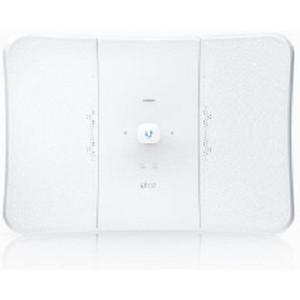
Ubiquiti LTU-PRO 5 GHz Wireless Bridge CPE Client
Overview
The LTU-PRO is a 5 GHz point-to-multipoint (PtMP) CPE client engineered for outdoor wireless network expansion. Delivering 900+ Mbps maximum throughput, it operates across U-NII frequency bands (5150–5875 MHz) and integrates directly with LTU-Rocket BaseStation infrastructure, making it suitable for telecom deployments, security integrators expanding site connectivity, and ISP network backhaul. The unit supports both CPE and point-to-point modes, providing flexibility in topology design — a critical advantage when you need to adapt a network without hardware replacement. Passive PoE 2-pair power delivery means simplified site cabling and no separate power supply. NDAA Section 889 compliance is included, satisfying federal procurement requirements.
Key Features
- 900+ Mbps Maximum Throughput: Exceeds typical site-to-site security camera backhaul and multi-tenant network demands. Actual sustained rates depend on distance, interference, and uplink/downlink ratio configuration — expect 60–80% of maximum in real deployments, but that still outpaces dual-band consumer equipment.
- Passive PoE 2-Pair Power: Draws a maximum of 9W, eliminating the need for a separate 12V supply or PoE injector. Standard 24V 0.5A passive PoE adapter is included. Reduces site power complexity and cable clutter.
- Configurable Uplink/Downlink Ratios: Choose 25/75, 33/67, or 50/50 splits to match your traffic pattern — if you're pulling video from a central NVR down to a remote office, favor downlink. If uploading alarm streams, rebalance accordingly. This prevents asymmetric performance surprises.
- Operating Temperature Range −40 to 60°C (−40 to 140°F): Covers outdoor deployments in cold climates and hot industrial zones without thermal shutdown risk. Crucial for unattended warehouse, parking lot, or perimeter installations.
- Wind Survivability to 200 km/h (125 mph): Designed for extreme weather. Mounting hardware and low profile minimize drag. Relevant for coastal sites, high-altitude installations, and hurricane-prone regions.
- Auto Distance and Power Adjustment: The unit automatically optimizes transmit power and sensitivity based on signal conditions, reducing interference to adjacent channels and extending battery-free operation on solar-powered remote sites.
- WPA2-PSK Encryption, SSH, and SNMP: Standard security protocols for management and traffic encryption. SSH access prevents unauthorized firmware changes; SNMP integration simplifies monitoring in large wireless networks.
- Dynamic DNS Support: Useful for sites with non-static public IPs. Automatically updates a DNS hostname so remote management stays reachable even after provider-assigned IP changes.
- Bluetooth + Web UI Management: Pair via the UISP App over Bluetooth for initial zero-touch provisioning, then manage via standard web browser on any modern OS — no vendor lock-in to specialized software.
Integration & Compatibility
The LTU-PRO operates as a CPE client within the LTU ecosystem, pairing with LTU-Rocket BaseStations as the access point. Router mode is available on firmware 1.5.x and later, enabling the unit to function independently if you need a point-to-point link without a central controller. Single GbE RJ45 port handles all data traffic. UISP management platform offers centralized provisioning of multiple units across geographically dispersed sites — essential for network infrastructure scaling. Integrates with standard ONVIF-compatible IP cameras and NVRs behind the link.
What's in the Box
- 1× LTU-PRO unit
- 1× 24V 0.5A Passive PoE adapter
- 1× Pole mount kit
Frequently Asked Questions
Q: Is the LTU-PRO NDAA Section 889 compliant?
A: Yes. The LTU-PRO is NDAA compliant, satisfying federal procurement restrictions on Huawei and ZTE equipment.
Q: Can I use the LTU-PRO in point-to-point mode without a LTU-Rocket BaseStation?
A: Yes. On firmware 1.5.x and later, router mode enables point-to-point operation. You can establish a direct link between two LTU-PRO units or pair it with other compatible Ubiquiti wireless equipment.
Q: What is the maximum power consumption, and will standard PoE+ supplies work?
A: Maximum power is 9W. The included 24V 0.5A passive PoE adapter is sufficient. Standard 802.3at PoE+ (30W) supplies will also work, though the unit will not draw the additional power.
Q: How is the LTU-PRO managed on remote sites without on-site IT staff?
A: UISP App provides Bluetooth provisioning on first power-up, then web UI or UISP platform manages the unit remotely over the backhaul link itself. SSH access and SNMP monitoring integrate with NOC tools.
Q: What uplink/downlink ratio should I configure for a security camera backhaul?
A: For continuous video streaming from remote cameras to a central NVR, a 25/75 (25% uplink, 75% downlink) or 33/67 ratio is typical. If uploading alarm events and low-resolution streams, 50/50 offers flexibility. Test with your actual camera bitrate and frame rate to avoid bottlenecks.
Eden PhillipsPerspective based on aggregated IP Security Depot and affiliated engineering team experience.
The LTU-PRO (often searched as LTU PRO) is a genuinely useful bridge for sites that have exhausted wired backhaul options but need more than Wi-Fi consumer gear can deliver. At 900+ Mbps throughput, it sits in that sweet spot between consumer mesh networks and licensed microwave — no frequency license required, and the 5 GHz U-NII bands are widely available. The 9W power budget is refreshingly low, meaning you can power it off a single PoE run without upgrading your network switch.
Technical Highlights:
- Configurable Uplink/Downlink Ratios (25/75, 33/67, 50/50): This is not a minor feature. Most wireless bridges force symmetric bandwidth. Here, you tune the split to match traffic direction — critical when you're streaming 24/7 video downlink from a central NVR to a remote office but uploading only occasional alarm alerts. Saves bandwidth and reduces latency jitter.
- Auto Distance and Power Adjustment: Means less manual tuning on site. The unit adapts to signal fade over distance and adjusts transmit power to stay within interference margins. Real time-saver on remote installs where you can't tweak settings from a radio van.
- Operating Temperature −40 to 60°C and 200 km/h Wind Rating: Outdoor reliability. Not all wireless CPE handles extreme cold or high wind. This one does — matters for unheated warehouse roofs and coastal sites.
Deployment Considerations:
- LTU-Rocket Ecosystem Dependency: The LTU-PRO shines as a CPE under LTU-Rocket BaseStation. If your architecture already uses Ubiquiti access points or you're migrating from other vendors, the learning curve is real. Router mode (1.5.x+) mitigates this for point-to-point links, but PtMP is the intended use case.
- Passive PoE Non-Standard: Passive 2-pair PoE is simpler than 802.3af in terms of wiring (no PoE injector needed if your switch supports it), but not all switches do. Verify your switch supports passive PoE output before assuming it can power the unit — this has caught installers off guard.
- Actual Throughput in Rain/Interference: The 900+ Mbps is ideal-condition maximum. Real-world sustained rates drop 20–40% in rain and high-interference urban areas. Test range and throughput with your actual antenna configuration and mounting height before committing to a site.
Position the LTU-PRO for warehouse-to-office backhaul, retail multi-location camera mesh, or small ISP point-to-multipoint expansion where licensed spectrum is overkill but consumer Wi-Fi is inadequate. Not a fit for long-distance (5+ km) links or interference-heavy environments — reserve licensed microwave for those scenarios.