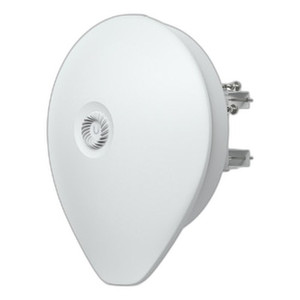
Ubiquiti LTU-XR Wireless ISP CPE
The Ubiquiti LTU-XR is a point-to-multipoint (PtMP) customer premises equipment (CPE) designed for wireless ISPs and rural broadband operators who need cost-effective, reliable coverage across remote and underserved locations. It delivers 550 Mbps throughput capacity—enough to serve multiple subscribers per radio without forcing you into expensive licensed spectrum or fiber-to-the-home infrastructure. The LTU-XR operates as a subscriber unit paired with Ubiquiti LTU base stations, making it ideal for last-mile connectivity where wired backhaul is impractical or prohibitively expensive.
Key Features
- 550 Mbps throughput capacity: Sufficient for residential multi-unit deployments or small business backhaul. Real-world performance depends on distance, interference, and antenna alignment, but this throughput envelope avoids bottlenecking typical ISP uplinks in rural markets.
- Independent TX/RX channel configuration: Transmit and receive can operate on separate frequencies within the same band. This eliminates crosstalk and spectral bleed-through between uplink and downlink, critical in dense or interference-prone RF environments. You avoid the throughput loss that occurs when CPE and base station compete on the same channel.
- Integrated Bluetooth for provisioning: Device setup and initial configuration happen over Bluetooth via the UISP Mobile app—no on-site laptop or serial console needed. Reduces truck roll complexity, especially when scaling to hundreds of subscriber units across a large coverage area.
- UISP ecosystem integration: Pairs with Ubiquiti's UISP management platform for fleet provisioning, monitoring, and firmware updates. If you already manage Ubiquiti AirMax infrastructure, the LTU-XR extends that operational continuity; if not, UISP learning curve is moderate but real.
- Outdoor-rated construction: Designed for roof or pole mounting in variable weather. Verify exact environmental ratings in the datasheet for your climate zone—desert heat, coastal salt spray, and high-altitude cold all impose different stress profiles.
- Compatible with Ubiquiti LTU base station family: Works with LTU-PRO and other LTU base stations in the same ISP ecosystem. Verify base station model before purchase to confirm feature parity (e.g., beam management, interference cancellation).
Integration and Compatibility
The LTU-XR integrates with wireless network infrastructure managed by UISP. It is compatible with the broader Ubiquiti networking equipment ecosystem and supports existing AirMax base station infrastructure in mixed deployments. For integration into a larger ISP network architecture, consult the network planning and spectrum management guide to confirm frequency coordination and interference mitigation strategies specific to your market area.
When to Choose a Different Model
If you require licensed-spectrum equipment or need higher throughput (1 Gbps+) per subscriber, explore higher-capacity LTU variants or licensed fixed wireless access (FWA) platforms. If subscribers are clustered within short range (<2 km) and fiber is feasible, PtMP CPE may be overkill—consider simpler access points. If you need client redundancy or dual-radio failover, confirm whether the LTU-XR supports dual-band simultaneous operation in your target band.
Deployment Checklist
- Confirm base station model and frequency band compatibility before ordering subscriber units.
- Survey RF coverage from the base station antenna to planned CPE mounting location (roof, pole, side-wall) to verify line-of-sight and expected throughput.
- Install UISP on-premises or use Ubiquiti's cloud management portal before deploying CPE units.
- Plan for Bluetooth-based initial provisioning; ensure installer has mobile device with UISP Mobile app pre-loaded.
- Verify power supply (DC input)—confirm voltage and current spec from datasheet and size backup power or UPS accordingly for high-availability deployments.
Frequently Asked Questions
Q: What power supply does the LTU-XR require?
A: The LTU-XR accepts DC power input. Exact voltage and current specifications are in the official datasheet. Confirm specifications before selecting a power supply or PoE injector.
Q: Can the LTU-XR work with non-Ubiquiti base stations?
A: The LTU-XR is designed for Ubiquiti LTU base stations. Cross-manufacturer compatibility is not supported. Verify your base station model before purchase.
Q: What is the maximum range for the LTU-XR?
A: Range depends on antenna gain, transmit power, receiver sensitivity, and RF path loss. Refer to the datasheet for link budget calculations and expected range in open-field scenarios. Actual deployment range varies with terrain, obstacles, and interference.
Q: Does the LTU-XR support failover or redundancy?
A: Confirm failover capabilities in the datasheet and consult with pre-sales engineering before designing critical links that require redundancy.
Q: How is the LTU-XR provisioned and configured?
A: Initial setup uses Bluetooth and the UISP Mobile app. Ongoing management is handled through UISP (cloud or on-premises). No serial console or laptop required for basic provisioning.
Q: What are the environmental and temperature ratings?
A: Operating and storage temperature ranges, humidity, and weather resistance are detailed in the datasheet. Verify these match your deployment region before installation.
Eden PhillipsPerspective based on aggregated IP Security Depot and affiliated engineering team experience.
The LTU-XR fills a specific gap in rural ISP deployments: you need subscriber-side CPE that works with standard unlicensed spectrum, scales to hundreds of units, and doesn't require onsite technical expertise to field-activate. The 550 Mbps headline throughput is real—it accounts for protocol overhead and realistic air-time sharing. For last-mile subscriber links in the 2–10 km range, this is solid performance without licensing friction.
Technical Highlights:
- Independent TX/RX frequency independence: This is not a gimmick. In congested RF markets or where you deploy multiple PtMP carriers in adjacent channels, splitting transmit and receive channels cuts self-interference by eliminating filter-induced suppression. You recover 5–15% of usable throughput in dense deployments.
- Bluetooth provisioning: Eliminates need for site survey crew to carry laptop, serial cables, and DHCP-assigned IP pools. Scales provisioning effort linearly instead of geometrically as subscriber count grows.
- UISP fleet integration: Firmware pushes, performance metrics, and subscriber-side QoS policy enforcement happen centrally. If you're managing 50+ CPE units, per-device manual configuration becomes a maintenance burden—UISP removes that tax.
Deployment Considerations:
- Antenna orientation is critical: CPE performance is antenna-directional. Misalignment by 15–20° from base station can halve throughput. Field technicians need training on alignment tools (inclinometer, compass, or mobile app-based orientation).
- RF survey before deployment: Do not assume range based on published link budget alone. Ground clutter, foliage loss, and urban multipath are not linear. Budget 1–2 hours per site for a proper RF walk-test before ordering CPE.
- Power and grounding: Outdoor DC power runs need proper surge protection, grounding to building earth, and considerations for UPS runtime if backup is required. Confirm DC voltage spec from datasheet and plan power infrastructure accordingly.
The LTU-XR is the right choice for ISPs scaling PtMP coverage in underserved markets where spectrum is unlicensed, subscriber density is moderate, and existing Ubiquiti LTU base stations are already deployed. It is not a plug-and-play solution—site survey and RF planning are required—but the provisioning and fleet-management overhead is significantly lighter than older CPE platforms.