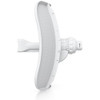
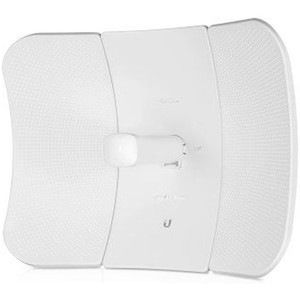
Ubiquiti LBE-M5-23-US 5 GHz Wireless Bridge CPE
The Ubiquiti LBE-M5-23-US is a compact, pole-mountable customer premise equipment (CPE) unit designed for fixed wireless bridging in the 5 GHz spectrum. Weighing just 2.65 pounds and operating on PoE power, this model delivers 100 Mbps throughput across medium-distance links where directional antenna performance and interference mitigation matter. The 23 dBi antenna gain is your primary advantage here—it focuses RF energy tightly toward a distant access point or base station, reducing multipath reflections and improving signal-to-noise ratio compared to omnidirectional designs. That focused gain trades mobility for distance and reliability; this is not a roaming device.
Key Features
- 5 GHz airMAX Technology: Operates on Ubiquiti's airMAX protocol stack, delivering predictable 100 Mbps throughput in stable point-to-point or point-to-multipoint configurations. airMAX is not standard Wi-Fi—it's optimized for outdoor fixed wireless where latency and collision avoidance matter more than mobile roaming support.
- 23 dBi Directional Antenna: The high-gain antenna requires precise aiming during site survey but delivers measurable performance improvement over lower-gain alternatives. In practice, this means longer distance budgets (typically 3–5 km line-of-sight) and rejection of off-axis interference from adjacent 5 GHz deployments.
- PoE Power Delivery: Draws approximately 8 watts or less, compatible with standard 48V passive PoE injectors or 802.3af/at PoE switches. This eliminates the need for an external 12VDC supply at the mounting location, simplifying cable runs and reducing voltage drop on long runs.
- Compact Form Factor: At 2.65 pounds, the LBE-M5-23-US minimizes wind loading on poles and towers. The lightweight housing makes single-hand installation feasible on most pole-mounted deployments, though RF-aware mounting height selection is still critical for link performance.
- UNMS Integration: Supports centralized provisioning, monitoring, and firmware updates via Ubiquiti Network Management System. Remote configuration is possible once the unit is online, reducing truck rolls for parameter adjustments.
- US Frequency Certification: CN-origin manufacturing with FCC approval for US 5 GHz allocations. Verify regulatory compliance for your target deployment region; unlicensed 5 GHz rules vary significantly by country.
Integration & Deployment Considerations
The LBE-M5-23-US integrates into mixed Ubiquiti wireless networks and third-party ONVIF-based management systems via its 802.11ac-compatible network interface. Throughput is not guaranteed 100 Mbps—it is determined by RF path loss, polarization match with the remote access point, antenna alignment accuracy, and ambient 5 GHz interference. This is why a professional RF site survey (using tools like Ekahau or a spectrum analyzer) is essential before committing capital. Align the antenna once during installation; horizontal versus vertical polarization must match the access point's antenna orientation.
Power budget on the PoE line is tight at under 8 watts, so no margin for heater or LED lighting modules. If you need extended environmental hardening (radome, surge protection, or weather sealing beyond the standard IP rating), plan for additional cost and complexity. Grounding of the mounting structure is recommended for RF safety compliance and lightning protection.
Cable runs should be as short as practical—long Ethernet runs introduce voltage drop that can degrade performance or cause intermittent resets. Use CAT5e or better and keep runs under 100 meters where possible; if you exceed 100 meters, consider a midspan PoE injector closer to the unit.
Typical Use Cases
Branch office connectivity when fiber backhaul is unavailable. Remote monitoring or sensor gateway links across parking lots or small distances. Redundant network path to a distant distribution point. Warehouse-to-office wireless link in semi-urban environments where licensed spectrum is cost-prohibitive. This model is not suitable for mobile or nomadic applications; it is a fixed, aimed link only.
Frequently Asked Questions
Q: What distance can the LBE-M5-23-US realistically cover?
A: In free-space line-of-sight conditions, expect 3–5 km links depending on Fresnel zone clearance, antenna quality at both ends, and environmental RF noise. Shorter distances (1–2 km) are typical in suburban areas with moderate interference. RF site survey is mandatory—do not assume distance without path analysis.
Q: Does the LBE-M5-23-US support standard 802.11 Wi-Fi clients?
A: No. It operates using Ubiquiti's airMAX protocol, which is proprietary. It will not communicate with standard Wi-Fi access points unless the access point is also airMAX-compatible (e.g., Ubiquiti UniFi or NanoStation series). Mixing airMAX and standard Wi-Fi requires a bridge or converter.
Q: Can I use any PoE injector?
A: Any 48V passive or 802.3af/at-compliant injector works, provided cable voltage drop is managed. For runs under 100 meters, standard passive 48V injectors are the norm. For longer runs, use a midspan injector closer to the unit to avoid brown-out resets.
Q: What maintenance is required after installation?
A: Check antenna alignment and physical security once a year, especially after storms or high winds. Monitor signal strength and throughput via UNMS. No moving parts or fans mean very low maintenance overhead. Firmware updates via UNMS should be applied as released.
Q: Is the antenna removable for relocation?
A: The 23 dBi antenna is integrated into the LBE-M5-23-US housing—not field-replaceable. If you need a different antenna gain or polarization pattern, you must swap the entire unit or use an external antenna adapter (consult Ubiquiti for compatibility).
Q: How does the LBE-M5-23-US compare to a standard Ubiquiti UniFi mesh access point?
A: The LBE-M5-23-US is a fixed-point CPE, not a mesh node. It is optimized for static, high-gain links where alignment is done once. UniFi mesh units are mobile-friendly and support roaming but lack the directional gain and long-distance budget of the LBE-M5-23-US.
Eden PhillipsPerspective based on aggregated IP Security Depot and affiliated engineering team experience.
The LBE-M5-23-US (often searched as LBE M5 23 US) is engineered for the narrow but real use case of fixed outdoor bridging where distance and RF isolation are priorities. The 23 dBi directional antenna is the core selling point—it delivers meaningful performance over lower-gain CPE units, but only if your site survey validates the Fresnel zone clearance and line-of-sight geometry before you commit hardware. At 2.65 pounds and under 8 watts, this is a low-friction deployment on existing poles or towers.
Technical Highlights:
- 23 dBi Directional Antenna Gain: Extends effective distance budgets to 3–5 km line-of-sight compared to ~1–2 km for lower-gain omni designs. Directional gain also rejects off-axis interference, making this the right choice for congested 5 GHz environments (e.g., shared spectrum near dense urban Wi-Fi).
- 100 Mbps airMAX Throughput: Sufficient for video backhaul, remote office uplink, or sensor gateway duty. Actual throughput depends on path loss and antenna alignment; RF site survey is non-negotiable before deployment.
- PoE Power Under 8 Watts: Eliminates need for external 12V supply at the mounting point. Standard 48V passive PoE injectors or 802.3af equipment suffice, but cable voltage drop over long runs (>100 m) requires midspan injection or closer injector placement.
Deployment Considerations:
- Antenna alignment is one-time and critical. Misalignment by 5–10 degrees can degrade throughput by 30–50%. Use an RF survey tool or site analysis software (Ekahau, etc.) before installation.
- airMAX is proprietary—this unit will not interoperate with standard 802.11ac Wi-Fi access points. Your remote end must be Ubiquiti airMAX-compatible (UniFi, NanoStation, or similar).
- Not suitable for mobile or roaming clients. This is a fixed point-to-point bridge only. If you need mesh or client mobility, choose a different Ubiquiti product line.
Deploy the LBE-M5-23-US when you have a fixed, aimed link budget (branch office to main site, remote monitoring gateway, warehouse-to-office backhaul) and spectrum constraints rule out licensed wireless or fiber. Conduct RF path analysis first; don't assume distance without validation.