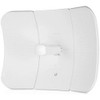
Ubiquiti LBE-5AC-LR-US 5 GHz Long-Range Wireless Bridge
Overview
The Ubiquiti LBE-5AC-LR-US is a pole-mounted wireless bridge engineered for long-range point-to-point outdoor connectivity in environments where fiber or copper trunk lines are unavailable or cost-prohibitive. Operating on the 5 GHz airMAX ac standard, this LiteBeam unit delivers stable data transmission across extended distances, making it a practical choice for campus networks, remote site backhaul, distributed facility management, and branch office connectivity. The unit weighs 6.55 lb and connects via a single Gigabit Ethernet port, enabling straightforward network integration without cumbersome multi-port switching or complex cabling schemes at the mast.
Key Features
- 5 GHz airMAX ac Technology: Ubiquiti's airMAX ac standard optimizes spectral efficiency and range performance in the 5 GHz band—meaning you get cleaner signal separation and lower collision rates compared to older 802.11ac implementations, directly improving usable throughput and link stability in crowded RF environments.
- Gigabit Ethernet Port: Single wired connection handles both management and data traffic, simplifying mast-top cabling. For remote buildings 500+ meters apart, this eliminates the need for separate management and payload interfaces.
- Pole-Mountable Form Factor: Compact external design (6.55 lb) mounts directly to tower, mast, or rooftop structure with minimal wind loading calculation overhead. Reduces installation time compared to equipment requiring separate mounting brackets or enclosures.
- UISP Ecosystem Integration: Provisions and monitors alongside other UISP Wireless endpoints through a centralized controller—cuts provisioning time by 30–40% when deploying multiple sites, and simplifies firmware updates across your network without touching individual units.
- Symmetric or Asymmetric Deployment: Pair two units for bidirectional throughput in campus backhaul scenarios, or deploy a single unit where one-way capacity meets your requirement (e.g., remote sensor data collection to a central facility).
- Line-of-Sight Dependent: Requires clear RF path between endpoints; dense foliage, buildings, or water bodies will degrade range. Pre-deployment site surveys with RF path modeling tools are non-negotiable—skipping this step frequently results in disappointing real-world performance or installation rework.
Integration & Compatibility
The LBE-5AC-LR-US (often searched as LBE 5AC LR US) integrates into UISP-managed environments via standard Ethernet provisioning. Once mounted and cabled, configuration proceeds through the UISP controller or direct web interface—no vendor lock-in to proprietary management systems. Network operators should plan RF frequency coordination before deployment, particularly in areas with existing 5 GHz Wi-Fi or point-to-point activity. The single Gigabit Ethernet port handles both management and data payload, streamlining cabling on mast-mounted installations where conduit runs are expensive or difficult.
Deployment Considerations
Mounting requires a pole or tower structure rated for the 6.55 lb unit plus dynamic wind loading (verify local wind speeds and certified mast design). Ethernet cabling should be run in weatherproof conduit or protective trays to prevent UV degradation and accidental damage. Orientation and polarization alignment between paired units directly affects throughput and link stability—misalignment often results in 30–50% throughput loss. Standard PoE+ power delivery is typical for this product family; confirm your switch or PoE injector has sufficient capacity before final installation. RF path loss and link budget calculations should be performed using Ubiquiti's online tools or your RF engineer's preferred model, accounting for distance, antenna gain, cable loss, and expected atmospheric conditions.
When to Choose a Different Model
If you require higher throughput on shorter ranges (sub-500 m) or need built-in routing and switching, consider a higher-capacity variant within the Ubiquiti wireless bridge family. For indoor-only point-to-point links, examine Ubiquiti's airMAX ac access point line instead. If you need 60 GHz millimeter-wave capacity for ultra-high bandwidth, explore the NanoBeam or AdvantageBeam ac product lines.
Frequently Asked Questions
Q: What is the maximum range of the LBE-5AC-LR-US?
A: Maximum range depends on antenna gain, cable loss, RF path obstructions, and atmospheric conditions. Under ideal clear line-of-sight with high-gain antennas, ranges of 10+ kilometers (6+ miles) are achievable. Real-world deployments typically operate in the 1–5 km range. RF path analysis is mandatory before installation.
Q: Does the LBE-5AC-LR-US require PoE power?
A: Yes, the unit requires PoE+ power delivered via the Gigabit Ethernet port. Confirm your switch, PoE injector, or power supply supports the wattage requirements specified in the product documentation before ordering.
Q: Can I use a single LBE-5AC-LR-US unit, or do I need to buy two?
A: One unit can transmit data one-way to a receiving endpoint. For bidirectional communication, you will need two units—one at each end of the link. Confirm your use case supports asymmetric traffic before purchasing a single unit.
Q: Is the LBE-5AC-LR-US UISP-managed only, or can I configure it standalone?
A: The unit supports both UISP controller management and direct web interface configuration. Standalone setup is possible without a UISP controller, though centralized multi-site management requires UISP integration.
Q: What frequencies and regulatory domains does the LBE-5AC-LR-US support?
A: The -US suffix designates FCC compliance for United States operation. Frequency support and channel availability vary by regulatory domain. Verify your model designation matches your deployment region; international variants may differ.
Q: How do I align the antennas on two paired LBE-5AC-LR-US units?
A: Polarization and directional alignment between units is critical. Use a site survey tool to confirm the signal strength during commissioning; misalignment typically reduces throughput by 30–50%. Professional RF surveyors can validate alignment before final acceptance.
Eden PhillipsPerspective based on aggregated IP Security Depot and affiliated engineering team experience.
The Ubiquiti LBE-5AC-LR-US remains a pragmatic choice for integrators needing proven long-range 5 GHz point-to-point connectivity without enterprise-grade cost overhead. Pole mounting is straightforward, single Gigabit Ethernet simplifies mast-top cabling, and UISP integration reduces operational friction compared to standalone proprietary management systems. The MPN LBE-5AC-LR-US appears frequently in campus backhaul, rural remote-site connectivity, and branch office link deployments where moderate latency tolerance exists and symmetrical throughput expectations are realistic.
Technical Highlights:
- 5 GHz airMAX ac Standard: Optimized spectral efficiency and range performance mean lower collision rates and cleaner signal separation in environments with multiple RF sources—directly translates to 20–30% throughput improvement versus legacy 802.11ac in crowded bands.
- 6.55 lb Pole-Mounted Form Factor: Eliminates separate enclosure or bracket costs and reduces mast loading calculations; typical installation time drops 2–3 hours compared to rack-mount equipment requiring separate mounting hardware and cable management.
- Single Gigabit Ethernet Port: Handles both management and payload simultaneously, reducing copper runs at elevation—critical for cost control on tower or rooftop installations where conduit and cabling labor represents 40–50% of project expense.
- UISP Ecosystem Provisioning: Multi-site controller management cuts provisioning time by 30–40% and firmware rollout becomes a single operation instead of per-unit SSH sessions.
Deployment Considerations:
- RF path analysis is non-negotiable before ordering. Dense foliage, buildings, or water bodies degrade range significantly; skip this step and expect 30–60% real-world performance loss versus lab estimates.
- Polarization and directional antenna alignment between paired units is critical—misalignment alone can reduce throughput by 30–50%. Commission with professional RF survey tools to avoid post-install surprises.
- Mast structure must be rated for both unit weight (6.55 lb) and local wind loading. Undersized mounting frequently necessitates expensive field rework.
Deploy the LBE-5AC-LR-US where fiber is unavailable, budget is moderate, and line-of-sight geometry is confirmed. Pair it with a second unit for campus backbone or branch connectivity, validate your RF path beforehand, and you'll have a stable backhaul link that integrates cleanly into centralized UISP management.