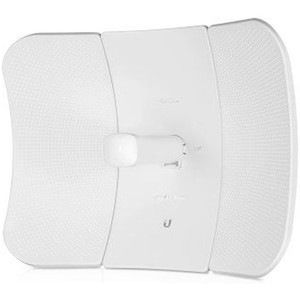
Ubiquiti LBE-5AC-GEN2 5 GHz Wireless Bridge
Overview
The Ubiquiti LBE-5AC-GEN2 is a compact 5 GHz airMAX ac wireless bridge engineered for point-to-point and point-to-multipoint backhaul connectivity across distances where fiber or copper deployment is economically unfeasible. This CPE (Customer Premises Equipment) unit operates on licensed-free 5 GHz spectrum and delivers 450+ Mbps sustained management radio performance—sufficient for redundant WAN links, campus interconnects, and remote site aggregation without the capital cost of fiber trenching or tower construction. Weighing just 3.5 pounds, the LBE-5AC-GEN2 (MPN: LBE-5AC-GEN2) mounts quickly to poles, walls, or mast clamps, reducing field labor and enabling rapid deployment when business continuity timelines are tight.
Key Features
- 450+ Mbps Throughput: airMAX ac technology sustains management radio performance well above typical 802.11ac client speeds, meaning you can reliably push real user traffic instead of hoping for best-effort performance. This matters for bridging multiple buildings or feeding remote network segments.
- 5 GHz Licensed-Free Spectrum: Operates on 5 GHz UNII bands (licensed-free in most jurisdictions), avoiding the regulatory overhead and cost of microwave backhaul licenses. Before deployment, verify 5 GHz channel congestion in your coverage area—RF saturation in dense urban environments can compress real-world throughput below the 450+ Mbps rating.
- PoE 48V Power Architecture: Draws power entirely via standard 802.3at PoE injector over a single Ethernet cable. This eliminates separate power supply runs, AC outlets, and ground problems at remote mounts—one cable delivers both network connectivity and power, cutting installation time and cost.
- Web GUI Management: Remote configuration, monitoring, and troubleshooting via browser-based interface from any networked terminal. No proprietary management platform required; straightforward radio settings, SSID/security mode, and endpoint MAC address assignment. Teams managing more than a dozen bridges should consider UISP controller integration for centralized monitoring and bulk provisioning.
- Compact Form Factor (3.5 lbs): Ultra-lightweight CPE design fits constrained installation spaces—rooftops, fence lines, utility poles—without structural reinforcement. Weight matters when mounts are undersized or when you're deploying on temporary structures.
- Point-to-Point & Point-to-Multipoint Modes: Supports both dedicated site-to-site links and one-to-many hub-and-spoke architectures, enabling flexible network topologies for retail chains, multi-building campuses, and service provider last-mile expansion without redesigning infrastructure for each use case.
Integration & Compatibility
The LBE-5AC-GEN2 integrates into wireless bridge deployments and hybrid networks combining wired and wireless segments. Standard Ethernet uplink consolidates network and power on a single category-6 cable run, reducing labor on installation and troubleshooting. Web-based management aligns with the broader Ubiquiti ecosystem, allowing this unit to coexist alongside EdgeRouter, EdgeSwitch, and other UISP components without proprietary management overhead. Link budget and Fresnel zone clearance (typically 60% of first Fresnel zone) should be confirmed before final positioning to maximize throughput and reliability.
Deployment Scenarios
This bridge excels in multi-site connectivity for retail chains, small business networks, and last-mile service provider deployments where fiber is unavailable or cost-prohibitive. Campus backhaul between buildings, temporary emergency response networks, and mesh network expansion leverage the LBE-5AC-GEN2's range and throughput. Rural broadband expansion and remote facility connectivity benefit from the unit's ability to bridge across distances where trenching or tower construction is economically unfeasible. For network infrastructure planning, plan antenna alignment and polarization matching as critical installation tasks—misalignment directly reduces throughput.
Frequently Asked Questions
Q: What is the maximum outdoor range of the LBE-5AC-GEN2?
A: Range depends on antenna gain, transmit power, Fresnel zone clearance, and RF interference. Typical line-of-sight deployments support multi-kilometer links; verify link budget and clear line-of-sight before final installation to confirm your specific distance.
Q: Does the LBE-5AC-GEN2 require a separate power supply?
A: No. PoE 48V injector delivers power directly over the Ethernet cable—no additional AC outlet or power adapter required at the mount location.
Q: Can I use the LBE-5AC-GEN2 in high-RF-interference environments?
A: The unit operates on 5 GHz licensed-free spectrum shared with Wi-Fi and other devices. In congested urban areas, channel selection and antenna positioning become critical. Conduct an RF survey before deployment to identify available channels.
Q: Does the LBE-5AC-GEN2 work with UISP controller software?
A: Yes. For centralized management of multiple units, integrate the bridge into a UISP controller deployment. Web GUI standalone management is also supported for single-unit or small-scale installations.
Q: What happens if polarization is misaligned between two LBE-5AC-GEN2 units?
A: Polarization mismatch causes signal loss—roughly 3 dB per 45-degree offset. Ensure both units use matching polarization (both vertical or both horizontal) during installation.
Q: Is the LBE-5AC-GEN2 suitable for mesh networking?
A: Yes. The unit supports point-to-multipoint mode, enabling mesh expansion where one bridge relays traffic from multiple remote sites back to a central hub. This avoids tree-and-branch redundancy issues in multi-site networks.
Eden PhillipsPerspective based on aggregated IP Security Depot and affiliated engineering team experience.
The LBE-5AC-GEN2 (often searched as LBE 5AC GEN2) remains a pragmatic choice for operators needing subsecond-mile backhaul without capital expenditure on fiber or microwave licenses. The PoE 48V architecture eliminates a common pain point in field deployment—no AC power runs, no separate injectors cluttering the equipment closet. That said, real-world throughput sits 10–20% below the 450+ Mbps specification in RF-saturated environments. Urban 5 GHz channels are congested; do a preliminary spectrum survey before committing to the LBE-5AC-GEN2. The Web GUI is straightforward for single units, but teams managing more than a dozen bridges should plan UISP controller integration upfront—it scales your operational visibility and makes firmware updates painless across fleets.
Technical Highlights:
- 450+ Mbps airMAX ac Management Radio: Enough headroom for multiple concurrent users or WAN failover scenarios; insufficient for high-bitrate video backhaul without QoS tuning and link conditioning on the application side.
- PoE 48V Single-Cable Power: Simplifies installation on rooftops and poles—one Cat-6 run delivers connectivity and power. Verify your PoE injector supplies at least 30W to account for cable loss on longer runs (100m+ stretches).
- 3.5 lbs Weight, Compact CPE Form Factor: Fieldable by single technicians; reduces structural load on legacy poles and temporary mounts. Weight matters when you're deploying on undersized infrastructure.
Deployment Considerations:
- Polarization alignment between paired LBE-5AC-GEN2 units is critical—misalignment introduces 3–15 dB signal loss depending on angle. Mount both units identically (vertical or horizontal) and test signal strength before final site acceptance.
- Fresnel zone clearance (target 60% of first zone) is non-negotiable for consistent throughput. Vegetation, buildings, or terrain in the link path will degrade performance noticeably—conduct a clear line-of-sight walk-through before ordering.
- 5 GHz channel congestion in dense urban areas can compress real throughput to 250–350 Mbps. Pre-deployment RF survey with a spectrum analyzer or Wi-Fi scanner will reveal competing channels and inform your frequency selection.
For service providers and integrators deploying rural broadband or multi-site retail backhaul where fiber is unavailable, the LBE-5AC-GEN2 punches well above its price point. Budget-conscious projects benefit from PoE power simplicity and straightforward configuration. For mission-critical infrastructure requiring >99.5% uptime, pair this with a cellular failover link and redundant site architecture.