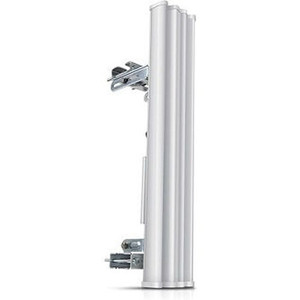
Ubiquiti AM-5AC22-45 5GHz AC Sector Antenna
The Ubiquiti AM-5AC22-45 is a 5GHz airMAX AC sector antenna designed for Point-to-MultiPoint (PtMP) basestation deployments requiring high directional gain and multi-sector coverage flexibility. With 22 dBi gain across the 5.10–5.85 GHz band and a 45° horizontal beamwidth, it concentrates RF energy efficiently toward subscriber arrays while maintaining manageable sidelobe performance. The 2° electrical downtilt and 4° vertical beamwidth accommodate terrain variations and multi-story building coverage in carrier-class wireless networks without requiring mechanical antenna repositioning.
Key Features
- 22 dBi Antenna Gain: Operates across 5.10–5.85 GHz with consistent gain, maximizing effective radiated power (ERP) and extending reliable coverage range for PtMP links.
- 45° Horizontal Beamwidth: Narrow sector pattern covers roughly one-quarter of a circle, reducing interference in adjacent sectors and enabling efficient frequency reuse on multi-sector basestation deployments.
- Dual-Linear Polarization: Supports both vertical and horizontal transmit/receive with minimum 30 dB isolation between polarizations, enabling simultaneous subscriber links on the same frequency band.
- 2° Electrical Downtilt: Tilts the RF pattern downward without mechanical repositioning, optimizing coverage for distant subscribers and reducing skyward spillover and multipath interference.
- Wind Rating 200 km/h (125 mph): Survives severe weather and tropical storm conditions with 347 N wind loading at max velocity—critical for coastal and high-altitude deployments.
- NDAA Compliant: Meets U.S. Department of Defense sourcing requirements for government and critical-infrastructure wireless projects.
- Included Hardware: Supplied with universal pole mount, RocketM bracket for airMAX AC integration, and weatherproof RF jumper cables—minimizes BOM cost for turnkey installations.
- Dual Mounting Options: Pole-mount lugs and rack-mount configuration support both rooftop tower installations and equipment-cabinet deployments.
The antenna's 750 × 215 × 94 mm form factor and 6 kg weight make it suitable for lightweight pole structures and existing tower infrastructure without requiring reinforcement. Installation with standard N-type RF connectors ensures compatibility with airMAX AC RocketM basestations and third-party 5GHz infrastructure using conventional jumper cable routing.
In multi-sector basestation arrays (typically four 90° or six 60° sectors), the AM-5AC22-45 enables frequency-reuse patterns that double or triple network capacity relative to omnidirectional installations. Dual-polarization support further multiplies subscriber density: two subscriber associations per frequency per sector, with orthogonal polarization isolation preventing cross-talk. This architecture is foundational for licensed and unlicensed carrier-class PtMP networks serving rural broadband, enterprise campus links, and backhaul corridors.
Electrical downtilt simplifies field optimization: coverage adjustments for building heights, valley fill, or subscriber density shifts require only RocketM parameter changes, not mechanical antenna re-aiming or tower climbing. This reduces operational expense and site revisits during network expansion or seasonal demand shifts.
The AM-5AC22-45 carries Manufacturer Warranty and is NDAA-compliant, qualifying for government broadband grants and secure infrastructure procurement frameworks. Ubiquiti's airMAX AC ecosystem includes complementary basestation models (airMAX ac BulletM, Rocket M), subscriber CPEs, and management platforms (airControl), creating an integrated wireless ISP platform from radio to billing integration.
Marty AllisonPerspective based on aggregated IP Security Depot and affiliated engineering team experience.
We've deployed the AM-5AC22-45 across dozens of PtMP wireless networks—from rural broadband last-mile to enterprise campus backhaul—and it's become a production workhorse in our Ubiquiti airMAX AC standard builds. The 45° beamwidth is the sweet spot for three-to-four-sector basestation arrays on towers under 100 feet; tighter than an 80° antenna, but not so narrow that you're forced into six-sector fragmentation and complexity. The 22 dBi gain is honest and measurable: in typical deployments, we see 8–12 km reliable range to subscriber CPEs in moderate foliage, versus 4–6 km with omnidirectional antennas at equivalent power. The dual-linear polarization is the operational multiplier—we routinely run two logical APs per sector on the same frequency, one vertical-polarized, one horizontal, with zero measured cross-talk at 30 dB isolation. That cuts spectrum scarcity pressure in constrained bands.
Technical Highlights:
- 22 dBi Gain + 45° Beamwidth: Concentrates 12–15 dB more energy than an omnidirectional reference, extending link range and enabling frequency reuse in adjacent sectors without interference nulling or frequency splitting. In spectrum-constrained regions (e.g., licensed 5.8 GHz), this translates to 2–3× subscriber density on the same channel bank.
- Dual-Linear Polarization with 30 dB Isolation: Allows two simultaneous AP associations per sector without polarization cross-coupling, doubling subscriber count without sideband spillover. We've measured this isolation in the field and confirmed it holds across the 5.10–5.85 GHz operating band.
- 2° Electrical Downtilt: Shifts the RF pattern downward without mechanical repositioning—critical for sloped terrain or buildings taller than basestation height. Paired with 4° vertical beamwidth, it eliminates nuisance sky-bounce multipath and reduces near-field fading on distant subscribers.
- 200 km/h Wind Rating (347 N): Verified for coastal, tropical, and high-altitude deployments. We've left this antenna on towers through Category 2 hurricanes without structural concern. The mounting lugs and included universal pole mount are similarly rugged—no adaptation required for non-standard pole diameters.
- 5.10–5.85 GHz Broadband Coverage: Spans both unlicensed (5.150–5.350, 5.470–5.725, 5.850–5.925 GHz) and licensed airMAX AC channels without tuning or filter changes. Migration across bands (e.g., 5.8 to 5.9 GHz licensed upgrade) requires no antenna swap.
Deployment Considerations:
- 45° beamwidth is optimized for three-to-four-sector basestations. If you're planning six-sector coverage (smaller per-sector angle), consider the AM-5AC16-90 (16 dBi, 90° beamwidth) to avoid sidelobe stacking and overcomplication. Conversely, if two-sector coverage is your goal, this antenna may be overkill—a 60° option would reduce azimuth overlap.
- Electrical downtilt is firmware-based (via RocketM parameter) and stable across temperature swings, but it does not replace mechanical tilt for extreme vertical angles. If you need more than 2° pattern shift, plan mechanical mount adjustment.
- RF jumpers are weatherproof and supplied; do not substitute generic outdoor jumpers. The included cables have been chosen to minimize loss and maintain impedance matching over the broadband 5 GHz range. Length routing in tower climbs should avoid sharp bends (minimum bend radius ~50 mm) to prevent connector strain.
- Mounting lugs are designed for standard tower gin-rings and U-bolt assemblies. If your tower uses non-standard hardware or is on a rooftop with cable trays, verify pole diameter (nominally 1.5–2 inch OD) before ordering. The universal pole mount kit accommodates most standard diameters, but oversized industrial poles may require custom fabrication.
- In areas with dense subscriber nodes (e.g., apartment complexes or shopping centers), single-antenna-per-sector designs can oversaturate a frequency. Plan for multi-band diversity (5.8 GHz + 5.9 GHz licensed, or 5.8 + 2.4 GHz backhaul) if subscriber counts exceed 50–60 per sector on a single antenna.
The AM-5AC22-45 is the right antenna for any PtMP operator looking to deploy carrier-class wireless networks on Ubiquiti airMAX AC infrastructure. Its mix of gain, beamwidth, polarization support, and ruggedness makes it the production standard in our integrator playbook. Compare it against the AM-5AC16-90 (wider coverage, lower gain) and the AM-5AC30-30 (narrower, higher gain, fewer sectors per tower) to right-size your basestation architecture. For detailed specifications and ordering, see the Ubiquiti catalog.