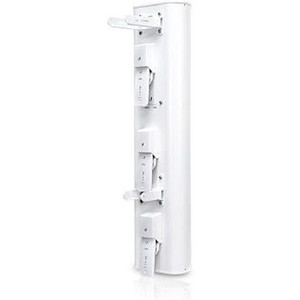
Ubiquiti AM-5G20-90 5GHz Sector Antenna
Overview
The Ubiquiti AM-5G20-90 is a 5GHz sector antenna engineered for point-to-multipoint wireless deployments in fixed wireless access (FWA), rural broadband, and campus base station clusters. The AM-5G20-90 delivers 20dBi directional gain across a 90-degree azimuth pattern, balancing coverage breadth against range and allowing integrators to partition service areas with four sectors covering a full 360-degree radius. At 9.2 lb, the antenna integrates with Ubiquiti airMAX base stations and supports both licensed and license-free 5GHz operation depending on regional regulatory compliance.
Key Features
- 20dBi Directional Gain: Elevates effective radiated power and range compared to omnidirectional antennas, reducing the number of base stations needed to cover sprawling suburban or semi-rural areas — a direct cost savings on infrastructure.
- 90-Degree Sector Pattern: Narrows the radiation envelope to a 90-degree wedge, allowing four antennas mounted on a single tower or rooftop to blanket 360 degrees with minimal overlap and inter-sector interference, critical for network stability in dense deployments.
- 5GHz Band Operation: Operates in the 5GHz spectrum, which offers wider channel availability and lower latency than 2.4GHz — essential for backhaul links and performance-sensitive subscriber networks.
- Standard RF Connector Interface: Uses standard connectors found on airMAX base stations and subscriber modules, eliminating custom cabling or adapter complexity during installation and maintenance.
- Outdoor-Rated Construction: Manufactured for weather exposure; proper cable management and weatherproofed connectors are required, but the antenna itself handles rain, wind, and temperature swings typical of outdoor wireless infrastructure.
- UISP Wireless Integration: Pairs with Ubiquiti's UISP Controller platform for centralized provisioning, monitoring, and interference management — vital when deploying multi-sector clusters on the same tower.
Integration and Compatibility
The AM-5G20-90 mounts directly to airMAX base stations (such as the LBE-5AC-GEN2 or equivalent) and integrates seamlessly into the Ubiquiti airMAX ecosystem. UISP Wireless Controller enables unified management of multiple sectors and base stations, automating frequency assignment, power limits, and link optimization. Integrators should verify connector type compatibility with their specific base station model and plan cable runs to minimize signal loss — industry practice suggests keeping runs under 100 feet when possible.
Deployment Considerations
The 90-degree pattern makes the AM-5G20-90 ideal for partitioning coverage in quadrants, but azimuth and elevation alignment are non-negotiable — misalignment directly degrades coverage predictability and increases inter-sector interference. Wind load on the 9.2 lb antenna requires mounting hardware rated for your region's peak wind speeds; undersized brackets invite mechanical failure and downtime. Cable loss over long runs erodes the 20dBi gain, so budget for quality outdoor-rated cabling and connectors. Four-sector deployments are the practical maximum for 360-degree coverage; tighter sector patterns (60-degree or 45-degree antennas) exist in the Ubiquiti catalog if you need higher gain in narrower zones but fewer total sectors.
When to Choose a Different Model
If your deployment requires broader coverage (wider than 90 degrees) with less directional focus, consider Ubiquiti's omnidirectional or lower-angle sector antennas. If you need higher gain (above 20dBi) for extremely long-distance point-to-point links, Ubiquiti offers 30dBi and higher-gain models with proportionally narrower patterns. For indoor or small-scale coverage, directional antennas are overkill; subscriber modules with integrated antennas are more cost-effective.
Frequently Asked Questions
Q: What mounting hardware does the AM-5G20-90 require?
A: The antenna requires a pole mount or wall bracket rated for at least 9.2 lb static load plus dynamic wind loading per your region's building code. Most integrators use standard 1.25-inch or 2-inch pole mounts compatible with tower hardware. No specific mounting kit is bundled; confirm compatibility with your existing infrastructure before ordering.
Q: Can the AM-5G20-90 be aimed in any direction?
A: Yes. Azimuth (horizontal) and elevation (vertical tilt) adjustment is standard. However, the antenna must be mechanically rotatable or re-mounted for azimuth changes — it does not electronically steer. Plan your tower layout so antennas point toward service areas with minimal dead zones and minimal overlap between adjacent sectors.
Q: What connectors does the AM-5G20-90 use?
A: The AM-5G20-90 uses standard N-type or RP-SMA connectors (verify with your specific base station model). Confirm connector type before purchasing jumper cables and RF components to avoid adapters, which introduce insertion loss.
Q: Is the AM-5G20-90 suitable for licensed spectrum?
A: Yes. The antenna operates across the 5GHz band and is compatible with both license-free (5150–5925 MHz in most regions) and licensed spectrum deployments, subject to regional regulatory approval. Verify your local frequency allocations before deployment.
Q: How much signal loss occurs over a typical cable run?
A: Cable loss depends on cable type and distance. A 100-foot run of LMR-400 coax loses roughly 4–5 dB at 5GHz. This erodes the antenna's effective gain, so minimize cable runs and use low-loss cable when distances exceed 50 feet. Plan your tower infrastructure to keep cable runs short.
Q: Does the AM-5G20-90 come with a cable?
A: No. The antenna includes only the radiating element and connector. You must source and install the RF jumper cable, routing it to your base station while minimizing exposure, kinks, and water intrusion. Outdoor-rated cable and connectors are mandatory.
Ted PerryPerspective based on aggregated IP Security Depot and affiliated engineering team experience.
The AM-5G20-90 is a workhorse for mid-range point-to-multipoint networks where cost control and coverage efficiency matter equally. The 20dBi gain and 90-degree pattern strike a practical balance — enough directional focus to minimize inter-sector noise, yet wide enough to cover meaningful subscriber clusters without the complexity or cost of narrower, higher-gain alternatives. It's the antenna you reach for when building regional wireless backhauls or last-mile FWA networks across 10–30 square miles.
Technical Highlights:
- 20dBi Gain: Compared to a typical 8–10dBi omnidirectional antenna, the 10dBi improvement translates to roughly 4–5x effective range extension, meaning one AM-5G20-90 base station covers what might otherwise require two or three omni-antenna sites.
- 90-Degree Sector Pattern: Four antennas spaced evenly on a single tower blanket 360 degrees with negligible overlap; tighter 60-degree patterns need six sectors and cost more to deploy, while broader patterns create coverage gaps and dead zones.
- 5GHz Operation: Wider channel bandwidth and lower latency than 2.4GHz; critical if your backhaul or subscriber links share spectrum with Wi-Fi or Bluetooth interference in dense urban areas.
Deployment Considerations:
- Cable loss is real and measurable — LMR-400 at 100 feet costs you 4–5 dB of your 20dBi gain. Integrate cable budgeting into your link margin calculation or you'll chase coverage gaps in the field.
- Azimuth misalignment of even 10–15 degrees noticeably degrades coverage to adjacent sectors. Use a compass and GPS during commissioning, and document the final azimuth for troubleshooting later.
- Wind load on a 9.2 lb antenna is deceptive — bracket failure is more common than antenna failure in high-wind regions. Spec-grade tower hardware is mandatory, not optional.
Best-fit scenario: a regional FWA provider building coverage across a 20–30 square mile service area with 4–8 base station sites. Each site runs four AM-5G20-90 antennas, pulling air time load off the backhaul while keeping subscriber latency under 15ms. Paired with a decent channel plan and UISP monitoring, this antenna set delivers reliability without overengineering cost.