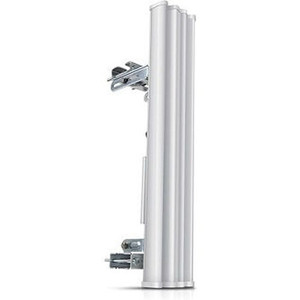
Ubiquiti AM-5G16-120 5GHz Sector Antenna
Overview
The Ubiquiti AM-5G16-120 is a sector antenna purpose-built for 5GHz airMAX point-to-multipoint wireless networks where a single basestation must cover a defined geographic sector without excessive energy waste or overlap. The 16dBi gain rating and 120-degree horizontal beamwidth balance signal amplification with coverage breadth—a deliberate tradeoff that matters when your subscriber distribution isn't uniform across the sector or when you're working within tower load constraints. At just 0.100 lb, the AM-5G16-120 integrates into existing infrastructure with minimal structural impact, a practical advantage on retrofit installations where existing mounts have load or space limitations. It connects via standard N-type connectors and operates across licensed and unlicensed 5GHz bands depending on regional regulations.
Key Features
- 16dBi Gain: Sufficient signal amplification for typical 2–3 km point-to-multipoint links without overshooting or creating dead zones in your service footprint. Compare this to narrower high-gain antennas (20+ dBi) that concentrate energy in tight 45–60° sectors—the AM-5G16-120 trades 3–4 dB of peak gain for broader coverage, which simplifies frequency coordination when multiple sectors overlap slightly.
- 120-Degree Horizontal Beamwidth: Wide enough to serve subscriber clusters spread across a sector without requiring multiple antennas, but narrow enough to minimize interference into adjacent sectors. Useful in grid-pattern deployments (e.g., four 90° sectors or three 120° sectors covering a city block).
- Lightweight 0.100 lb Form Factor: Reduces burden on tower mounts, guy-wire tension, and structural reinforcement. Critical on older installations or where load studies limit antenna weight. Simplifies temporary or semi-permanent deployments where quick repositioning is needed.
- N-Type Connector: Industry-standard connection point compatible with Ubiquiti airMAX basestation radios and access points. Supports standard coaxial cable runs with minimal connector loss.
- 5GHz airMAX Band Support: Works across the airMAX frequency family (standard U-NII-1, U-NII-2, U-NII-3 bands depending on regional rules). Pairs directly with airMAX basestation units managed through the UISP platform for link monitoring, power adjustment, and frequency coordination.
- Weather-Rated Outdoor Construction: Designed for persistent outdoor deployment—mast-mounted on towers, poles, or building structures with clear line-of-sight to subscriber radios. No enclosure or radome upgrade needed for rain, snow, or UV exposure typical of ISP and enterprise mesh installations.
Integration and Deployment Context
The AM-5G16-120 is a basestation antenna, not a client-side CPE unit. Mount it on mast or tower infrastructure where subscribers connect via separate airMAX client radios positioned within the 120-degree coverage zone. The antenna pairs with Ubiquiti airMAX basestation hardware and integrates into networks managed through the UISP wireless platform, where operators can monitor link health, adjust transmit power in real time, and coordinate frequencies across overlapping sectors. This architecture is common in ISP backhaul, enterprise campus connectivity, and multi-sector mesh backbone deployments where one or more basestation sectors must serve dozens of subscriber locations.
When to Choose a Different Model
If you need significantly longer range (4+ km) or have a very narrow subscriber distribution within a tight 45-degree sector, consider a higher-gain Ubiquiti sector antenna with narrower beamwidth—this concentrates energy more effectively at distance and reduces overlap interference. If coverage must extend beyond 120 degrees (e.g., covering nearly 180 degrees from a single basestation), you'll need two AM-5G16-120 units or a different form factor. For very short-range dense deployments (under 500 meters) or omni-directional coverage, a lower-gain omnidirectional antenna may be more practical.
Frequently Asked Questions
Q: Can I use the AM-5G16-120 as a client antenna on a remote subscriber site?
A: No. The AM-5G16-120 is designed as a basestation sector antenna. Client-side (CPE) antennas are typically panel or patch designs with different beam patterns. Install the AM-5G16-120 at the basestation tower or rooftop; subscribers connect via separate airMAX client radios.
Q: What's the effective range of the AM-5G16-120 in a typical deployment?
A: Typical point-to-multipoint links extend 2–3 km depending on subscriber radio power, client antenna gain, terrain, and fresnel clearance. Range varies with line-of-sight obstruction and atmospheric conditions. Exact performance requires a detailed site survey and link budget calculation.
Q: Does the AM-5G16-120 require grounding or lightning protection?
A: Yes. Like all mast-mounted antennas, secure proper cable grounding at the antenna connector and follow electrical codes for tower installations. Use surge protection appropriate to your region and local regulations.
Q: What cable and connectors do I need to connect the AM-5G16-120 to my basestation?
A: Standard N-type to N-type coaxial cable. Use low-loss cable (LMR-400 or equivalent) to minimize signal degradation over longer runs. Exact cable length depends on your tower layout; consult your system designer.
Q: Can I combine multiple AM-5G16-120 antennas on one basestation?
A: Yes. Multiple sectors use multiple antennas connected to separate basestation radios on different frequencies. This is standard practice for full 360-degree coverage (e.g., three or four sectors, each with its own basestation radio and antenna).
Q: Is the AM-5G16-120 NDAA-compliant?
A: Ubiquiti products carry country-of-origin labeling (manufactured in China). Confirm NDAA Section 889 compliance with Ubiquiti or your procurement policy before deploying in U.S. federal or defense-adjacent networks.
Ted PerryPerspective based on aggregated IP Security Depot and affiliated engineering team experience.
The Ubiquiti AM-5G16-120 fills a practical and often overlooked niche in airMAX basestation deployments: moderate gain with broad sector coverage. The combination of 16dBi gain and 120-degree beamwidth is deliberate. Most engineers reaching for an antenna want maximum gain, but the AM-5G16-120 trades 3–4 dB compared to 20+ dBi narrowband antennas because real subscriber distributions aren't uniform. When your client radios spread across a 100–120 degree arc and you're not trying to squeeze every kilometer out of a single link, the AM-5G16-120 delivers balanced coverage without dead zones or wasted energy into adjacent sectors.
Technical Highlights:
- 16dBi Gain Profile: Suitable for 2–3 km point-to-multipoint links in typical terrain. Paired with a standard airMAX basestation radio (typically 23–27 dBm transmit power) and a subscriber client antenna (10–14 dBi), this antenna does not over-amplify in short-range scenarios where overshooting causes interference or client saturation.
- 120-Degree Horizontal Beamwidth: Eliminates the need for sector splitting on many deployments. A four-sector 90-degree pattern or three-sector 120-degree pattern covers 360 degrees with minimal overlap. In grid-block topologies common to municipal broadband, this beamwidth reduces frequency coordination complexity.
- 0.100 lb Weight: Often dismissed, but critical on retrofit installations. Legacy tower mounts rated for 10–15 lb antenna loads can accept the AM-5G16-120 without structural reinforcement. This reduces permitting delays and engineering costs on constrained sites.
Deployment Considerations:
- Line-of-Sight Requirement: Like all directional antennas, performance depends on clear RF path to subscriber radios. Terrain blockage, dense vegetation, or building clutter degrades range faster than narrow-beam high-gain antennas. Conduct a detailed RF survey before committing to sector placement.
- Frequency Coordination Gotcha: The 120-degree beamwidth means some energy spills into neighboring sectors, especially at the -3dB beamwidth edges. In dense urban or multi-operator environments, coordinate your basestation frequencies carefully. A 45-degree-narrower antenna requires less coordination but covers fewer subscribers per sector.
Position the AM-5G16-120 for ISP point-to-multipoint networks, enterprise mesh backhaul, and municipal broadband projects where basestation sectors serve subscriber clusters across 100–120 degree coverage zones and tower load or retrofit constraints rule out heavier equipment. It's a workhorse, not a specialist—and that's its strength.