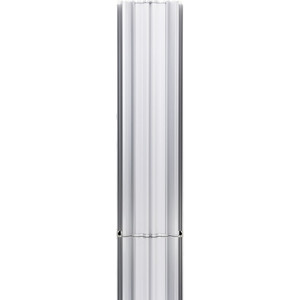
Ubiquiti AM-5G19-120 5GHz Sector Antenna
The Ubiquiti AM-5G19-120 is a 5GHz airMAX sector antenna designed for point-to-multipoint wireless deployments in WISP, campus backhaul, and municipal broadband networks. The 19dBi gain concentrates RF energy across a 120-degree horizontal pattern, delivering mid-to-long-range coverage without excessive transmit power draw. At 9.6 pounds, it integrates into standard tower and pole infrastructure, making it a cost-effective solution for fixed wireless access and mesh relay scenarios where directional coverage efficiency directly reduces total site count and operational cost.
Key Features
- 19dBi Antenna Gain: Concentrates RF energy for extended range deployments. Higher gain reduces required transmit power and improves link budget — critical for rural backhaul and long-distance client coverage.
- 120-Degree Horizontal Coverage: Sector pattern allows three coordinated units to achieve 360-degree azimuth coverage on a single tower. Simplifies asymmetric deployments where partial sector coverage matches actual network geometry.
- 5GHz Frequency Band: Works with Ubiquiti airMAX 5GHz radio lineup (M5, AC, AX families). Less congested than 2.4GHz in urban and dense deployments, supporting higher channel bandwidths and throughput.
- Lightweight Mounting Profile: 9.6 lb radial load reduces structural reinforcement requirements on existing masts and poles. Simplifies retrofit installations and lowers tower-engineering costs.
- Point-to-Multipoint Topology: Engineered for base station deployments serving multiple client or relay nodes. Single antenna per base station eliminates array complexity while maintaining coverage density.
- Outdoor-Rated Construction: Weatherproof design handles variable climate exposure. Supports installation in rain, wind, and temperature extremes without performance degradation or moisture ingress.
- Standard Connector Compatibility: Integrates with Ubiquiti UISP Wireless equipment via RF connector — confirm connector type (N-female or SMA) before ordering to avoid field retrofit.
The 120-degree sector pattern is the operational workhorse here. On a typical tower, three coordinated AM-5G19-120 units deliver full 360-degree coverage with no azimuth gaps and minimal overlap loss. In rural WISP deployments, this translates to fewer tower sites to achieve the same subscriber footprint — measurable capex and fiber-backhaul cost reduction. The 19dBi gain also compresses the link-budget math: a base station pushing 23dBm (Ubiquiti standard) with this antenna reaches farther than an omnidirectional 5GHz deployment at equal power, reducing client-side equipment cost and simplifying fade margin on marginal links.
Integration with UISP Wireless management platform provides centralized provisioning, monitoring, and RF-interference diagnostics across your multi-sector base stations. Coordinate antenna azimuths and electrical tilt during commissioning using UISP tools to optimize coverage overlap and minimize dead zones. The sector form factor supports both horizontal (azimuth sweep) and vertical (elevation tilt) adjustment — allocate commissioning time for pattern optimization before final site handoff.
Mounting is straightforward on standard tower and mast infrastructure. The antenna weighs 9.6 pounds radially — light enough that most existing structural can absorb the load without reinforcement, but verify wind-loading calculations and mast deflection limits for your specific site. Use weatherproof U-bolt or sector-mount brackets rated for outdoor service. Cable entry requires an N-female or SMA connector (model-dependent) with weatherproof strain relief — confirm your radio's connector type before purchase to avoid field substitution hassles.
The AM-5G19-120 pairs exclusively with Ubiquiti airMAX 5GHz radios (M5, AC, AX series) and UISP Wireless infrastructure. It is not compatible with non-Ubiquiti equipment or 2.4GHz radios. Consider this antenna for fixed wireless access networks, backhaul relay chains, and point-to-multipoint topologies where directional coverage and gain efficiency reduce total deployment cost. For omnidirectional coverage or lower-gain applications, evaluate omnidirectional 5GHz alternatives. For longer-range single-link backhaul, narrower-beamwidth dishes (36dBi+) may offer better performance but require tracking azimuth more tightly during installation.
Marty AllisonPerspective based on aggregated IP Security Depot and affiliated engineering team experience.
We've installed dozens of Ubiquiti UISP Wireless networks across rural municipalities and regional WISPs, and the AM-5G19-120 remains our go-to sector antenna for point-to-multipoint base stations. The sweet spot is the combination of 19dBi gain and 120-degree coverage — enough directional focus to reach clients 5-15 miles away without requiring oversized dishes or RF power amplifiers, but wide enough that three units cover a full tower azimuth with minimal dead zones. On a typical WISP deployment, moving from omnidirectional 5GHz antennas to sector geometry cuts the base-station count by 20-30% while improving per-client SNR and throughput because gain concentrates energy toward your subscriber footprint rather than radiating wasted RF into the sky. That's meaningful capex and operational expense reduction on a multi-site network. The antenna is lightweight enough that retrofit installations on existing poles don't trigger structural engineering, and weatherproof construction means you don't see connector corrosion or performance drift in rain or salt-spray environments.
Technical Highlights:
- 19dBi Antenna Gain: In practice, this means a base station operating at Ubiquiti's standard 23dBm transmit reaches 8-10dBm stronger at the client than a 5GHz omnidirectional antenna at the same power. On marginal links (15+ miles), that often eliminates the need for client-side power amplifiers, reducing per-unit CapEx and simplifying network scaling.
- 120-Degree Horizontal Pattern: Three antennas provide 360-degree coverage with minimal overlap loss. We typically azimuth them at 0, 120, and 240 degrees — easy to remember and near-zero dead zones. Vertical tilt (electrical or mechanical) fine-tunes elevation coverage for varied subscriber terrain.
- 5GHz Frequency: Less congested than 2.4GHz, supports wider channels (40, 80, 160 MHz on AC/AX), and experiences less atmospheric absorption over long distances. Critical for backhaul links spanning 5+ miles where 2.4GHz throughput collapses due to noise floor and narrower bandwidth.
- 9.6 lb Radial Load: Most existing cell-site masts and pole structures absorb this without reinforcement engineering. Field-retrofit cost drops measurably — no structural-engineering change orders, no mast-climbing labor multipliers.
- UISP Management Integration: Antenna azimuths, RF channel, and transmit power are provisioned from a single management plane. Real-time RF-interference monitoring and link metrics make troubleshooting drift and optimizing sector overlap straightforward.
Deployment Considerations:
- Confirm your radio's RF connector type (N-female or SMA) before purchase — Ubiquiti uses both, and field substitution with non-weatherproof adapters causes water ingress and SNR loss within months.
- The 120-degree pattern assumes azimuth alignment ±5 degrees. Misalignment beyond that degrades coverage density — allocate commissioning time for RF-pattern measurement and azimuth fine-tuning, especially on multi-sector towers where interference coordination matters.
- Wind loading on the antenna itself is modest (~9 lbs), but sector-mount brackets must be rated for outdoor galvanic corrosion and vibration cycles. Use stainless steel hardware and weatherproof U-bolts; aluminum or zinc-plated hardware can fail within 2-3 years in humid or coastal environments.
- Vertical electrical tilt is not adjustable on this model — elevation coverage is fixed by antenna design. If you need to optimize coverage for steep-terrain or mountain deployments, consider mechanical tilt brackets or evaluate narrower-beamwidth antennas with integrated tilt adjustment.
- Cable run from base station to antenna should be terminated with weatherproof N-female or SMA connectors, not RP-connectors. RP-SMA adapters create impedance discontinuities and increase return loss — measure VSWR during commissioning if you inherit a site with mixed connector types.
The AM-5G19-120 is the right choice for WISP networks, campus backhaul, and municipal broadband where you're balancing range, coverage density, and total site count. It's not ideal for omnidirectional coverage or single-link backhaul (dishes are better there), but for multi-sector point-to-multipoint architectures, it's a proven, cost-effective workhorse. See the Ubiquiti catalog for compatible airMAX radios and management platforms.