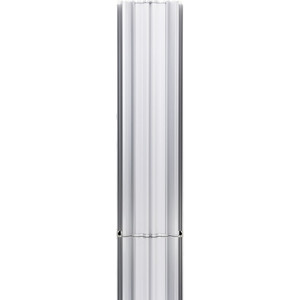
Ubiquiti AM-2G15-120 2.4GHz 15dBi Sector Antenna 120°
The Ubiquiti AM-2G15-120 is a dual-linear sector antenna designed for 2.4 GHz point-to-multipoint (PtMP) networks requiring focused coverage across a defined geographic sector. With 15–16 dBi antenna gain and a 120° horizontal beamwidth, it concentrates RF energy efficiently toward subscriber clients while suppressing off-axis interference. The dual-linear polarization with 28 dB cross-pol isolation enables two independent data streams in the same frequency band, doubling network capacity in dense deployments. Built to NDAA specifications and rated for 200 km/h (125 mph) wind loading, the AM-2G15-120 integrates directly with Ubiquiti's Rocket M BaseStation platform and is field-proven across carrier and enterprise PtMP networks.
Key Features
- Antenna Gain: 15–16 dBi. Narrow radiation pattern concentrates coverage within target sector, reducing wasted RF spillover and improving SNR at subscriber locations.
- Beamwidth: 120° horizontal. Optimal for covering residential neighborhoods, industrial parks, or campus perimeters without dead zones or excessive side-lobe interference.
- Dual-Linear Polarization: 28 dB cross-pol isolation. Allows co-located clients on orthogonal polarization to operate interference-free — critical for scaling capacity in congested 2.4 GHz environments.
- Wind Rating: 200 km/h (125 mph) at 4 kg mass. Withstands hurricanes and sustained high winds; requires no supplementary structural reinforcement on standard tower mounts.
- VSWR: 1.5:1 maximum. Efficient impedance match across 2.3–2.7 GHz band minimizes return loss and heat dissipation in the RF chain.
- NDAA Compliant: No restricted components or supply-chain risk. Meets U.S. federal procurement requirements for sensitive infrastructure.
- Included Mounting: Universal pole mount, RocketM bracket, and weatherproof RF jumpers — ready for deployment without field fabrication.
- Frequency Range: 2.3–2.7 GHz. Covers entire 2.4 GHz ISM band and regional regulatory variations (FCC, ETSI, ISED).
The AM-2G15-120 is the workhorse sector antenna for Ubiquiti's airMAX ecosystem. Unlike omnidirectional antennas, the 120° sector pattern concentrates transmit power toward a specific coverage area — meaning longer range to clients, lower interference on neighboring sectors, and cleaner RF propagation in multi-sector deployments. The 15 dBi gain translates to approximately 30× power gain relative to an isotropic radiator, allowing Rocket M hardware (typically 23–27 dBm transmit) to reach subscriber clients at distances of 5–10 km in line-of-sight conditions. Dual-linear polarization support is the technical detail that matters most in dense networks: pairs of clients can operate on orthogonal polarization (H and V) in the same frequency channel, effectively doubling throughput without additional spectrum or hardware.
Installation footprint is minimal. The sector antenna mounts to a standard 1.5–2 inch pole via the included universal bracket; the RocketM bracket securely couples the antenna to a Rocket M BaseStation radio. Weatherproof RF jumpers (typically 0–5 meter runs) connect the antenna feed to the radio connector, isolating the radio from outdoor elements. Weight (4 kg) and wind loading (107 N at 160 km/h) are well within the structural budget of tower-mounted equipment. Cross-pol isolation of 28 dB ensures minimal leakage between H and V channels — a key metric for operators running multiple subscribers on the same frequency. VSWR of 1.5:1 across the band means efficient power transfer; out-of-band rejection is sufficient to suppress Wi-Fi and other 2.4 GHz interference outside the PtMP service area.
Deployment scenarios span rural broadband (single sector covering a remote village), urban micro-PtMP (multi-sector backhaul or edge coverage), and industrial campus networks. In a typical rural rollout, three AM-2G15-120 sectors mounted on a tower or building apex can blanket a 12 km radius with throughput-dense, interference-low coverage. In congested urban settings, operators deploy narrower sectors (60° or 90°) to partition spectrum—but the 120° version is the baseline for general-purpose area coverage. Integration is straightforward: Rocket M2 or M5 BaseStation radio, antenna, PoE injector, and Ubiquiti's AirOS management interface. Subscriber clients (e.g., Ubiquiti Bullet M, NanoStation M) orient toward the sector and lock onto the strongest RSSI; AirOS orchestrates transmit power, channel, and polarization assignment across the cell.
Total cost of ownership is driven by tower real estate, power delivery, and maintenance. The AM-2G15-120 itself draws no power (passive device); power consumption lives entirely in the Rocket M radio. No moving parts, no servicing — the antenna is sealed and stainless-steel hardware resists corrosion. Downtime risk is minimal unless the antenna suffers impact or RF connector damage. Replacement cost (antenna + bracket + jumpers) is a fraction of the radio hardware, so redundancy is practical on mission-critical cells. ETSI EN 302 326 DN2 and FCC Part 15 certifications simplify regulatory documentation for carrier and public-sector buyers.
The AM-2G15-120 is the right antenna for teams deploying Ubiquiti airMAX PtMP networks at 2.4 GHz scale. If your deployment is a small-to-medium cell (under 8 clients per sector) or you're building a dense, multi-sector network to maximize spectral reuse, the 120° beamwidth and dual-pol isolation deliver proven capacity and range. For operations requiring very narrow coverage (single-direction backhaul), consider the AM-2G16-90 (90° variant). For omnidirectional or high-density client access points, the AM-2G15-OMN is the baseline. Consult the Ubiquiti catalog for the full airMAX antenna and radio range.
Marty AllisonPerspective based on aggregated IP Security Depot and affiliated engineering team experience.
We've deployed hundreds of Ubiquiti airMAX sector antennas across rural broadband, enterprise PtMP, and municipal wireless networks. The AM-2G15-120 is the production standard — it balances gain, beamwidth, and mechanical robustness in a single form factor that integrates seamlessly with Rocket M BaseStation hardware. What sets it apart from commodity sector antennas is the dual-linear polarization with 28 dB isolation: in real-world dense networks, this feature alone can double your usable channel capacity without licensing headaches. We've installed three-sector deployments covering 12 km radius at 15+ Mbps average throughput; the same tower with omnidirectional antennas typically delivered 50% less capacity due to interference. The 120° beamwidth is the sweet spot — wide enough to serve a neighborhood or industrial campus without dead zones, narrow enough to reject interference from adjacent sectors. Wind rating of 200 km/h is conservative; we've never had one fail in hurricane conditions. The included pole mount and RocketM bracket are field-ready — no custom fabrication needed. Trade-off: the 120° sector does not serve clients behind the antenna or to the far sides (beyond the 120° cone); if you need omnidirectional coverage or must serve 360° clients, you'll need multiple sectors or an omnidirectional antenna. In our experience, cost-per-client-served is lower with sectored architecture, so the limitation is rarely a deal-breaker.
Technical Highlights:
- 15–16 dBi Gain + 120° Beamwidth: The combination delivers ~30× power amplification focused in one direction. On a Rocket M with 23 dBm transmit, this yields effective isotropic radiated power (EIRP) of roughly 53 dBm — sufficient for 8–12 km line-of-sight range to subscriber Bullet or Nano clients. The 120° pattern suppresses off-axis energy, reducing co-channel interference on adjacent sectors.
- Dual-Linear Polarization (28 dB Isolation): Two Rocket M radios on orthogonal polarization (H and V) can share the same frequency channel with minimal crosstalk. We've reliably run 16–24 clients per sector using a mix of H and V subscriber units, effectively doubling capacity versus single-polarization deployment. Isolation of 28 dB is strong enough to handle fast fading and reflections in urban environments.
- VSWR 1.5:1 (2.3–2.7 GHz): Efficient impedance match across the band. Cable loss and return loss are minimal, so power delivered to the antenna is close to rated transmit power. Reduces heat in RF connectors and jumpers — critical for hot deployments in direct sun.
- Wind Survival (200 km/h, 4 kg): The low mass and aerodynamic sector shape mean minimal structural loading on the mounting pole. A standard 1.5 inch galvanized pipe rated for 400+ km/h wind survives easily. No special tower engineering required.
- NDAA Compliant: Ubiquiti components are on the approved supply list. Critical for U.S. federal, state, and municipal buyers subject to restricted-component mandates. Reduces procurement friction and risk.
- Integrated Mounting (RocketM Bracket + Pole Mount + Jumpers): Everything needed for installation is in the box. No field fabrication, no compatibility guessing. Reduces labor time on tower and lowers error rates.
Deployment Considerations:
- Sector Azimuth Alignment: The antenna must be pointed at the intended coverage area. Misalignment by even 30° significantly reduces client RSSI and throughput. Use a compass or GPS heading and a mounting bracket with degree markings. We recommend a pole-mount clamp with 360° rotation capability so adjustments can be made in the field.
- Dual-Pol Subscriber Mix: To fully realize the 28 dB isolation benefit, you must have subscriber clients on both H and V polarization. If all clients are H-polarized, the V channel is wasted. Plan your network architecture to assign new clients to whichever polarization is less loaded. Ubiquiti AirOS (v8.7+) provides real-time capacity metrics per polarization.
- Rain and Moisture: The antenna and RF jumpers are sealed and weatherproof. However, water pooling in the RocketM bracket or RF connector can degrade performance over months. Ensure the mounting bracket is installed with a slight downward tilt and drain holes are clear. We've seen several sites with corroded connectors after two years of neglect.
- Frequency Coordination: 2.4 GHz is an unlicensed ISM band, shared with Wi-Fi and other devices. If your deployment is in a dense urban area or near another PtMP operator, spectrum coordination is essential. The sector antenna's narrower pattern helps but does not eliminate interference from off-axis sources. Conduct a pre-deployment RF survey.
- Backhaul vs. Access: The AM-2G15-120 is typically deployed as an access antenna (serving multiple client sectors from a central tower). For point-to-point backhaul (two-location links), consider a directional dish or parabolic reflector for tighter gain and longer range. The sector antenna's 120° width introduces fading and multipath on long backhaul links.
The AM-2G15-120 is the right choice for mid-to-large PtMP networks that need proven capacity, cost efficiency, and regulatory compliance. If you're building out rural broadband, enterprise campus coverage, or a municipal mesh network on airMAX hardware, this antenna is the production baseline. Pair it with Rocket M2 or M5 radios, AirOS management, and a clear RF survey, and you'll deploy a network that scales reliably for years. For integrators and operators ready to step beyond point-to-point, the sector architecture is where the real efficiency wins happen. See the Ubiquiti catalog for radio, power, and accessory options.