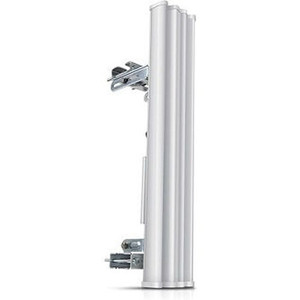
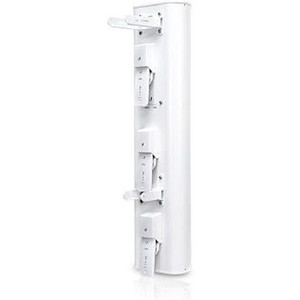
Ubiquiti AM-2G16-90 2.4 GHz Sector Antenna
Overview
The Ubiquiti AM-2G16-90 is a 2.4 GHz sector antenna engineered for point-to-multipoint (PtMP) wireless base station deployments. The 16 dBi gain provides focused coverage across a 90° horizontal beamwidth, allowing you to partition a service area into sectors with minimal overlap and interference. The integrated 9° electrical downtilt simplifies field adjustments when aiming the antenna at subscriber locations spread across varied terrain. This is a purpose-built alternative to omnidirectional antennas when you need directional gain without the cost and complexity of tracking arrays.
Key Features
- 16 dBi Gain: Higher directional gain concentrates RF energy in the intended sector, reducing power requirements on the base station radio and improving signal-to-noise ratio at subscriber receivers — a direct win for link margin in rural or distance-limited deployments.
- 90° Horizontal Beamwidth: Covers a defined sector without wasting power on adjacent areas. Four antennas at 90° spacing can tile a full 360° footprint; three-antenna setups reduce build cost for single-direction or campus deployments.
- 28 dB Isolation (Dual-Linear Cross-Pol): Cross-polarization rejection suppresses interference when multiple sectors operate on the same channel — essential in dense urban or multi-operator environments where spectrum reuse is necessary.
- 9° Electrical Downtilt: Factory-set mechanical downtilt reduces the need for field adjustments after mounting. For fine-tuning, mechanical tilting brackets are widely available and work with the included universal pole mount.
- Frequency Range 2.3–2.7 GHz: Covers standard 2.4 GHz ISM band (2400–2483.5 MHz) and extends into licensed LTE Band 40 (2300–2360 MHz) and other regional allocations — useful if your network spans multiple frequency bands or regulatory zones.
- Robust Environmental Spec: Rated for 200 km/h (125 mph) wind survivability with 85 N loading at 160 km/h. VSWR 1.5:1 maximum ensures efficient power transfer to the radio connector. Deploy this in coastal regions, mountain passes, or high-latitude sites without concern for wind-induced detuning.
- NDAA Compliance: Meets ETSI EN 302 326 DN2 specification and NDAA requirements — critical if your customer base includes U.S. federal agencies, critical infrastructure, or regulated procurement contracts.
- Compact Form Factor: 700 × 145 × 79 mm (27.6 × 5.7 × 3.1 inches) and 3.9 kg (8.6 lbs) makes this antenna easy to mount on existing poles, mast arms, or rooftop structures without requiring heavy-duty support reinforcement. Weatherproof RF jumpers are included to eliminate outdoor connector failure as a reliability risk.
Integration & Compatibility
The AM-2G16-90 pairs directly with Ubiquiti Rocket M base station radios and all airMAX-compatible equipment. The package includes a universal pole mount (suitable for 1.5–2.4 inch OD poles) and a dedicated RocketM bracket, enabling rapid field deployment. Weatherproof RF jumpers eliminate the need to source connectors separately. If you are migrating from a legacy omnidirectional setup or expanding coverage into a new sector, this antenna integrates into existing Ubiquiti infrastructure without firmware updates or configuration changes — it is a drop-in replacement.
What's in the Box
- 1× AM-2G16-90 Sector Antenna
- 1× Universal Pole Mount
- 1× RocketM Bracket
- Weatherproof RF Jumpers
Frequently Asked Questions
Q: Can I use the AM-2G16-90 with non-Ubiquiti radios?
A: The antenna connector and RF characteristics are standard for 2.4 GHz wireless equipment. Compatibility depends on the radio's connector type (typically RP-SMA or N-type). Verify the radio's specifications before pairing; Ubiquiti Rocket M and airMAX equipment work natively with the included bracket and jumpers.
Q: What is electrical downtilt, and why does it matter?
A: Electrical downtilt tilts the antenna's radiation pattern downward by 9° without physically rotating the antenna. This reduces signal towards the horizon (which would otherwise propagate far beyond your service area) and concentrates coverage towards nearby subscriber locations — important for reducing interference on neighboring sites sharing the same frequency.
Q: Is the AM-2G16-90 suitable for long-distance point-to-point links?
A: The AM-2G16-90 is optimized for point-to-multipoint (PtMP) sector coverage, not point-to-point (PtP) links. For PtP long-distance shots, consider a high-gain dish or Yagi antenna designed for narrower beamwidth and higher directivity. Check the Ubiquiti antenna family for PtP-specific options.
Q: What wind speed can the antenna handle?
A: The antenna is rated for 200 km/h (125 mph) wind survivability with 85 N loading at 160 km/h. Structural safety also depends on your mounting pole, brackets, and installation. Have a structural engineer review the entire mast assembly in high-wind zones.
Q: Does the AM-2G16-90 require grounding?
A: As an antenna, proper grounding of the mast and RF connectors is essential for lightning safety and RF performance. Follow local electrical codes and Ubiquiti's installation guide for grounding requirements at your site.
Q: Can I mount the antenna indoors?
A: The antenna is designed and rated for outdoor deployment. RF propagation through building materials will degrade performance. Mount outdoors on a rooftop, tower, or pole for best results.
Ted PerryPerspective based on aggregated IP Security Depot and affiliated engineering team experience.
The AM-2G16-90 is a solid workhorse for any PtMP network where you need to break a service area into sectors without resorting to omnidirectional antennas. The 16 dBi gain combined with 90° beamwidth gives you real coverage control — you can tile multiple sectors onto the same channel and rely on the 28 dB cross-pol isolation to keep interference manageable. The 9° electrical downtilt is a practical touch that reduces field adjustment burden on installation crews.
Technical Highlights:
- 16 dBi Gain + 90° Beamwidth: Delivers focused sector coverage without omnidirectional waste; allows four-sector full-circle deployment or three-sector cost-optimized installations. Real gain improvement means lower transmit power and longer link reach on the same radio power output.
- 28 dB Cross-Polarization Isolation: Critical for spectrum reuse on the same frequency in adjacent sectors. Interference rejection at this level keeps noise floor low even in dense multi-operator ISM band environments — common in urban hotspot and municipal mesh networks.
- VSWR 1.5:1 Maximum: Tight impedance match ensures 95%+ of RF power reaches the antenna; mismatches above 2:1 waste 11% of your transmit power. This spec matters when every watt counts in distance-limited rural deployments.
- Wind Survivability to 200 km/h (125 mph): Rated for extreme weather without requiring reinforced mast engineering. The 85 N wind load specification is conservative enough for coastal and alpine sites where other sector antennas might require structural upgrades.
Deployment Considerations:
- Electrical downtilt is factory-set at 9°. If you need adjustment beyond mechanical tilting, you'll need a bracket with tilt range — the included universal mount is fixed. Plan mast orientation during site survey.
- The 2.3–2.7 GHz range spans both unlicensed ISM and some licensed LTE bands. Verify your regional frequency allocation and radio's channel support before ordering to avoid spectrum mismatch. Cross-border deployments (Canada/U.S./Mexico) require band-specific validation.
- RF connectors are exposed; weatherproof jumpers are included but field repairs require N-type or RP-SMA connectors on hand. Stock spares if you're deploying multiple sites.
Deploy the AM-2G16-90 when you're building a sectored PtMP backbone for rural broadband, campus mesh networks, or licensed ISM band private networks where interference rejection and link margin matter more than omnidirectional simplicity. It's not a fit for point-to-point long-haul shots — use a dish antenna for those.