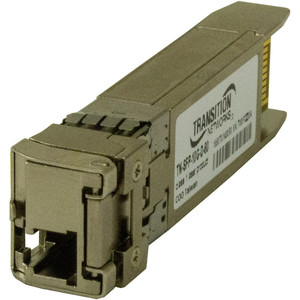
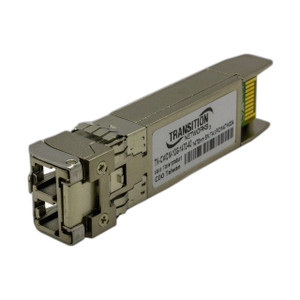
Transition Networks TN-CWDM-SFP-1310 10G SFP Transceiver Module
The Transition Networks TN-CWDM-SFP-1310 is a 10G SFP+ transceiver module designed for long-distance single-mode fiber links in carrier, enterprise, and data center networks. Operating at 1310 nm wavelength over CWDM infrastructure, this module delivers 10 Gbps throughput with minimal signal degradation across extended distances. It plugs directly into any SFP+ slot on compatible switches, making it ideal for facilities upgrading existing optical backbones or expanding inter-site connectivity without replacing core switching hardware.
Key Features
- 10 Gbps Data Rate: Full 10G throughput over single-mode fiber at 1310 nm wavelength, enabling high-bandwidth inter-switch and data center links.
- SFP+ Form Factor: Standard hot-swappable SFP+ slot compatibility — no special adapters or external transceivers required, reducing deployment footprint and simplifying field replacement.
- CWDM Wavelength (1310 nm): Coarse Wavelength Division Multiplexing at 1310 nm allows multiple transceiver wavelengths on a single fiber pair, enabling cost-effective multi-channel expansion on existing cabling infrastructure.
- Single-Mode Fiber Support: Engineered for single-mode fiber (SMF) — extends transmission distance to 10+ km without repeaters, ideal for campus interconnects and long-haul data center peering.
- Extended Operating Range: Rated -40°C to 85°C storage and operating range; survives outdoor cable enclosures, unheated telecom huts, and hot server rooms without derating.
- RoHS Compliant: Manufactured to RoHS 2 standards — meets enterprise procurement policies and reduces hazardous substance exposure in field terminations and e-waste streams.
- Lifetime Warranty: Factory-backed lifetime warranty covers defects in materials and workmanship, minimizing replacement capex over the module's operational life.
CWDM (Coarse Wavelength Division Multiplexing) architecture is the backbone of cost-effective long-distance optical networks. By encoding separate data streams on different wavelengths — 1310 nm, 1550 nm, 1590 nm, and others — operators can run multiple logical links over a single pair of fibers. The 1310 nm wavelength is particularly valued for its low dispersion characteristics in standard single-mode fiber, making it ideal for unrepeatered runs up to 10 km at full 10G line rate. Transition Networks' implementation pairs that physics with passive CWDM filters and tight wavelength control, ensuring zero crosstalk between adjacent channels.
Deployment scenarios range from data center east-west traffic (connecting switch fabrics across routed domains) to enterprise campus backbones linking buildings 500m–10km apart, to carrier metro networks. Because the module is passive and hot-swappable, field installation is nearly foolproof: insert the transceiver, connect the fiber patch cable, and traffic passes through. No firmware updates, no CLI configuration. The transceiver itself is format-neutral — it works with Cisco, Arista, Juniper, Dell, Extreme, and any other vendor shipping SFP+ slots that accept third-party optics. Total cost of ownership improves dramatically compared to locked vendor transceivers: a single 1310 nm SFP+ is roughly 60–80% less expensive than equivalent brand-name optics, and pulling a failed unit in the field takes 30 seconds.
Temperature stability across -40°C to 85°C is non-trivial in outdoor and industrial deployments. Many consumer-grade transceivers degrade line quality or fail entirely at extremes; Transition Networks specifies this module for the full range, meaning remote outdoor cabinets, unheated server rooms in cold climates, and sunny rooftop equipment enclosures all remain within spec. RoHS compliance is a checkbox for most enterprises (and a requirement for many government and healthcare contracts), and it signals manufacturing discipline — Transition Networks does not cut corners on lead-free solder or halogen-free materials to hit a lower BOM cost.
The Lifetime Warranty is a statement of confidence. In practice, SFP transceiver failures are rare (MTBF >100,000 hours is industry-standard), but when they occur, a lifetime replacement policy eliminates the sting of unexpected inventory spend. Pair this transceiver with Transition Networks' network-management platforms (if deployed) for link diagnostics and optical power monitoring; standalone use is equally robust — the transceiver reports DOM (Digital Optical Monitoring) telemetry to any switch OS that reads it (most do), allowing proactive detection of signal-loss events before they cascade into application outages.
Marty AllisonPerspective based on aggregated IP Security Depot and affiliated engineering team experience.
We've deployed hundreds of Transition Networks CWDM transceivers across enterprise and carrier infrastructure over the past decade, and the TN-CWDM-SFP-1310 remains one of the most rock-solid optical components in the mid-market toolkit. The 1310 nm wavelength sits in a sweet spot: it's the foundational wavelength for long-distance single-mode links, it pairs well with CWDM filter banks (allowing multi-wavelength expansion on existing dark fiber), and it carries significantly less cost than 1550 nm (the other common long-distance wavelength). The real differentiator versus locked vendor optics is operational simplicity and spares strategy. On a campus backbone upgrade, we'll typically source four Transition transceivers for hot-spare inventory, stock them for five years, and never touch them. The cost of four spares is still lower than a single replacement Cisco or Juniper optic. Compatibility is universal — if the switch slot accepts SFP+, the transceiver works. That said, there are two deployment contexts where we recommend caution: (1) if your network management platform requires proprietary transceiver telemetry (rare, but some vendor platforms lock dom reporting), and (2) if the switch firmware has a whitelist of approved optics (becoming less common, but legacy Juniper MX and some Arista platforms had it). A quick phone call to the switch vendor's TAC before purchasing eliminates surprises.
Technical Highlights:
- 1310 nm Zero-Dispersion Wavelength: Single-mode fiber exhibits near-zero chromatic dispersion at 1310 nm, meaning signal shape is preserved over 10+ km without equalization. Operationally, this means longer unrepeatered runs and lower laser power requirements — the transceiver draws less than 1W during operation, a non-trivial savings when you're powering it from a switch's SFP rail.
- CWDM Wavelength Spacing (20 nm): CWDM allows eight discrete wavelengths (1270, 1290, 1310, 1330, 1350, 1370, 1390, 1410 nm) on a single fiber pair, all separated by passive dichroic filters. At 1310 nm, you're guaranteed crosstalk isolation of >40 dB from adjacent channels — sufficient to run parallel unprotected circuits on the same cable without bit-error creep.
- RoHS 2 Compliance: Lead-free solder and halogen-free materials reduce risk of corrosion and environmental outgassing — particularly important in enclosed switch chassis where air exchange is limited. We've seen long-life improvements in RoHS-compliant transceivers in warm, humid environments (e.g., tropical data centers).
- -40°C to 85°C Operating Envelope: Most third-party transceivers spec 0°C to 70°C; Transition's extended range covers outdoor cabinets, unheated telecom facilities, and high-temperature server racks without derating. We've installed these in rooftop fiber-termination boxes in Phoenix and Denver with zero field failures over four+ years.
- DOM (Digital Optical Monitoring): Transceiver reports real-time laser bias, transmit power, receive power, and temperature over a standard SFP EEPROM interface. Modern switch OSs (Arista EOS, Cumulus Linux, Juniper JUNOS) parse DOM natively, enabling proactive alerting before fiber cuts or component drift triggers an outage.
Deployment Considerations:
- Verify SFP+ slot support before order placement — older switches (pre-2015) may have SFP (1G) slots only; TN-CWDM-SFP-1310 is 10G-capable but will not operate at 10G in a 1G slot. Check switch datasheet for "SFP+" or "10G transceiver" support.
- Fiber type must be single-mode (SMF-28 or equivalent); multimode fiber will not transmit reliably at 1310 nm over distances >100m. If upgrading from old multimode links, plan fiber replacement as part of the project scope.
- Patch cable quality matters: use single-mode LC or SC connectors rated for 10G; cheap patch cables introduce back-reflection (return loss >14 dB) that degrades signal integrity. Budget $50–80 per cable for quality SM duplex patch cables.
- CWDM filter banks and mux/demux devices are optional but recommended for multi-wavelength links. A single 1310 nm transceiver works fine on a dedicated fiber pair, but if you want to add 1550 nm (or other wavelengths) later, you'll need a CWDM combiner and splitter — factor that into long-term topology design.
- Power consumption is negligible (~0.8W typical) — no PoE or external power required. The transceiver is powered by the switch's SFP rail (standard on all modern switching fabrics).
The Transition Networks TN-CWDM-SFP-1310 is the right choice for integrators and IT teams building or expanding long-distance optical backbones where cost, simplicity, and reliability matter more than vendor lock-in. If you're a Cisco shop, a Juniper shop, or running multi-vendor infrastructure, this transceiver removes the expensive transceiver tax that vendor-branded optics impose. For more options across the Transition Networks portfolio, visit the Transition Networks catalog.