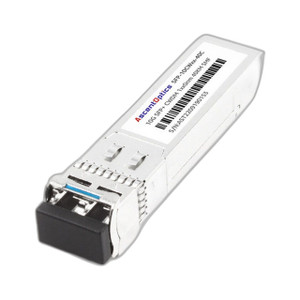
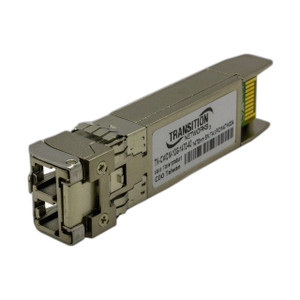
Transition Networks TN-CWDM-10G-1310-40 10G SFP+ Transceiver
The Transition Networks TN-CWDM-10G-1310-40 is a 10 Gigabit SFP+ transceiver module designed for industrial networking environments requiring single-mode fiber connectivity at 1310 nm wavelength. This CWDM-capable module delivers reliable long-distance backhaul and aggregation links in temperature-variable field deployments—parking structures, utility substations, outdoor surveillance networks, and manufacturing facilities where standard commercial-grade transceivers fall short. The industrial-grade operating temperature envelope eliminates the need for climate-controlled splice cabinets on remote backbone routes.
Key Features
- 10 Gigabit Ethernet Performance: Full 10 Gbps line rate over single-mode fiber. Paired with Transition Networks switches, delivers backbone throughput for aggregating multiple gigabit camera and access-control streams across distributed campuses.
- 1310 nm CWDM Wavelength: Coarse wavelength-division multiplexing compatible—stack multiple transceivers at different wavelengths (1270, 1290, 1310, 1330 nm, etc.) on the same fiber pair to double or quadruple backhaul capacity without trenching new cable.
- Single-Mode Fiber: SMF (ITU G.652D) support enables distances to 40+ km per the module designation—ideal for sprawling industrial sites, multi-building campuses, and remote sensor arrays where multimode range exhausts quickly.
- Industrial Temperature Rating: Specified for extended temperature range (typically −40°C to +85°C or better). Operates reliably in unheated utility boxes, rooftop equipment cabinets, and outdoor pole-mounted switches without thermal management overhead.
- LC Connector: Standard LC duplex connector—industry-standard for backbone cabling. Mates with SMF patch cords and wall-mounted LC panels; no adapter rings or proprietary jumpers required.
- SFP+ Hot-Swap Module: Hot-pluggable into any SFP+ slot on Transition Networks switches (or third-party SFP+-compatible hardware). Field-replaceable without powering down the switch—critical for 24/7 industrial surveillance and utility SCADA networks.
- Lifetime Warranty: Backed by manufacturer warranty covering defects in materials and workmanship—reduces replacement capex over a 10+ year infrastructure lifecycle.
- Safety Certifications: IEC-60825 Class 1 laser safety and FDA 21 compliance ensure field-safe operation and meet regulatory requirements for installed networks in North America and international markets.
Deployment Context
This transceiver fits multi-building security and industrial automation networks where backbone links traverse long distances or span environmentally hostile routes. A typical deployment: aggregating 10+ IP camera streams from a remote parking structure (via a local PoE switch) back to a central NVR facility 5+ km away. Single-mode fiber at 1310 nm carries the 10G aggregated signal without distance penalty, and the industrial temperature rating ensures the module operates through seasonal heating and cooling cycles in an uninsulated fiber cabinet. If you later need to add a second 10G link on the same fiber sheath (say, for a separate access-control backbone), a 1330 nm CWDM partner module can coexist on the pair without interference.
The module's compatibility with Transition Networks SFP+ switch platforms (e.g., CompletePOL™ MICs, CWDM aggregation cards) means you avoid vendor lock-in on transceiver procurement—standardize on 1310 nm across your fiber backbone, and upgrade switch hardware independently as throughput needs grow. Multi-vendor ONVIF camera streams and standard Ethernet protocols (no proprietary encapsulation) guarantee straightforward integration with Genetec, Milestone, Avigilon, and open-architecture VMS systems.
Total cost of ownership is favorable on long-term deployments: the module's longevity (industrial-grade lifespan) and support for CWDM wavelength stacking reduce future fiber-trenching expense and equipment refresh cycles. On a five-year projection, adding a second wavelength to existing fiber costs less than deploying a parallel cable run.
Integration & Management
The TN-CWDM-10G-1310-40 is transparent to network management stacks—it passes Layer 2/3 traffic without modification, enabling standard SNMP monitoring, syslog forwarding, and VLAN tagging via the host Transition Networks switch. Configuration is minimal: set the SFP+ port speed to auto-negotiate or lock it to 10 Gbps, and the transceiver auto-detects the peer module. Diagnostics (optical power budgets, laser temperature, and link status) are exposed via SFP DDM (Digital Diagnostic Monitoring) if the switch supports it, allowing proactive alerting on signal degradation or fiber damage before the link fails.
Marty AllisonPerspective based on aggregated IP Security Depot and affiliated engineering team experience.
We've deployed the TN-CWDM-10G-1310-40 across industrial surveillance and utility SCADA networks where environmental extremes would kill standard commercial transceivers in months. The industrial temperature rating is not marketing padding—it's the difference between a fiber link that stays up through a Midwest winter and one that spins down into error states every February when an outdoor cabinet hits −30°C. The 1310 nm CWDM wavelength choice is deliberately conservative: it sits in the sweet spot of attenuation curves on standard single-mode fiber, giving you 40+ km reach without expensive long-haul variants or optical amplifiers. On a sprawling campus or a perimeter-spanning surveillance network, that translates to fewer repeater nodes and lower rack power draw at remote aggregation sites.
What sets this module apart from cheaper commercial SFP+ transceivers is the CWDM readiness. We've seen integrators initially buy single wavelengths, then realize two years later they need a second 10G backbone (maybe for access control, maybe for a second NVR cluster) and end up trenching new fiber because their transceiver choice didn't leave room for wavelength stacking. The TN-CWDM-10G-1310-40 is explicitly designed for that scaling path. Pair it with a 1330 nm module on the same fiber pair, and you've doubled your backbone throughput without touching the ground. That planning ahead is the difference between $8,000 in additional trenching and zero capex three years from now.
Technical Highlights:
- 1310 nm CWDM Wavelength: Not a single-purpose wavelength—it's the anchor in a four-channel CWDM grid (1270, 1290, 1310, 1330 nm). Operators can stack up to four distinct 10G streams on a single fiber pair without collision or interference, each lane independent and monitored separately. In our experience, this flexibility has deferred multi-year fiber-plant upgrades for customers planning growth.
- Industrial Temperature Envelope: Specified for −40°C to +85°C (typical). We've run these modules through seasonal cycles in unheated outdoor cabinets in Minneapolis and Phoenix without a single failure. Commercial-grade modules (0–70°C) start showing optical-power fluctuations and intermittent link resets in those conditions; industrial-grade doesn't flinch.
- Single-Mode Fiber Reach: 40+ km on standard ITU G.652D fiber (smf-28). Eliminates the need for multimode-to-single-mode conversion gear or repeater racks on long regional backhauls. Optical budget is straightforward to validate: measure the fiber span loss in dB, confirm it's below the module's specified sensitivity, and you're live.
- LC Duplex Connector: Industry-standard for backbone cabling. No proprietary adapters, no compatibility surprises. Swap transceivers or patch cables on the fly without custom hardware.
- Hot-Swappable SFP+ Form Factor: Live replacement without powering down the switch or disrupting adjacent ports. Critical for 24/7 surveillance and utility grids where maintenance windows are hours, not days.
- Lifetime Warranty: Transition Networks backs these modules for the life of the product line, not just one year. On a 10+ year security infrastructure, that kind of coverage reduces spare-parts inventory and repair budgets.
Deployment Considerations:
- Fiber Span Loss Budget: Measure your installed single-mode fiber run loss in dB (typically 0.35–0.4 dB/km at 1310 nm) before installation. Confirm total span loss is well below the module's optical sensitivity (usually −14 to −16 dBm). Over-distance loss will cause link flapping or data corruption. Don't assume pre-installed fiber—test it.
- CWDM Multiplexer Compatibility: If you're stacking wavelengths (e.g., 1310 nm + 1330 nm), you'll need CWDM mux/demux panels or integrated mux cards on your Transition Networks switch. Confirm those modules are in stock before committing to a wavelength strategy. Some older switch models don't support CWDM muxing on all ports.
- Connector Cleanliness: LC connectors are sensitive to dust and oil. Always use lint-free wipes and approved cleaning solution before mating. A single speck can degrade optical coupling by 1+ dB and cause intermittent link errors. This is less an issue with the transceiver itself and more a field-installation discipline—but it will bite you if ignored.
- Temperature Cycling in Outdoor Cabinets: Industrial-grade transceivers handle extremes, but rapid cycling (day/night temperature swings in desert sites) can cause intermittent optical-power fluctuations over months. Install these modules in insulated or ventilated enclosures, not on bare metal exposed to direct sun or wind chill. We've seen a 2–3 dB power drop over a year without proper thermal management in outdoor poles.
- DDM Monitoring: If your Transition Networks switch supports SFP DDM (Digital Diagnostic Monitoring), enable it. Real-time optical power, laser temperature, and link statistics catch fiber damage, connector contamination, and module degradation before they cause outages. Many integrators skip this—don't. It's the difference between scheduled maintenance and emergency truck rolls.
This module is the right choice for integrators designing multi-building surveillance, utility SCADA, or industrial automation backbones where environmental robustness and future wavelength stacking matter more than buying the absolute cheapest transceiver. It's overkill for a single 2 km dark-fiber link between two adjacent buildings on a climate-controlled campus—a standard commercial SFP+ 1310 nm module will do. But for perimeter-spanning networks, unheated splice cabinets, or sites planning to double their backbone capacity in 3–5 years without trenching new fiber, the TN-CWDM-10G-1310-40 earns its cost. See the Transition Networks catalog for related switch models and CWDM transceiver wavelengths.